Kissinger remembered for pivotal role










Kissinger: He always tried to 'think in long-range terms'
Former US secretary of state Henry Kissinger, who helped to change the course of history by playing a pivotal role in normalizing United States-China relations, passed away at his home in the US state of Connecticut on Wednesday at age 100.
"The world has lost a tireless advocate for peace. America has lost a towering champion for the national interest. I have lost a cherished friend and mentor," Winston Lord, Kissinger's top aide in the 1970s, told China Daily.
At dawn on July 9, 1971, Kissinger and Lord entered Chinese airspace aboard a Pakistani plane. The clandestine trip, which resulted in a Chinese invitation to then US president Richard Nixon, resulted in top leaders from the US and China meeting in February 1972 for the first time in two-and-a-half decades — a period during which the two countries were, in Kissinger's words, "at war, near war".
The trip also helped lay the foundation for today's international geopolitical structure.
The Nixon visit was followed by a prolonged period of what Kissinger called "cooperative coexistence" that saw China rising to be a dynamic element in the world economy and the US "easing out of its pain at the outcome of the Vietnam War", according to Lord.
The passing of Kissinger, who had been the last surviving member of Nixon's Cabinet, comes at a time when China and the US are working to improve what Kissinger deemed "the world's most consequential bilateral relationship".
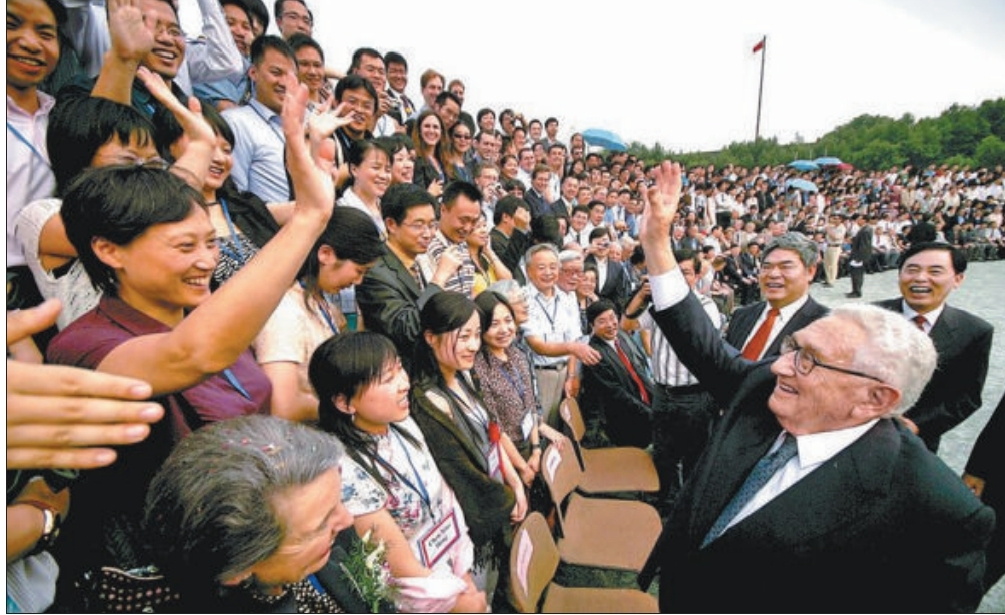
In July, two months after Kissinger celebrated his 100th birthday, the centenarian traveled to Beijing, where his host reminded him of what had happened there 52 years before.
"It was in July 1971 in the same place — Villa No 5 of Diaoyutai State Guesthouse — that you and Premier Zhou Enlai had a meeting to start the normalization process," President Xi Jinping told Kissinger.
Some of the most intense hours of that visit and a subsequent one in October 1971 were spent between Kissinger and Zhou as the two negotiated a draft of what would become known as the Shanghai Communique.
"Today, more than 50 years later, the communique is still being invoked as one of the foundations of our relationship, while most communiques disappear within weeks," said Lord, who was US ambassador to China from 1985 to 1989.
In a message of condolence, Chinese Ambassador to the US Xie Feng wrote, "History will remember what the centenarian has contributed to China-US relations, and he will always remain alive in the hearts of the Chinese people as a most valued old friend."
Recalling his 1972 meeting with Mao Zedong, Kissinger said the Chinese leader spoke allegorically, in "a Socratic manner", and "had the quality of being at the center of wherever he stood", adding that "it moved with him wherever he moved".
In December 1975, Mao told visiting US president Gerald Ford that his secretary of state, Kissinger, "has been interfering in my internal affairs".
When asked to elaborate, the 82-year-old chairman answered, "He does not allow me to go and meet God."
"That would be too powerful a combination if he went there," Kissinger, who was also present, told Ford.
On May 27, 1923, Heinz Alfred Kissinger was born in the German city of Fuerth in northern Bavaria, the son of a schoolteacher and a homemaker. In 1938, five years after Adolf Hitler became chancellor of Germany, Kissinger fled from home with his Jewish parents and younger brother. He would return, first in a US Army intelligence role in 1944 before Germany's defeat in World War II and then, years later, as Nixon's national security adviser, bleakly admitting that "my (left-behind) relatives are soap".
Many, including Walter Isaacson, former editor of Time magazine and author of the book Kissinger: A Biography, argue that this traumatic childhood experience explained Kissinger's preoccupation with peace and order, and had influenced the formation of his realist approach to foreign policy — a view that Kissinger himself did not share.
"The political persecutions of my childhood are not what control my life", he once said.
Scottish American writer-historian Niall Ferguson, who had immersed himself in Kissinger's private papers, correspondence and academic writings from Harvard, where Kissinger was a student and later a professor, sought to fathom the man in his 2015 book Kissinger 1923-1968: The Idealist.
"The idea of Kissinger as the ruthless arch-realist is based on a profound misunderstanding," Ferguson wrote, pointing to Kissinger's undergraduate thesis "The Meaning of History", in which the aspiring intellectual, after having studied the 18th-century German philosopher Immanuel Kant, said, "Peace is therefore the noblest goal of human endeavor, the affirmation of the ultimacy of man's moral personality."
Speaking to the UN General Assembly on Sept 24, 1974, Kissinger, then newly appointed as US secretary of state, and who first gained public attention as a nuclear strategist a decade before, echoed his younger self. "Two centuries ago, the philosopher Kant predicted that perpetual peace would come eventually. … What seemed utopian then looms as tomorrow's reality," he said, alluding to the avoidance of nuclear annihilation.
Nixon made Kissinger his national security adviser after taking office in 1969. With a shared strategic approach to foreign policy, the two pursued the dual approaches of detente with the Soviets and opening to the Chinese throughout the late 1960s and early 1970s.
"Our basic strategy was to be closer to both of them than they were to each other," reflected Kissinger, whose ultimate goal was, in his own words, "to shape a global equilibrium" that he and Nixon believed could best serve US national interests.
"I'd like to think that what I have tried consistently to do is to think in long-range terms and in the national interest, but in the national interest related to the national interests of other countries. Because if you assert only your interests, without linking them to the interests of others, you will not be able to sustain your efforts," Kissinger said.
A prolific author of intellectually hefty books, Kissinger was effusive about the ancient Chinese military strategist Sun Tzu in his 2011 book On China, written partly based on Kissinger's "conversations with four generations of Chinese leaders".
"Western strategists test their maxims by victories in battles; Sun Tzu tests by victories where battles have become unnecessary," wrote Kissinger, who also traveled to China in his post-retirement days. This saw him continue to meet with prominent US and international leaders in what Lord described as "a remarkable display of savvy, stamina and sway".
Reflecting on his mentor's legacy, Lord said, "Kissinger's single greatest achievement, I would say, was holding this country together in the wake of the Watergate scandal … to maintain American posture and ensure the continuity of its foreign policy."
Tom Watkins, a former adviser for the Michigan-China Innovation Center, said, "Kissinger challenged all of us to take our society from where it is to where it has never been — that is the challenge of leadership."
Kissinger is survived by his wife, Nancy, and two children, David and Elizabeth, from his first marriage, to Ann Fleischer, as well as five grandchildren.
Lamenting the fact that Kissinger was never called back to office since stepping down as secretary of state in January 1977, Wu Xinbo, director of the Center for American Studies at Shanghai's Fudan University, said, "This was largely due to the coming to power of neo-conservatives in the administrations of Ronald Reagan and his successors. Unlike Kissinger, who was aiming for a balance of power favorable to the US, the neo-conservatives insist on American primacy and domination, something that Kissinger had consistently warned against."
Kissinger, who credited leaders of his generation with a "willingness to raise their sights beyond the immediate issues of the day", said that the US "must temper its missionary spirit with a concept of the national interest and rely on its head as well as its heart in defining its duty to the world".
Regarding the US and China, Kissinger said, "In a way, they were fortunate that their long isolation from each other meant that there were no short-term day-to-day issues between them."
This, he added, "enabled them to lay the basis for a world unimaginable then but unachievable without Sino-American cooperation".