Poll: Almost 8 in 10 Asians seen as foreigners in US









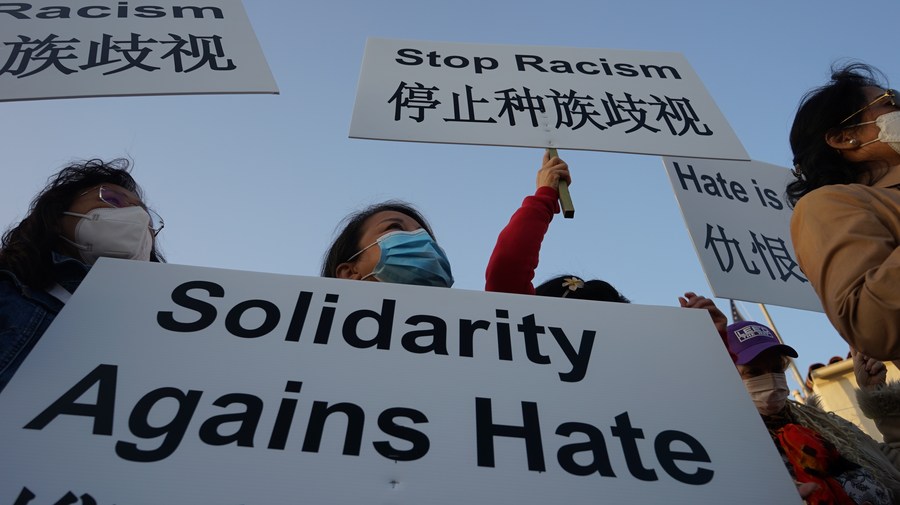
A couple of months ago, Natalie (last name withheld for privacy), a young professional in her 20s, went to a local Oktoberfest in the Dallas area.
"I was asking a guy to order some pretzel, and he said to me: 'Wow, you speak very good English.' I replied: 'Oh, thank you. It is the only language I speak,'" said Natalie.
Natalie, who is ethnically Chinese and was born and raised in the United States, was assumed by the man as an outsider and non-American, purely based on her looks
Her experience is quite common among Asian Americans, according to the results of a recently survey by Pew Research Center.
The data, collected from a nationally representative survey of 7,006 Asian adults over a half-year span from 2022 to 2023 and 66 focus groups with 264 participants, show that a majority of adult Asian Americans — 78 percent — have been treated as a foreigner, even if they are born in the US as Natalie was.
The survey showed that most Asian Americans experience discrimination in three broad ways: being treated as a foreigner; being seen as a model minority; and other discrimination incidents in day-to-day encounters because of their race or ethnicity.
"I have had this kind of incidents a couple of times before. It's not that big a deal. People are not trying to be rude or aggressive, but it shows that when people look at you, that's their first impression and what they are thinking: Oh, you are not from here; you are from somewhere else."
Coming from a diverse neighborhood in Houston, Texas, Natalie said she didn't experience such "outsider" incidents while growing up. But it's different for her boyfriend who, a Filipino, went to a private Christian school growing up.
Because his last name sounds like a Mexican name even though it's not, other students called him Mexican jokingly. By making fun of his last name, "they were like: You are not one of us," Natalie said.
Some outsider experiences turned out to be much harsher than what Natalie had. "I had my assigned parking lot, and when a white man parked his car on my spot, I told him to move his car, he said 'Ching, Chang, Chong' to me and called the guard," an immigrant man of Korean descent in his late 40s, told Pew.
A man of Filipino descent born in the US was invited to a party by his white girlfriend at her uncle and aunt's house. Being helpful, he brought in a tray of food from outside. The aunt automatically assumed that he was one of the caterers, got upset and asked him to use the rear service door.
"That's just one example of many, that much racism I've had when I've interracially dated," he told Pew.
The Pew survey showed that about 9 in 10 Asian Americans have personally experienced at least one of the 17 discrimination incidents asked about in the survey. The most common incidents are that strangers mispronounced their name (68 percent) or assumed that they are good at math and science (58 percent).
In Natalie's case, her name wasn't mispronounced; she was called by a wrong name by her former supervisor.
"In my last job, the director at my department kept getting me and another Asian girl mixed up. It was crazy to me," said Natalie. "We didn't look alike at all, we didn't sound alike — she has some accent, and I don't, and our names are totally different. Yet he kept calling us by the other's name. After a while I felt like, he's not even trying."
The survey found that about 20 percent of Asians experienced discrimination in the workplace, and they were denied a raise or promotion due to their race.
Discrimination incidents experienced in day-to-day life can be subtle.
"One time we went to a restaurant and our waitress was kind of cold. I don't really hold it against her because sometimes people just don't feel friendly," said Natalie, in recounting one of her experiences.
"Then, a white couple came in sitting right next to us, and her mood just shifted. She became super friendly like 'How's your day,' and laughing. The contrast was stark."
The Pew survey found that 40 percent of Asian adults say they have received worse service than other people at restaurants and stores.
While some incidents are minor and annoying at most, other discrimination incidents can be quite unpleasant. The survey found that about 35 percent of South Asians say they have been held back at a security checkpoint for a secondary screening because of their race or ethnicity.
An US-born man of Pakistani origin in his early 30s said in the survey that he was pulled aside at the airport for three hours because he had a beard one time when he was flying back to the US. "They didn't believe my passport was real, that I was trying to sneak in," he said.
It first happened to him when he was 17 years old. "This happens every time I fly now, so I tell my friends to be two hours late to pick me up from an airport. I mean, this is not a joke. This is every time I travel. Every time, they do this to me."
Some discrimination can turn violent. Threats and physical attacks went up during the pandemic. The survey found that 32 percent of Asian adults say they personally know an Asian in the US who has been threatened or attacked.
A Korean immigrant told Pew during the survey that once when she was walking in the city, an elderly white poked her in the face saying: "You are disgusting," and tried to hit her. "I ran away crying," she said.
Overall, 57 percent of Asian adults see discrimination against Asians living in the US as a major problem, and 63 percent say too little attention is paid to race and racial issues concerning Asian Americans.