
Province branches out into tree protection
Updated: 2023-12-15
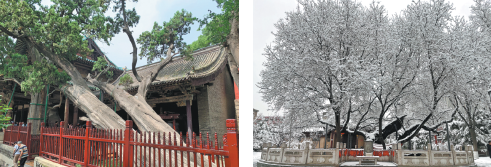
From left: With a history of more than 2,900 years, the cypress in Taiyuan's Jinci Temple is the oldest living tree in Shanxi. The Chinese scholar tree in Dicun village in Taiyuan city is said to be planted during the Tang Dynasty (618-907). [Photo provided to China Daily]
Ancient plants have an ecological, historical and cultural value, say Shanxi officials
In an era where ecological civilization is highlighted, trees are seen as one of the most valuable assets.
The oldest trees, which have lived for hundreds or even thousands of years, are the most precious because of their association with history and culture. This is especially true in the North China province of Shanxi, which boasts many ancient trees.
Local statistics show that the province has a total of 102,200 living ancient trees, including 14,297 with life spans between 100 and 299 years; 4,426 between 300 and 499 years; and 4,475 above 500 years, which fall in the categories of third to first class respectively on the national list of recognition.
In addition, there are 94 trees in Shanxi that have been recognized as precious trees by the State's forestry authorities for their age, rareness, and historical and cultural significance.
The trees are a source of pride for residents in Shanxi and attract tourists to the province.
Among the tens of thousands of ancient trees still alive in Shanxi, the oldest might be a cypress tree in Jinci Temple in the provincial capital of Taiyuan.
Jinci used to be the ancestral temple of kings of the Jin state (1033-376 BC) during the Western Zhou Dynasty (c. 11th century-771 BC) and the Spring and Autumn Period (770-476 BC).
Inside the temple and close to the Never Aging Spring, there are two cypress trees. The two trees – one died in the early 1900s, leaving its trunk – with a history of more than 2,900 years, are the oldest relics in Jinci, older than any built structure.
The two trees are said to have been planted by a certain king of the Jin state. The Jin state disappeared into history 2,300 years ago but the trees remained, standing as witnesses to the rise and fall of many states and dynasties that followed.
In the Lingkong Mountain National Forest Park in the counties of Qinyuan and Guxian, a Chinese pine called "Nine Flags" is also a must-see attraction for tourists.
Standing on the top of a peak near the Shengshou Buddhist Temple, a tree with a history of more than 600 years is the largest Chinese pine in the world, according to Li Zhenjun, head of the local forestry bureau.
"When we say it is the largest, we mean its size gauged by the diameter of its canopy," Li said. "People often say that a tree doesn't make a forest but this tree is an exception."
The tree begins to branch out at its base section. But several meters above the ground, the nine branches turn upright to heights reaching 40 meters, like nine flagpoles.
According to Li, the canopy of the tree covers a projected area of nearly 400 square meters, making it the largest of its kind in the world and earning it the fame of a nationally recognized precious tree.
"The 'Nine Flags' is not alone here – there are another seven trees in the forest park falling in the same category of recognition," Li said. "In this park, the old trees enjoy the best care from our forestry workers, from growth monitoring to the control and prevention of pests, diseases and natural disasters."
In Jinci, more than 100 ancient trees in the temple are now under intensive care, according to Bai Kaiwen, an official in charge of gardening at Jinci Museum.
"We are using nondestructive testing technologies to diagnose the hidden ailments of trees, either in the trunks or deep in the roots," Bai said. "And there are also ventilation and fertilizing ducts installed underground to help the roots breathe better and take in nutrition."
But in Shanxi not all ancient trees could enjoy the same level of care as those in forest parks and places of historical interest. The majority of them are scattered across the countryside, some in the wilderness that is not easy to access.
However, this situation is expected to change after Shanxi recently issued a number of documents and regulations, putting the protection of ancient trees in a legal framework.
For instance, Shanxi's authorities in public security, forestry and grassland, and urban and rural construction jointly launched a provincial campaign in 2022 to tackle the illegal logging of ancient trees.
Li Jun, an official in charge of ecological repair at the Shanxi Forestry and Grassland Bureau, said the province is exploring a forest chief mechanism and the protection of ancient trees will be a responsibility of local government heads.
He added that the protection of ancient trees is a multidisciplinary mission that involves the integration of botany, plant medicine, soil studies, ecology, climatology and microbiology, as well as other modern technologies.
"We will do our best to gather all the possible resources in these sectors for the better care of old trees," Li Jun said. "And we will establish a pool of multisector experts, conducting joint research programs and giving training to people engaged in ancient tree protection."
He said raising awareness and enthusiasm among the general public is also vital to the protection of ancient trees.
"We are publicizing knowledge on ancient tree protection to the public through the internet, and encouraging businesses and individuals to become patrons of ancient trees in their communities.
"We should further tap into the ecological, cultural and tourism values of ancient trees, making them an important part in rural vitalization," Li Jun said.
Zhang Liyuan contributed to this story.


 主站蜘蛛池模板:
一卡二卡三卡四卡视频区|
丰满的少妇一区二区三区|
久久精品国产亚洲av麻豆小说|
亚洲中文字幕日产无码成人片|
国产成人av乱码在线观看|
91色老久久精品偷偷蜜臀|
日99久9在线 | 免费|
日本亚洲成高清一区二区三区|
制服丝袜美腿一区二区|
无码中文字幕动漫精品|
国产成人精品久久一区二区|
久久精品波多野结衣|
亚洲久久色成人一二三区|
亚洲经典在线中文字幕
|
精品久久久久久无码人妻蜜桃|
国模少妇无码一区二区三区|
亚洲欧美在线观看一区二区|
国产成人A区在线观看视频|
亚洲成在人线AV品善网好看|
亚洲AⅤ乱码一区二区三区|
116美女极品a级毛片|
无码国产精品一区二区免费i6
|
中文字幕精品无码一区二区|
成人免费看片又大又黄|
久久91精品牛牛|
中文字幕在线观看亚洲日韩|
一本大道无码高清|
国产成人8X人网站视频|
国产高清精品自拍av|
成人午夜大片免费看爽爽爽|
亚洲有无码av在线播放|
91色老久久精品偷偷性色
|
久久成人国产精品免费软件|
1000部拍拍拍18勿入免费视频|
欧美交性一级视频免费|
亚洲最大成人美女色av|
亚洲综合精品第一页|
亚洲中文字幕人妻系列|
亚洲精品一品二品av|
久久99久国产麻精品66|
午夜精品久久久久久久爽|
主站蜘蛛池模板:
一卡二卡三卡四卡视频区|
丰满的少妇一区二区三区|
久久精品国产亚洲av麻豆小说|
亚洲中文字幕日产无码成人片|
国产成人av乱码在线观看|
91色老久久精品偷偷蜜臀|
日99久9在线 | 免费|
日本亚洲成高清一区二区三区|
制服丝袜美腿一区二区|
无码中文字幕动漫精品|
国产成人精品久久一区二区|
久久精品波多野结衣|
亚洲久久色成人一二三区|
亚洲经典在线中文字幕
|
精品久久久久久无码人妻蜜桃|
国模少妇无码一区二区三区|
亚洲欧美在线观看一区二区|
国产成人A区在线观看视频|
亚洲成在人线AV品善网好看|
亚洲AⅤ乱码一区二区三区|
116美女极品a级毛片|
无码国产精品一区二区免费i6
|
中文字幕精品无码一区二区|
成人免费看片又大又黄|
久久91精品牛牛|
中文字幕在线观看亚洲日韩|
一本大道无码高清|
国产成人8X人网站视频|
国产高清精品自拍av|
成人午夜大片免费看爽爽爽|
亚洲有无码av在线播放|
91色老久久精品偷偷性色
|
久久成人国产精品免费软件|
1000部拍拍拍18勿入免费视频|
欧美交性一级视频免费|
亚洲最大成人美女色av|
亚洲综合精品第一页|
亚洲中文字幕人妻系列|
亚洲精品一品二品av|
久久99久国产麻精品66|
午夜精品久久久久久久爽|