


More light shone on ancient palace site










Evidence of early-stage construction of the Forbidden City has been uncovered by archaeologists, experts said at a news conference in Beijing on Friday.
Widely known as the Palace Museum today, the Forbidden City functioned as China's imperial palace from 1420 to 1911 during the Ming (1368-1644) and Qing (1644-1911) dynasties.
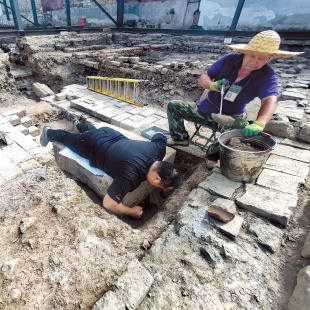
In an area of the imperial workshops, or zaobanchu in Chinese, archaeologists unveiled palatial foundations in the western portion of the venue dating back to the early Ming Dynasty.
Though it was a specialized institution for crafting royal utensils within the Forbidden City, more precise knowledge about its more ancient structural conditions remained vague.
Due to fire and strife in the closing years of the Ming Dynasty, and sometimes simply due to wear and tear, many portions of the Forbidden City were destroyed, demolished and reconstructed throughout its nearly half-millennium royal history.
"Ongoing excavations since the end of 2020 have confirmed it as a site with layered remnants from the Yuan (1271-1368), Ming and Qing dynasties," said Wu Wei, an archaeologist with the Palace Museum.
The unearthed ruins include diverse building foundations, roads, drainage systems, kilns and various materials such as bricks, tiles, stones, ceramics, jade, copper, iron, glass and bones.
For example, the size of each cornerstone was more than 4.4 meters, even more splendid than the highest existing architecture in the Palace Museum today.
"Some construction methods have surpassed our imagination," Wu said. They indicated that the site was home to a once-ornate grand palace, whose colossal size can be better imagined through its super-sized pillar cornerstones.
He said the findings also provide crucial clues to better understand the grandeur of the lost imperial city of the Yuan Dynasty.
"Some remnants might be construction debris of demolished Yuan-era palaces when the Forbidden City was first built," Wu said.
In addition to discoveries concerning architectural ruins, some other findings also helped to shed more light on royal artisans' mastery.
Originally situated in the Forbidden City's Hall of Mental Cultivation at the start of the Qing Dynasty, the imperial workshops were later moved to the southeast corner of the Palace of Compassion and Tranquility, and were renamed as zaobanchu, which lasted through the dynasty.
The area is the largest site discovered within the Forbidden City, displaying the most diversified remnants from all the dynasties since the Yuan, making it a crucial archaeological achievement that sheds light on the historical development of the Forbidden City — its construction and renovations, and life and work in the zaobanchu, said Xu Haifeng, director of the Archaeological Institute of the Palace Museum.
Also during Friday's news conference, Zhang Lifang from the Beijing Archaeological Research Institute presented findings on a historical family plot.
Seven generations of artisans within the legendary Lei family were posthumously honored as royal architects, not only for their role in reconstructing palaces in the Forbidden City, but also for designing other key royal structures like the Old Summer Palace, the Summer Palace, the Chengde Mountain Resort and imperial tombs, spanning over 200 years. They left precious design drawings of the buildings known as the Yangshi (architect) Lei Archives.
Recent investigations from October to November into a Qing Dynasty cemetery in Beijing identified 29 ancient tombs. Judging from its location and layout, referring to historical documents and earlier investigations, it is believed to be the family plot of Yangshi Lei, Zhang said.
This archaeological discovery provides concrete evidence to assist in the study of the history, layout and location of the family cemetery, offering a scientific basis for future conservation and exhibition plans, Zhang added.