


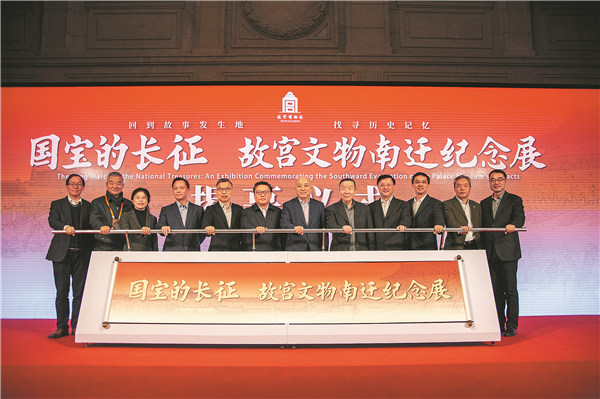
An exhibition at the city's history museum reveals the story of the emergency relocation of celebrated relics during Japan's invasion of China, Zhang Kun reports.
Many people ran for their lives. And some fled the invading forces to not only save themselves but also national treasures.
It's this saga, which unfolded during the War of Resistance Against Japanese Aggression (1931-45), that's being recounted at the Shanghai History Museum through to March 29.Subsequently, The Long March of the National Treasures: An Exhibition Commemorating the Southward Evacuation of the Palace Museum's Artifacts will tour other cities, including Guiyang, Guizhou province, and Beijing.
After the Japanese invaders occupied regions in northeastern China in 1931, the Chinese government decided to relocate the Palace Museum's treasured artifacts to the south. It took over a year to pack the selected artifacts in more than 13,000 wooden crates. In 1933, they were sent to Shanghai by train, along with over 6,000 boxes of relics from other historical sites in Beijing, and were stored in a warehouse in the former French Concession.
By the end of 1936, a new warehouse was built in Nanjing, the then capital of China, and the artifacts were transported there. The following year, fighting battles against Japanese invaders broke out in Shanghai and Nanjing, and the artifacts had to be relocated again. They were eventually transported to three counties in southwestern China's Sichuan province: Baxian, Emei and Leshan.
In 1946, just after the war, these artifacts were moved to Chongqing and the next year to Nanjing. From the end of 1948 to 1949, a portion was shipped across the Strait after the founding of the People's Republic of China in 1949.
The 2,971 boxes of artifacts later made up the Palace Museum in Taipei's core collection.
By 1958, more than 10,000 boxes stored in Nanjing had been shipped back to the Palace Museum in Beijing. The 2,221 boxes left behind then became the main collection of the Nanjing Museum in Jiangsu province.
The Palace Museum later sent many objects from its collection to other museums, libraries and archives around China to support the construction of cultural facilities all over the country.
"Spanning more than two decades and covering thousands of kilometers, the 'Long March of the National Treasures of the Palace Museum' was a miraculous achievement in the protection of cultural heritage for all human civilization," says Wang Xudong, director of the Palace Museum in Beijing.
It was common for museums around the world to relocate their artifacts to avoid damage during the war, points out Zheng Xinmiao, a former director of the Palace Museum in Beijing, who is also a senior scholar researching on this chapter of the Palace Museum's history.
What's unique about the Palace Museum's collection, compared to other leading museums in the world, is that these objects have been accumulated across centuries and dynasties as testimonials to Chinese civilization, Zheng says. Such relics as ancient books and documents, as well as fine bronze, jade and ceramic pieces, represent China's collective cultural identity. So, when the country was fighting against Japanese invaders, their protection stoked the flames of patriotism, Zheng says.








