RCEP boosts China-Thailand trade ties









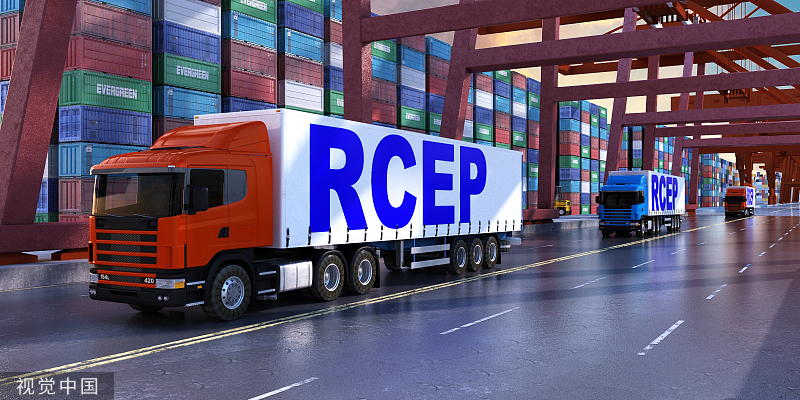
NANNING - Thailand's coconut, famous for its rich and sweet taste, has gained significant popularity in the Chinese market. In recent years, it has been extensively used in various foods and beverages in China, such as cakes, coffee, and hot pot, especially after the implementation of the Regional Comprehensive Economic Partnership (RCEP) agreement.
The RCEP, which entered into force on Jan 1, 2022, comprises 15 Asia-Pacific countries, including 10 ASEAN member states and their five trading partners, namely China, Japan, the Republic of Korea, Australia and New Zealand.
Two years on, many Thai industries in agriculture, textiles, and automobiles have benefited from the RCEP. Tariff cuts have further stimulated trade and investment growth of RCEP member countries. In 2022, Thailand's trade with other RCEP members rose 7.11 percent year-on-year to $300 billion.
The agreement has also boosted trade cooperation between China and Thailand. According to Han Zhiqiang, Chinese Ambassador to Thailand, in the first 10 months of 2023, bilateral trade between the two countries reached $105.1 billion. China continued to be Thailand's largest trading partner for 11th consecutive year and its largest agricultural export market, of which tropical fruits alone reached $5.8 billion, accounting for 90 percent of Thailand's fruit exports.
Han said that Thai durian has transformed from a niche fruit to a "top stream" product in the Chinese market. Chinese consumers favor Thai fruits, and the Chinese government supports Thai agricultural exports to China.
"As a fruit importer, the RCEP agreement brings real benefits to me. The growing popularity of Thai coconuts in China is also bringing me new opportunities," said Mo Jiaming, a fruit dealer in Nanning, capital of South China's Guangxi Zhuang autonomous region.
Thanks to the Belt and Road Initiative (BRI) and the RCEP, more diversified trade and transportation modes have been adopted, and more Thai goods have entered the Chinese market at favorable prices.
The transport of fresh Thai durians from Thailand to Southwest China's Chongqing municipality on the flagship BRI project, the China-Laos Railway, takes only four days. This is a vast improvement compared to the previous land-sea routes, which took eight to 10 days.
"Goods which could only be previously purchased during a trip to Thailand are now available in local supermarkets with a rich variety," said Huang Ying, a Nanning citizen, adding that she has many Thai products at home ranging from rice and seasonings, to latex pillows and mattresses, and daily beauty and sun protection products.
The RCEP agreement has also enhanced the industrial chains of China and Thailand, bringing new opportunities to enterprises.
Construction machinery made by Guangxi Mesda Group Co Ltd has entered the markets of ASEAN countries like Thailand in recent years, and has been warmly welcomed by local customers.
Huang Kanghua, chairman of the company, said that ASEAN countries have a great demand for China's advanced technology and products. "We are full of confidence in the ASEAN market," Huang said.
In the first nine months of 2023, Chinese enterprises applied for 264 investment projects in Thailand, up 196.6 percent year-on-year, with a total investment value of 97.46 billion baht ($2.8 billion), up 116.5 percent year-on-year. China will continue to maintain its position as the largest source country of foreign investment in Thailand.
Kirida Bhaopichitr, director for the Economic Intelligence Service of the Thailand Development Research Institute, said that Chinese investments drive the growth of industries such as electric vehicles in Thailand.