



Scientists reveal gibbons' gift for choral singing









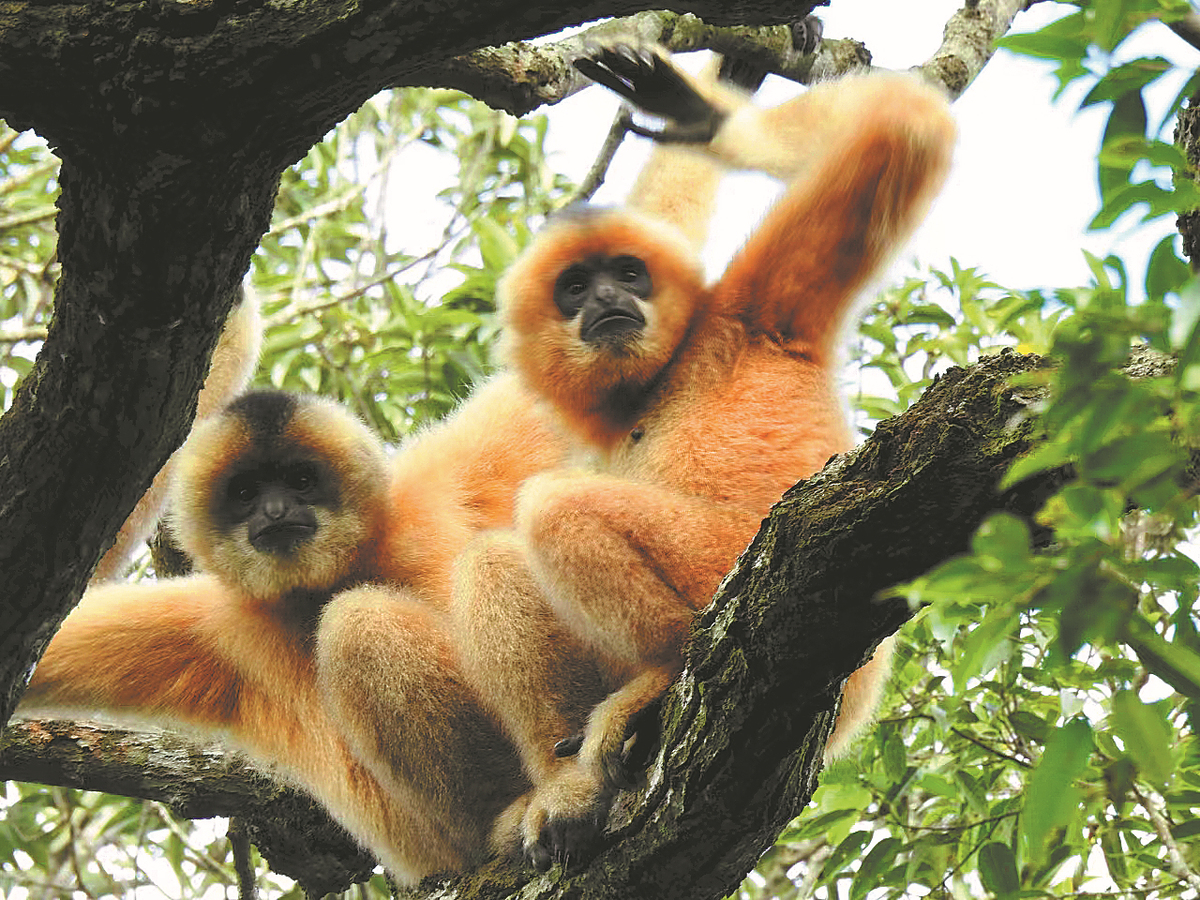
The origin of human music was a mystery highlighted as one of the 125 most challenging scientific questions in a 2005 issue of Science journal. But now, a group of scientists from China, the United States and Canada have delved into the question by focusing their research on the mechanism and evolution of song coordination in animals, especially in three closely related species of wild gibbons.
On Jan 24, they published a paper titled "Small apes adjust rhythms to facilitate song coordination" in Current Biology. The study marks the first time that adult male gibbons in the wild, specifically those in polygynous groups (a male pairing with two females), have been reported to adjust the timing, speed and rhythmic pattern of their vocalizations to better facilitate coordinated singing.
"Our research answered the question of 'How do animals coordinate their vocalization to form elaborate duets or choruses?'," said professor Fan Pengfei from the School of Life Sciences at Sun Yat-sen University in Guangzhou, Guangdong province, who is the senior author of the paper. Ma Haigang, a postdoctoral researcher with the school, and Wang Zidi, a graduate student with the school, were lead authors.
"It provides insights into the origin and evolution of song coordination in music," Fan said.
The researchers emphasize choral singing is not only an important musical form but also a significant behavior among various non-human animal groups, including duets formed by two individuals or larger choruses.
Choral singing in humans plays a crucial role in promoting prosocial behavior, increasing social cohesion and strengthening social relationships, Fan said. "The coordination of individual voices into an organized chorus has long been a subject of scientific inquiry," he said.
Rhythm, as a fundamental element of music, organizes the temporal patterns of sound. Scientists believe that isochronous rhythms, such as those emitted by a clock or metronome, are easier for recipients to perceive and predict, and they facilitate coordination among individuals, thus promoting choral singing. Until the research, however, the role and mechanisms of rhythm and its variations in promoting choral singing in non-human animals remained poorly understood.
Gibbons are ideal subjects for studying these questions, Fan said.
"Among all the apes, and even among all non-human primates, the vocalizations of gibbons bear the closest resemblance to human music," he said. "They are the only apes capable of producing complex phrases or sequences composed of multiple syllables, which can be combined to form a 'chorus' — a feature not found in any other ape species. It's been observed that they dynamically adjust their vocalizations to align the first resonance peak frequency, akin to the singing pattern of human sopranos."
The loud and enduring songs of gibbons can travel 1 to 2 kilometers and are believed to serve functions such as attracting and defending mates, marking and defending territories, and reinforcing pair bonds.
China is home to three species of crested gibbons: the Cao-vit gibbon, the Hainan black-crested gibbon and the black-crested gibbon.
Unlike other gibbons that primarily live in monogamous family groups, these three species typically reside in stable polygynous family groups, consisting of one adult male and two adult females, Fan said.
Within these family groups, adult males and one or two adult females combine their gender-specific calls to form duets or trios, with the males predominantly leading the singing.
The study first demonstrates the presence of isochronous rhythms (with a rhythm ratio of 1:1) and other small integer rhythms (with a rhythm ratio of 2:1) in the male sequences of these gibbons, Fan said. "After the males emit multiple sequences, the females respond with successful or unsuccessful excited calls to coordinate with the males, resulting in singing bouts," he said.
"Based on our long-term field observations, our study discusses for the first time the evolutionary basis of rhythm and its variations — adult males demonstrate bond strength with females through successful choral singing to avoid being replaced by other males," he said.
This study has revealed the function of rhythm and its variations in promoting choral singing, the professor said.
It has advanced the understanding of the function and evolution of rhythm for humans and proposed several avenues for future research, contributing important data and theoretical foundations for further understanding the origins and evolution of music.
However, the team's joy of discovery was tempered by the grim reality of the gibbons' dwindling populations.
"Gibbons once flourished in central, southern and southwestern China. But over the centuries, their numbers have plummeted, and their habitat has steadily receded," Fan said.
After the founding of New China in 1949, the country was still home to seven species of gibbons.
Regrettably, he said, the northern white-cheeked gibbon and the white-handed gibbon have already been declared extinct in the country.
At present, the Hainan gibbon, with only six groups totaling 37 individuals, stands as the world's most critically endangered primate species.
The Cao-vit gibbon, the second-rarest gibbon worldwide, numbers fewer than 80 individuals distributed in China and Vietnam, with 36 in five families within the country.
The Skywalker hoolock gibbon, named by Fan, has a population of fewer than 200, while even the most populous of gibbons in China, the western black-crested gibbon, numbers only 1,300 to 1,500 individuals.
Fan called for urgent action to conduct further research and to protect the gibbons. "If we lose these precious species, we will forever lose the opportunity to explore the mysteries of their behavior," he said.


- Investigation uncovers mismanagement of donated artifacts
- Gold mine accident kills 7 in East China
- Defense minister greets foreign military envoys at Chinese New Year event
- Judicial efforts lead to decline in China's pollution cases
- SPP steps up food and drug safety oversight
- Visually impaired student's rail journey goes viral












