


Giving folk art a sharper profile









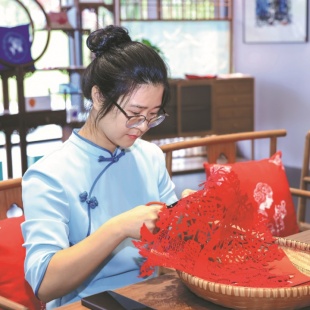
A fold, a cut, scissor blades zigzag back and forth, a flick, and dancing pieces of red paper unfold as several pomegranates emerge, side by side. "I could have done it better," Zhou Dongmei says humbly, as she puts down the scissors and shows the finished paper-cut to curious onlookers.
"When I was young, my grandmother used to make paper-cuts, and I would watch her. In my hometown, many of our neighbors knew how to make paper cuttings. Since it was so common in our village, every household had a 'flower-cutting aunt' or a 'flower-cutting mother'," she says.
Zhou grew up in Pucheng, Fujian province. The paper-cutting tradition took root in this southern county 1,700 years ago, when migrants from the northern Central Plains introduced it during the Western Jin Dynasty (265-316). Literati chronicled the relocation, writing about the craft, and since then, paper-cutting in Pucheng has evolved into a uniquely diverse and exquisite form that sets it apart from the simple style found in the north.
"Take pear blossoms as an example. Northern paper-cuts produce a general outline lightly embellished with patterns. But in Pucheng, we add many delicate patterns and Chinese characters to the blossoms as well," Zhou explains.
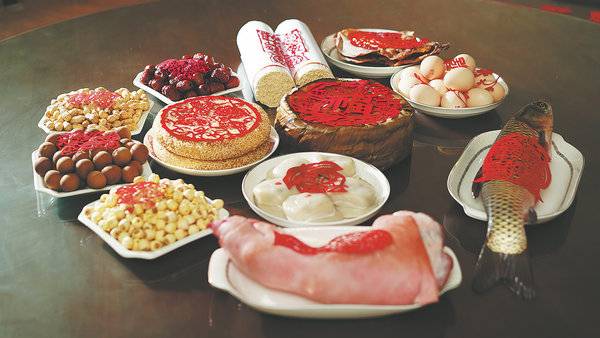
Paper-cuts were once used in every rite of passage in Pucheng. From birthdays to weddings, food and gifts were all presented with paper-cuts in corresponding patterns.
"When I got married, we had a big rice cake with a cake-shaped paper-cut on it, and a pair of fish with a fish-shaped paper-cut on them," says Zhou.
Both craft and tradition are fading away with the younger generation. Zhou, who has maintained her ties and is dedicated to preserving the art, set up a workshop in 2008 to produce and sell paper-cuts and train craftspeople.
She has created many innovative patterns that have contemporary relevance, such as her Fu Culture series, which features local specialties and patterns based on elements of the Beijing Winter Olympics. In order to appeal to young people, she applies patterns to cultural and creative products like tote bags, teacups and cellphone cases.
Her workshop also offers free short-term and long-term training for those interested, and both organizes and participates in events to promote Pucheng paper-cuts.
"During the Spring Festival, we used to make paper-cuts and give them out to passengers at Changle Airport in Fujian province for free. We do such things to continuously promote our products," says Zhou.
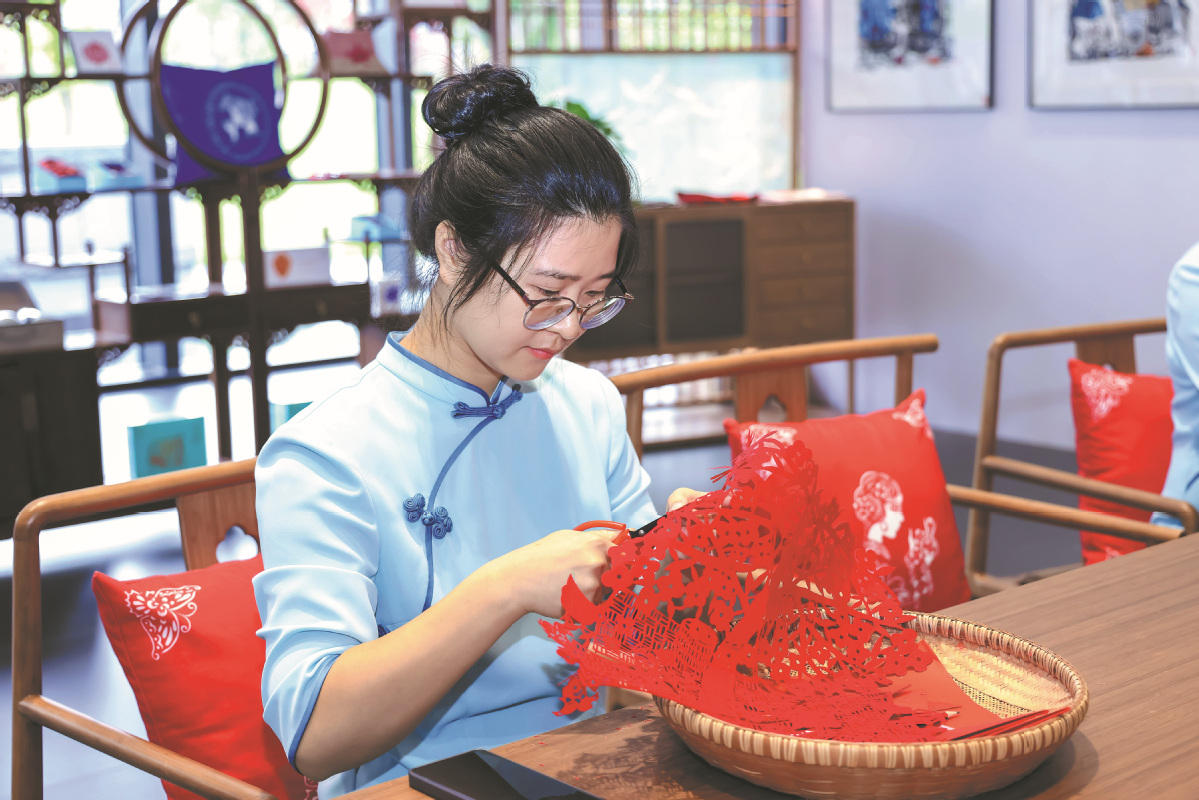
Her efforts have not been in vain. Young people are now becoming both buyers and inheritors of this ancient art form. Wang Xu has been learning paper-cut for more than a decade under Zhou, who is also her husband's aunt.
"At first, we learned the basic skills, so we were able to make the necessary cuts. By practicing more, we gradually came to understand the language of paper-cutting and its forms. We also learned drawing techniques and then, we started creating our own pieces through trial and error," says Wang.
Pucheng paper-cutting was listed as national intangible cultural heritage in 2014. The same year, Zhou was recognized as an inheritor at the provincial level and eight years later, in 2022, Wang was recognized as an inheritor at the municipal level — one of the youngest additions to the inheritor list.
A number of pieces made by her have been collected by local museums and some have been exhibited in countries such as Panama, Costa Rica and Peru. Apart from making new pieces, Wang also regularly teaches paper cutting for free at primary schools, high schools and universities.
"Intangible cultural heritage represents our distinctiveness. We hope to improve it, so that more young people will be willing to join us," says Wang.
Li Hezi contributed to this story.