The life and times of Dr K the conciliator
As a young man, he was exposed to the ravages of tyranny and war, and he would later champion the cause of bringing two nations together









Depicting Zhou as "equally at home in philosophical sweeps, historical analysis, tactical probing and light repartee", Kissinger clearly saw in this combination an alter ego of himself. And he detailed their meetings in the 2011 book On China, written "to explain the conceptual way the Chinese think about problems of peace and war and international order, and its relationship to the more pragmatic, case-by-case American approach", to quote its preface.
"The Chinese don't think of negotiations as solving individual problems," Kissinger said. "They think that every solution is an admission ticket for another problem. They think in terms of processes. … Hence Chinese diplomats consider continuity of relationships an important task and perhaps more important than formal documents. In this context, hospitality becomes an aspect of strategy."
Here comes what Lord considers Kissinger's biggest asset as a diplomat: his adaptability to the history and culture of his interlocutor. In On China, Kissinger, once described by his US army mentor Fritz Kraemer as "musically attuned to history", expounded the thoughts of Sun Tzu, the ancient Chinese military strategist canonized by his work The Art of War.
"Western strategists test their maxims by victories in battles; Sun Tzu tests by victories where battles have become unnecessary," Kissinger said, conceding that although negotiation is what keeps the threat of war "potential", it is often viewed with suspicion because of its inbuilt "admission of finite power".
Another place where Kissinger had tried to grasp the essence of what he dubbed Chinese realpolitik was in the board game go, or weiqi. In the game, invented in China more than 4,000 years ago, two protagonists try to defeat each other by encirclement, which Kissinger believes historically has been "the greatest strategic fear" for China, with its vast periphery.
"Chess produces single-mindedness, weiqi generates strategic flexibility," said Kissinger, who shared the view with Nixon that moving to China was "not to collude against the Soviet Union but to give us a balancing position to use for constructive ends, to give each Communist power a stake in better relations with us". In other words, "maximum diplomatic flexibility", as Kissinger called it.
In May 1972, three months after Nixon's historic trip to China, the US president met his Soviet counterpart Leonid Brezhnev in Moscow, where two arms control agreements were signed. This was followed by the Berlin Agreement, put into force in June that year. Finally, on Jan 27, 1973, the Paris Peace Accords were signed, officially ending direct US involvement in the Vietnam War, which had cost the lives of more than 58,000 US soldiers. In the previous decade, the US, with the Republic of Vietnam (South Vietnam), had fought the Democratic Republic of Vietnam (North Vietnam), backed by the Soviet Union and China, in an effort to contain what it saw as the threat of spreading communism.
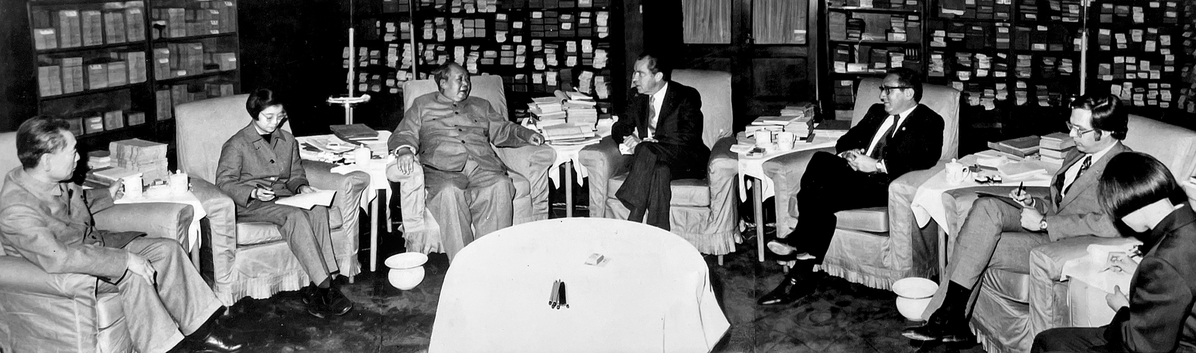
The meeting between Nixon and Chairman Mao Zedong took place in the early afternoon of Feb 21, 1972, the first day after Nixon and his entourage arrived in Beijing and about seven months after Kissinger's secret trip that resulted in a Chinese invitation for Nixon. The president brought with him Kissinger, who in turn brought Lord.
Observing that Mao "would almost invariably begin a conversation with a question "before proceeding to answer it "by means of a Socratic dialogue", Kissinger was initially somewhat baffled by his "elliptical comments "and "abstruse language". But he was quick to declare the man "Sun Tzu's student" who thought strategically and pragmatically, with full recognition of "the need for priorities".
"Mao suggested that each side develop a clear concept of its national interest and cooperate out of its own necessity," recalled Kissinger, who throughout his diplomatic career "tried consistently to think in long-range terms and in the national interests, but in the national interests related to the national interests of other countries".
"A sustainable outcome must be one that both sides have an interest in maintaining," he said.
Mao's tireless stressing of contradiction and disequilibrium as "a law of nature" had also struck a chord with Kissinger, whose 1954 doctoral dissertation Peace, Legitimacy and Equilibrium is widely seen as foreshadowing his activities on the international stage.
In the dissertation, published three years later as A World Restored: Metternich, Castlereagh and the Problems of Peace 1812-1822, Kissinger came up with two core concepts of his thinking as a political theorist: legitimacy and equilibrium, which he argued are inextricably linked to one another.