



Peace still elusive in Moscow-Kyiv conflict









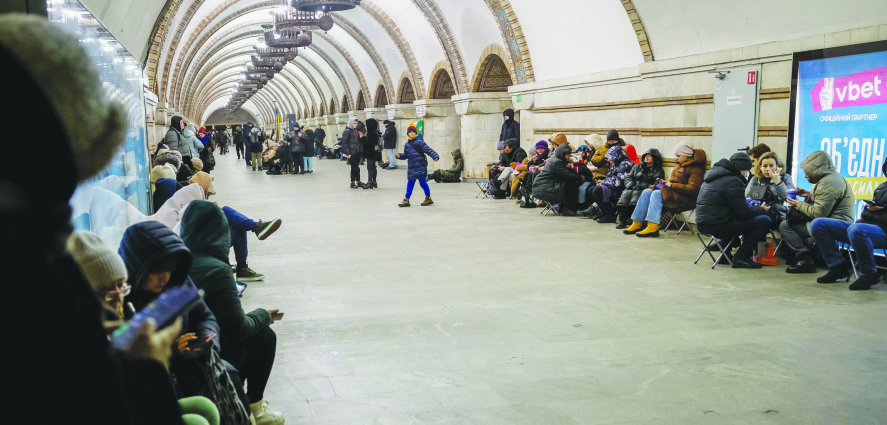
In the tumultuous theater of the Russia-Ukraine conflict, this year seems full of uncertainties and shifting alliances. The fervor over Ukraine in Western corridors has metamorphosed into palpable weariness, mainly due to the Israel-Palestine conflict. With Ukrainian forces being compelled to shift from an offensive to a defensive stance, the scales seem tipped in favor of Moscow, which was perhaps evident in Russian Defense Minister Sergei Shoigu's claim of having been in complete control of Mariupol on Dec 25, 2023.
Ukraine is caught between the pursuit of war and the clamors for peace at home. The Ukrainian government's call for an immediate withdrawal of Russian forces and the need for the international community to recognize Ukraine's borders with Russia reflect the harsh reality of a divided population. The majority of the Ukrainian people, though, still believe that the "resistance" against Russia should continue and Ukraine should not make any compromise on its territorial integrity.
But since those demanding a "cease-fire" are in a minority in Ukraine's corridors of power, the Ukrainian government is not only unwilling to engage in negotiations but has also refrained from changing the piece of legislation implemented in October 2022 which explicitly prohibits negotiations with Russian President Vladimir Putin.
The fulcrum of Ukraine's military capabilities rests precariously on the lever of Western support. A decline in military aid from the West could lead to a more severe crisis. The pivotal variable in the United States' policy toward Ukraine is the looming specter of the US presidential election in November. Should former US president Donald Trump or his endorsed candidate win the election, a seismic shift in US support for Ukraine could recalibrate the geopolitical chessboard, and prompt the US administration to divert its military and strategic resources to the Asia-Pacific region.
The US, meanwhile, has been treading cautiously, continuing to support Ukraine and coaxing European allies into making greater commitments to help Ukraine, with the ultimate goal of strategically weakening Russia so that the Russian people vote out Putin in the presidential election scheduled for March. But the fact that Hungary, Poland and Slovakia have halted their military support to Ukraine shows the US policy is a failure. Worse, thanks to the support of the US and the European Union to Ukraine, the European Parliament elections in June threaten to cause a surge in far-right parties, widening the divisions within the EU.
In Ukraine, internal strife and corruption have undermined the Ukrainian military's resolve. A combination of factors, from a shortage of recruits to poorly trained and inexperienced soldiers, paints a bleak picture of the Ukrainian military's spirit and fighting capability. In the quest to bolster its ranks, Ukraine has widened the conscription net, by inviting older and inexperienced individuals to join the armed forces.
Besides, Ukraine's massive economic quagmire has exacerbated the country's predicament, not least because its national debt had increased further to $136.35 billion by November 2023. That prompted Ukrainian Finance Minister Vladimir Martynenko to seek more foreign aid, citing a shortfall of $290 billion in the required $410 billion. The economic strains mean the government will struggle to provide adequate logistical support to the Ukrainian armed forces, creating a perfect storm of challenges.
On the opposite side of the chessboard, Russia sees Ukraine not only as a piece on the geopolitical chessboard but also as an internal affair. Though there were initial anti-war rumblings in Russia, the Russian government has successfully molded public opinion into resolute support for its actions against Ukraine. And since Putin is widely expected to be re-elected as the Russian president in March, the stage seems set for a bolder, more confident Russia.
Russia says it's on a mission to demilitarize and "de-Nazify" Ukraine, and simultaneously counter neocolonialism, oppose hegemony and reshape the global order to make it fairer and equitable. In fact, the political unity, economic rebound and efficient production of military equipment and weapons have helped Russia take forward its agenda.
However, the road ahead is not without challenges. Russia still faces resistance to its plan to "reclaim" southern Ukraine so as to establish a land route between "New Russia" (sparsely settled land south of Russia) and "Transnistria" (strip of land between Ukraine and Moldova). And should Ukraine show signs of retreat, Western support might recalibrate, plunging both sides into a longer conflict, perhaps with diminishing intensity.
A cease-fire seems like a distant dream and comprehensive peace a mirage on the geopolitical horizon given the recent developments. The prolonged conflict is inherently tied to the geopolitical tug-of-war between Russia and the West. It's a high-stakes geopolitical game where neither side is willing to yield. As a result, the future of Ukraine hangs in the balance.
Only when one side exhausts its military capabilities or faces strong opposition at home can one expect any change in the stances of Russia and Ukraine. A cease-fire agreement may follow in such a case, but territorial disputes are likely to persist. The conflict also shows that Russia and the US-led West are locked in a zero-sum game, making it difficult for both parties to agree to a compromise.
The quest for peace, elusive yet imperative, has to navigate a treacherous path, highlighting the dance between diplomacy, military might and the human cost of conflict.
The author is a research fellow at the Institute of Russian, Eastern European and Central Asian Studies, Chinese Academy of Social Sciences. The views don't necessarily reflect those of China Daily.
If you have a specific expertise, or would like to share your thought about our stories, then send us your writings at opinion@chinadaily.com.cn, and comment@chinadaily.com.cn.





