



Firecrackers call for balancing tradition and law









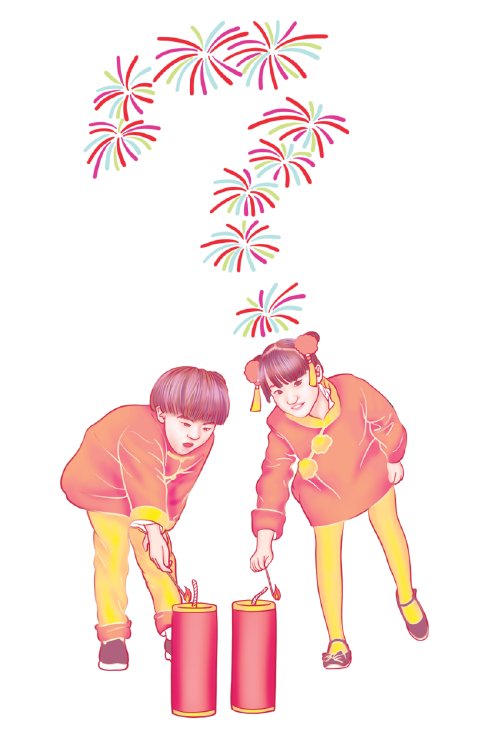
As Spring Festival approaches, whether people should be allowed to burst firecrackers has become an important question.
Toward the end of 2023, the Legislative Affairs Commission of the Standing Committee of the National People's Congress, China's top legislature, presented a nuanced report on legislative records at its seventh session. Among other things, the report said that "a comprehensive ban on fireworks and firecrackers is illegal", revealing discrepancies and recommending legislative adjustments to address the issue.
The intricate dance between tradition and legislation on the firecrackers issue has been a subject of long-running debates.
Laws, at their core, are reflections of the public's will. If there is a fervent public demand for firecrackers, especially during festivals, stringent legislation against it could be interpreted as an affront to public sentiment. In many places in China, adherence to some traditional concepts persists. In some circles, a transcendent will symbolizes advanced cultural development, capable of evolving into national law that would guide the pursuit of sophisticated cultural practices, including an advanced legal culture.
Regarding the debates on the ban on firecrackers during Spring Festival, some view the ban as a symbol of cultural progress, breaking away from outdated traditions that can pollute the environment and lead to fire accidents. On the other hand, some say the authorities are caught between ban and no ban.
In addressing the issue of the ban on firecrackers, folklorists and sociologists may hold more sway than law experts. Behind their criticisms of a comprehensive ban might lie the wishes of millions of people. But despite democracy in legislation inherently involving the denial of some of the demands and wishes of the majority, decision-makers must take into consideration diverse perspectives before reaching a conclusion.
The firecracker issue becomes more complicated given its asymmetrical effects on different groups. By adjusting regional regulations to allow the sales of firecrackers, some provinces might be able to bring spiritual joy to some people and, increase holiday consumption, but the move could worsen air pollution manyfold and cause fire accidents. Conversely, a ban on firecrackers may be good for the environment and public safety, but it could result in huge material losses for certain individuals. The modern democratic processes attempt to reconcile these conflicting interests through compromise.
However, nationwide discussions on the firecracker ban are a pseudo-proposition due to the high costs and difficulties in ensuring the same effects across regions.
If a government allows people to burst firecrackers in a city's central district, the views of the area's residents would be in minority compared with the opinions of the entire city's residents or legislative body. Thankfully, modern democratic systems offer remedies for such conditions including legislative hearings, open debates and the requirement of absolute majority to tilt the decision in one direction, ensuring the protection of citizens' interests.
Therefore compared with a total ban, modified regulations will be better. There may be a partial reinstatement of the production and use of fireworks and firecrackers, which would require further technological refinement. With significant advancements in science and technology, we can now exert a certain degree of control over the drawbacks caused by the traditional use of fireworks and firecrackers. Therefore, local authorities can consider allowing fireworks and firecrackers to be set off at different times and in different areas, which will cater to ordinary people's needs during Spring Festival.
The author is a professor of law at the Zhongnan University of Economics and Law.
The views don't necessarily reflect those of China Daily.
If you have a specific expertise, or would like to share your thought about our stories, then send us your writings at opinion@chinadaily.com.cn, and comment@chinadaily.com.cn.





