



Ren'ai Reef: DOC's value and the Philippines' delusion









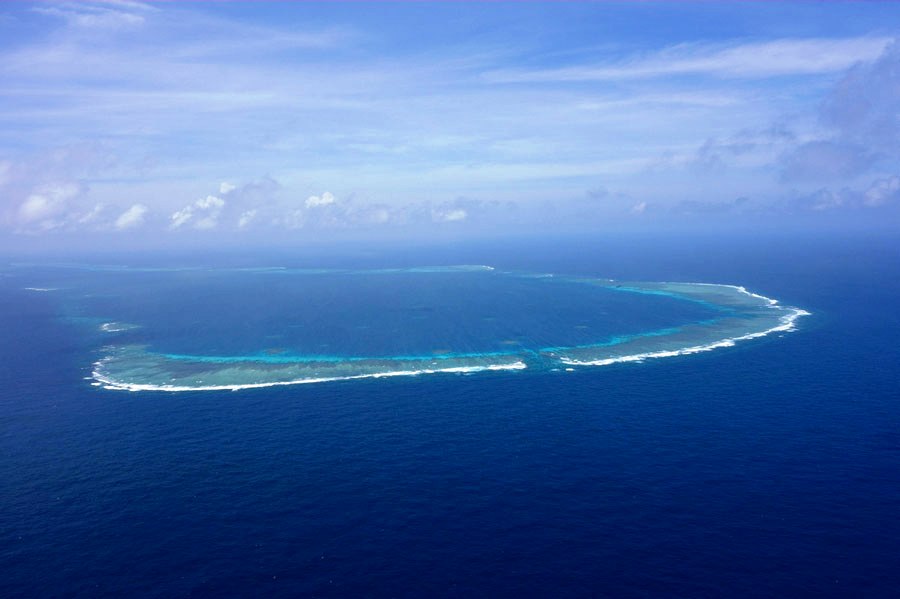
On February 2, the China Coast Guard (CCG) monitored and tracked the Philippine civilian vessel that delivered supplies to a military vessel illegally "grounded" at China's Ren'ai Reef. The delivery of subsistence supplies of the Philippines was a temporary approach, which was allowed by Chinese side and based on humanitarian considerations.
The situation at Ren'ai Reef has continued to attract attention from the outside world. In a joint statement issued by the EU-ASEAN Ministerial Meeting last week, the two sides underscored the importance of the full and effective implementation of the 2002 Declaration on the Conduct of Parties in the South China Sea (DOC) in its entirety.
It is very important for countries and regions inside and outside the South China Sea to be able to see the value of DOC. Over the past 20 years, the situation in the South China Sea has generally remained peaceful and stable, with no other countries openly occupying new islands and reefs, and the trend of expanding disputes has been effectively curbed. One important reason is that DOC plays a crucial role in this.
The fifth paragraph is the core clause of the DOC, which provides that the parties undertake to exercise self-restraint in the conduct of activities that would complicate or escalate disputes and affect peace and stability including, among others, refraining from action of inhabiting on the presently uninhabited islands, reefs, shoals, cays, and other features and to handle their differences in a constructive manner.
Such provision has three implications. First, although it aims to regulate the actions of the relevant countries in the South China Sea after the signing of the DOC, it does not mean that the "status quo" of some of the parties illegally occupying China's islands and reefs would be given legitimacy.
Second, behind the wording of "refraining from action of inhabiting" is the principle of seeking common ground while reserving differences in the original efforts of the parties concerned to reach the DOC, and the cautious text embodies the common will of all parties to maintain peace and stability in the South China Sea.
Third, it shows that both ASEAN countries and China clearly understood when they signed the DOC that the core of the South China Sea issue and the fundamental factor affecting peace and stability is the territorial disputes between the countries concerned over some islands and reefs of the Nansha Islands.
No matter how the international and regional situation changes, no matter what kind of deception the Philippines makes through the third-party compulsory settlement mechanism of the Law of the Sea, and no matter what kind of narrative the US tries to shape in the arena of international public opinion, it will not change the current legal and political reality in the South China Sea: the territorial sovereignty dispute triggered by the invasion and occupation of China's islands and reefs by the countries concerned.
The Philippines, as a party to the dispute, occupied eight islands and reefs of China's Nansha Islands before the signing of the declaration. As a member of ASEAN, the Philippines participated in the entire consultation process of the DOC. It should therefore be very clear what the obligations under paragraph 5 of the DOC were and why they were so provided. The DOC is an agreement reached between China and 10 ASEAN countries, and the commitments made by the Philippines under paragraph 5 are obligations not only to China, but also to other ASEAN countries which are the parties to the DOC. China's countermeasures against the Philippines' violation of paragraph 5 are not only based on the need to safeguard its territorial sovereignty, but also out of the need to safeguard the seriousness and authority of the DOC. Without the full, effective, complete, and faithful implementation of the DOC, the political gains achieved by all parties after years of hard work would be diminished and eroded. If the situation at Ren'ai Reef continues following the Philippine script, the DOC would eventually become invalid and stability in the South China Sea would be destroyed. ASEAN countries are obviously aware of this.
Ren'ai Reef is an integral part of the Nansha Islands and is within the scope of “uninhabited islands, reefs, shoals, cays, and other features” referred to in paragraph 5 of the DOC. The grounding of the Philippine warship in 1999 should not be considered as "the action of inhabiting". However, after the signing of the DOC, the Philippines attempted to turn the grounded warship into a permanent facility on the reef by transporting construction materials, which was an "action of inhabiting on the presently uninhabited islands, reefs, shoals, cays, and other features" and violated the Philippines' commitments and obligations under paragraph 5 of the DOC.
A high-level Philippine official had stated in 2003 that the Philippines had no intention of building facilities on Ren'ai Reef and that the Philippines as a party to the declaration would not and did not want to be the first to violate it. However, in a government memorandum released in 2013, the Philippines made it clear that it wanted to occupy Ren'ai Reef as territory, and it also publicly stated that it would deploy the warship as a permanent facility. Such inconsistent rhetoric and approach of the Philippines is a clear violation of the principle of good faith in international law and a disrespect for the DOC.
The way the Philippines will go on the Ren'ai Reef issue will not only affect China-Philippines relations, but also affect peace and stability in the South China Sea. The situation at Ren'ai Reef is not a new issue, but the Philippines' dishonest approach has led to a new question, that is, how should the value of the DOC be maintained? what should regional countries do if the Philippines ignores the collective consensus reached by China and ASEAN countries? The Philippines’ choice is not only crucial to the comprehensive, effective and faithful implementation of the DOC, but will also have a long-term impact on the ongoing consultations on the Code of Conduct in the South China Sea and the effective application of the COC in the future.
Ding Duo is the deputy director and an associate research fellow at the Research Center for Ocean Law and Policy, the National Institute for South China Sea Studies. Zhong Huiis an assistant researcher at the Division of International Exchanges, the National Institute for South China Sea Studies, and the Secretary at the China-Southeast Asia Research Center on the South China Sea.
The opinions expressed here are those of the writer and do not necessarily represent the views of China Daily and China Daily website.
If you have a specific expertise, or would like to share your thought about our stories, then send us your writings at opinion@chinadaily.com.cn, and comment@chinadaily.com.cn.





