Revisiting Chang Daichien, misunderstood Chinese artist









Weimin Zhang, a professor and filmmaker at San Francisco State University, shares one trait with the internationally renowned and controversial artist Chang Daichien (better known as Zhang Daqian in China).
That is an unquenched thirst for self-fulfillment, evolution and the revelation of identities.
The strong motivation might explain why Chang, after decades of nomadic migration among different continents since 1949, kept awing the world and his followers with artistic breakthroughs, and why Zhang, dedicating 12 years of her life arduously tracing Chang's footsteps, unveiling a nostalgic soul that eternally aspires to his utopia.
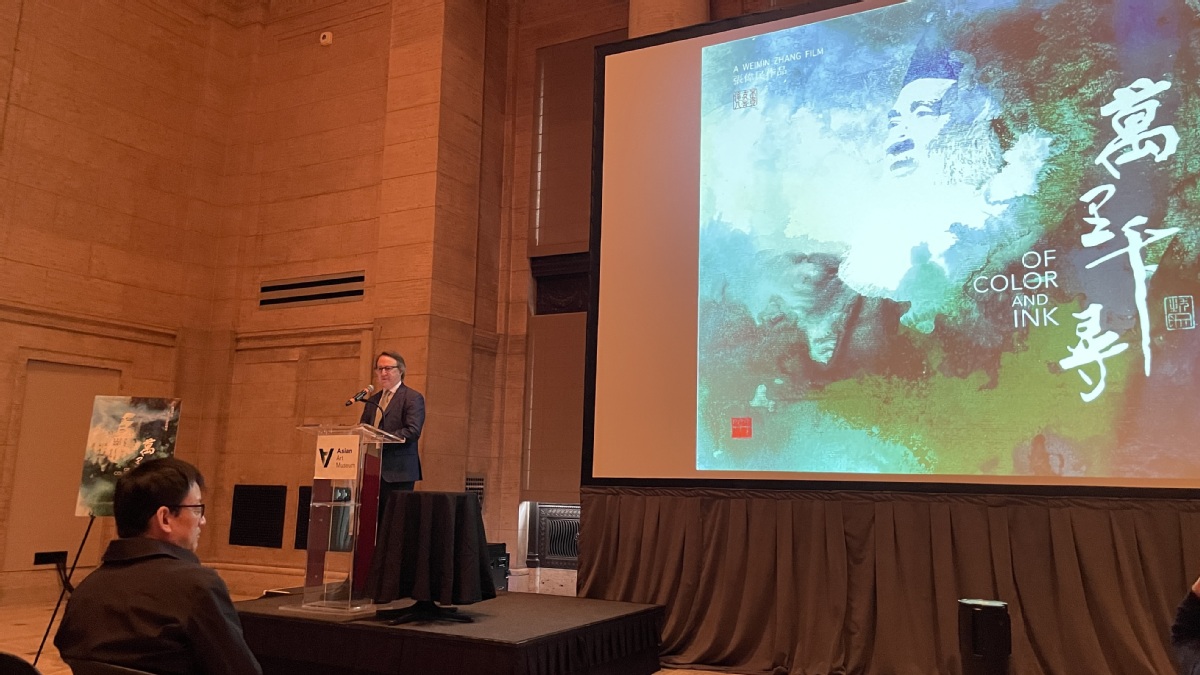
Recently, the Asian Art Museum in San Francisco hosted the premiere for Of Color and Ink: Chang Daichien After 1949, a documentary produced by Zhang.
Family members and students of Chang's, art critics and enthusiasts packed the auditorium to hear stories about one of the most influential Chinese artists (1899-1983) of the 20th century.
Adept in a broad range of classical Chinese painting styles and skills such as brush and ink, Chang in his later years developed innovative approaches to drawing — pouring ink and colors on paper or silk for a random and creative form of production.
It is a method many art scholars believe Chang had borrowed from Western counterparts such as the impressionists or abstractionists.
However, "Chang's work is misunderstood in both China and the West," said Mark Johnson, an American art critic who is deeply involved in the documentary.
Chang left Sichuan in 1949. Along with some of his family members, he first flew to Argentina, then, due to visa problems, had to transfer to Brazil. Chang finally relocated to the United States and spent the rest of his life in the coastal city of Carmel, California.
"Chang's 30 years of overseas expedition remains a mystery to many, and for the most part misunderstood in both China and the West," said Zhang, detailing her intention to document Chang's depth of life and art creations. "This used to be an area nobody has ever touched."
Of Color and Ink was inspired by 1967 film footage, produced by California art historian Michael Sullivan, said Zhang, who said that Sullivan later donated the 21-minute-long raw material to San Francisco State University, where she teaches and conducts research.
In 1999, when the university decided to screen the footage as part of Chang Daichien's centennial exhibition, with a focus on the artist's California years, Zhang helped transfer the original celluloid to a digital format.
Seen through the lens of a local cinematographer, Chang Dai-chien in California featured vivid episodes — the artist's random walks with his wife along the seashore on the Monterey Peninsula, his seemingly effortless painting of twisted cypress trees, his Chinese traditional uniform, and his distinctively iconic, long beard.
"Then comes the moment that I realize I have to do something," said Zhang. "What was Chang's life like? What has he been through during these 30 years?"
Bearing those questions in mind, Zhang started her own journey of inquiry about and discovery of Chang as an individual and artistic master. Setbacks and bewilderment were by no means rare, said Zhang.
"The more details I collected, the more complicated and sophisticated Chang becomes," she said.
Zhang traveled extensively to gather material about Chang by interviewing his neighbors and journalists who covered Chang's exhibitions. She annotated primary sources in French, English, Spanish, Italian, Japanese and Chinese that documented Chang's trips and works, and made field trips to Chang's former residences and apartments.
She then stitched the pieces together.
In Brazil, Zhang made a painstaking effort to locate Chang's abandoned home, which now was under a lake. According to recollections by his family members, the house was nestled in a serene small town called Mogi das Cruzes.
In 1954, Chang had replicated a traditional Chinese residential compound on a 30-acre lot, constructing what he called the Bade Yuan, or Eight Virtues Garden, featuring pavilions, a giant lotus pond, spacious grassland with a lush meadow, and bamboos.
"This is his remake of the spiritual paradise, his version of utopia," said Zhang. There he dressed himself in traditional Chinese robes, running his family following Chinese rituals and rules, and always being homesick.
In one of his long strolls, Chang started from the chain bridge in his hometown of Neijiang, near Chengdu along the Yangtze River, which stretches thousands of miles.
Barry Lam, an art collector, believes that when Chang left Qingcheng Mountain in Sichuan, "he must have been looking down from airplane at his beloved hometown".
Xiao Daiwen, granddaughter of Chang, was in the audience at the premiere. "This film is so touching and drew a true picture of my grandfather. Over the years, there are many misconceptions, rumors and misinterpretation of his work." Xiao said. "My grandfather loves China, deeply."
The film, using archival interviews with the artist, showcased Chang's perspective on integrating artistic expressions between East and West. In his opinion, brush, ink, color and medium are nothing but tools.
Chang's deep roots in Chinese thought and culture never hindered him from artistic pursuit across geopolitical borders.
Ba Dong, an art scholar, said Chang has reinterpreted Chinese traditional painting style and has invented his own artistic way to present Chinese paintings.
"Some thought Chang had abandoned China. No, he never abandoned China. He holds China close to his heart," Johnson said.