



Young artist helps further inner painting tradition









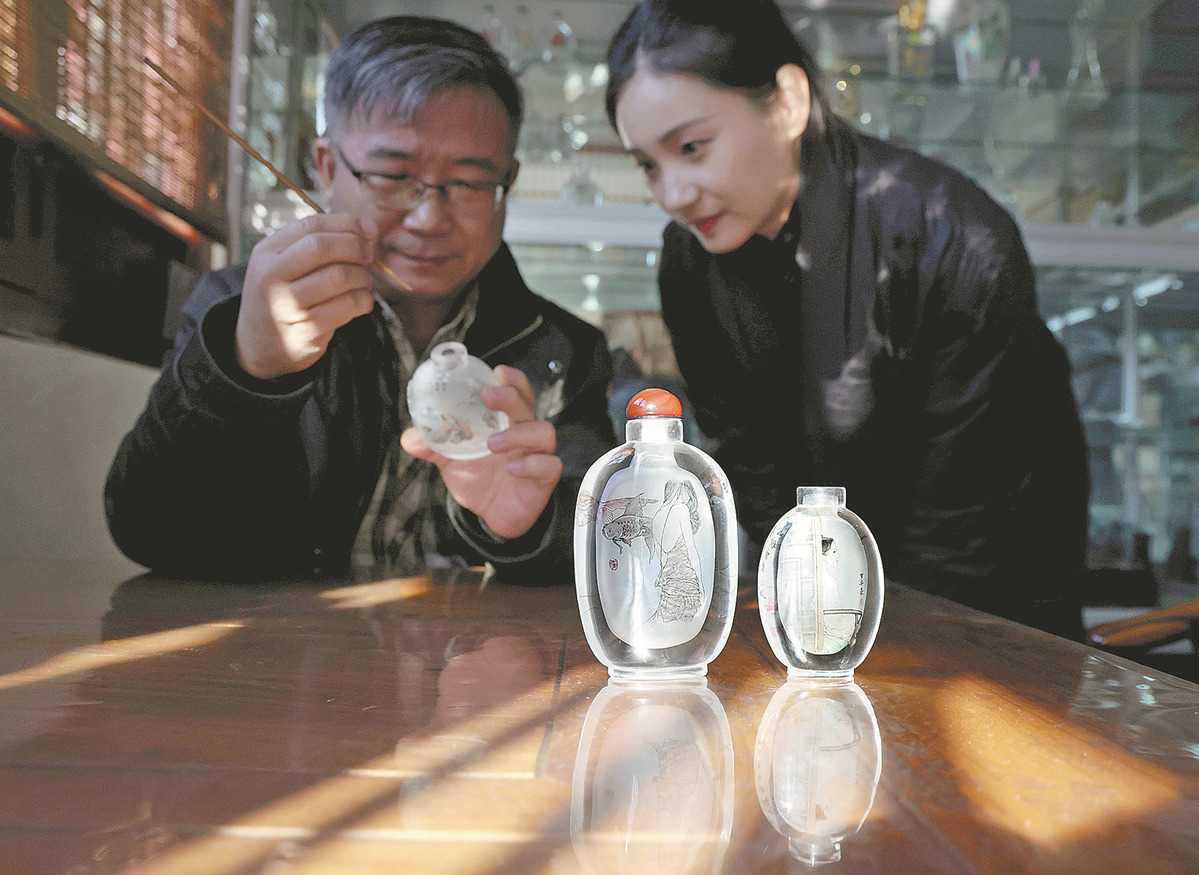
Seated at her desk and holding a brush in her right hand, Li Shaoyue completes an exquisite miniature ink painting on the inside of a glass bead.
The 30-year-old from Zibo, Shandong province, has been working as an inner painter since 2015.
Inner painting, a traditional art in China that involves painting in reverse, is a national-level intangible cultural heritage that uses materials such as glass, crystal and amber as a base. Artists use special, fine brushes that can enter tiny containers to create their paintings.
With a history of over 200 years, inner painting is mainly divided into four major schools: Beijing, Hebei, Shandong and Guangdong.
Li, a fifth-generation inheritor of the Shandong or Lu school, learned the skills from her father, Li Huitong, a master of traditional Chinese arts and crafts.
An introverted child, Li Shaoyue started learning how to sketch in primary school. In college, she majored in traditional Chinese painting in Jingdezhen, Jiangxi province. After graduation, she decided to focus on inner painting after giving it considerable thought.
She said that besides her love of drawing, her father's artistic career had a significant influence on her pursuit of painting.
"I saw my father doing this since I was a child and knew that his journey was not easy because he couldn't hear since childhood due to illness, making many things inconvenient," she said. "I also particularly wanted to inherit his profession because I knew that fewer young people were continuing to learn inner painting, and if it were to be discontinued here, it would be a pity."
Li Shaoyue said inner painting is different from other forms of painting. Even with a foundation in painting, one must start from scratch with line practice when transitioning to inner painting.
With a background in traditional Chinese painting, she helped with some color work in her family's studio while she was at college, and her study gave her a relatively strong wrist, the key to ensuring smooth lines in inner painting.
Li Shaoyue started to create some relatively simple finished products that could be sold in stores after about four months of intense practice.
Zhang Luhua, a fourth-generation inheritor of the Lu school of inner painting from Zibo, said the production of inner painting is demanding, requiring extremely high precision. During painting, there is no sketching or room for corrections. Only those skilled and confident in their abilities can handle it proficiently.
Zhang, 45, began learning inner painting in 1992. His father, Zhang Guangqing, also a master of traditional Chinese arts and crafts, had a significant impact on his painting career.
Zhang said inner painting relies on wrist strength, because a trembling hand leads to mistakes.
"Training was very tedious," he said. "When my hand trembled, I would bite my wrist. If it hurt, it would stop trembling. It took me about a year of training before my hand stopped trembling, and then I began drawing various lines."
As he learned more about inner painting, Zhang realized he needed further education in painting. Over the next two decades, he pursued studies at the Nanjing University of the Arts, the Central Academy of Fine Arts, the China National Academy of Painting, Tsinghua University and Renmin University of China.
Both inner painting and Chinese painting have similar standards, but they have different forms of expression, he said.
"The Shandong school of painting did not arise from one person but a group of people," Zhang said. "To truly become a school of painting, the group had to incorporate Shandong's inherent culture into its landscapes."
Inner painting has its advantages due to its uniqueness, he said, but also has disadvantages in the lack of a market and a shortage of learners and talented artists to drive its development.
One peculiar inner painting phenomenon is that only snuff bottles have foreign collectors and collector groups. Many collectors contact artists directly to purchase and collect high-quality works. The remaining mid- to low-end works flow into the mass market, he said.
Li Shaoyue now works in her father's studio. She can create up to five pieces a month for sale in the store, and spends the rest of her time conceiving and creating exhibition pieces.
The studio's operation was affected by the COVID-19 pandemic, but when large numbers of tourists flocked to Zibo to eat barbecue last year, its business improved.
The first artwork Li Shaoyue sold was a complex figure painting. Her mother helped her sell it for over 2,000 yuan ($278) at an exhibition in Jinan, Shandong, in 2016. Li Shaoyue was delighted to have her work recognized by the market.
"I want inner painting to be more integrated into our lives," she said. "It originated from snuff bottles, and it has passed its peak period. Now, I am sharing the painting techniques via social media platforms to make more people aware of inner painting, trying to make everyone recognize inner painting as the main focus, rather than just recognizing it in the form of snuff bottles."
The most marketable patterns are landscapes, followed by flowers and birds. Flowers and birds are priced lower than landscapes and figures because they are easier to paint. Figures mainly focus on auspicious themes, she said.
The process of creating inner painting products is relatively long, and their price is usually higher than other handmade products, ranging from hundreds of yuan to tens of thousands. Without prior fame, an artist's works may not be readily accepted by the market, she said.
Building upon traditional inner painting mediums, Li Shaoyue has also ventured into creating inner paintings on accessories. Many of the bead accessories she paints are purchased and worn by enthusiasts of hanfu, traditional Chinese-style clothing, resulting in high market acceptance.
"I hope that more young people will join inner painting, such as starting it on campus as an elective course," she said. "I wish the market would put more focus on such techniques."
yangzekun@chinadaily.com.cn





