Countryside playing catch-up with EVs
Charging stations, favorable policies helping rural areas become more eco-friendly










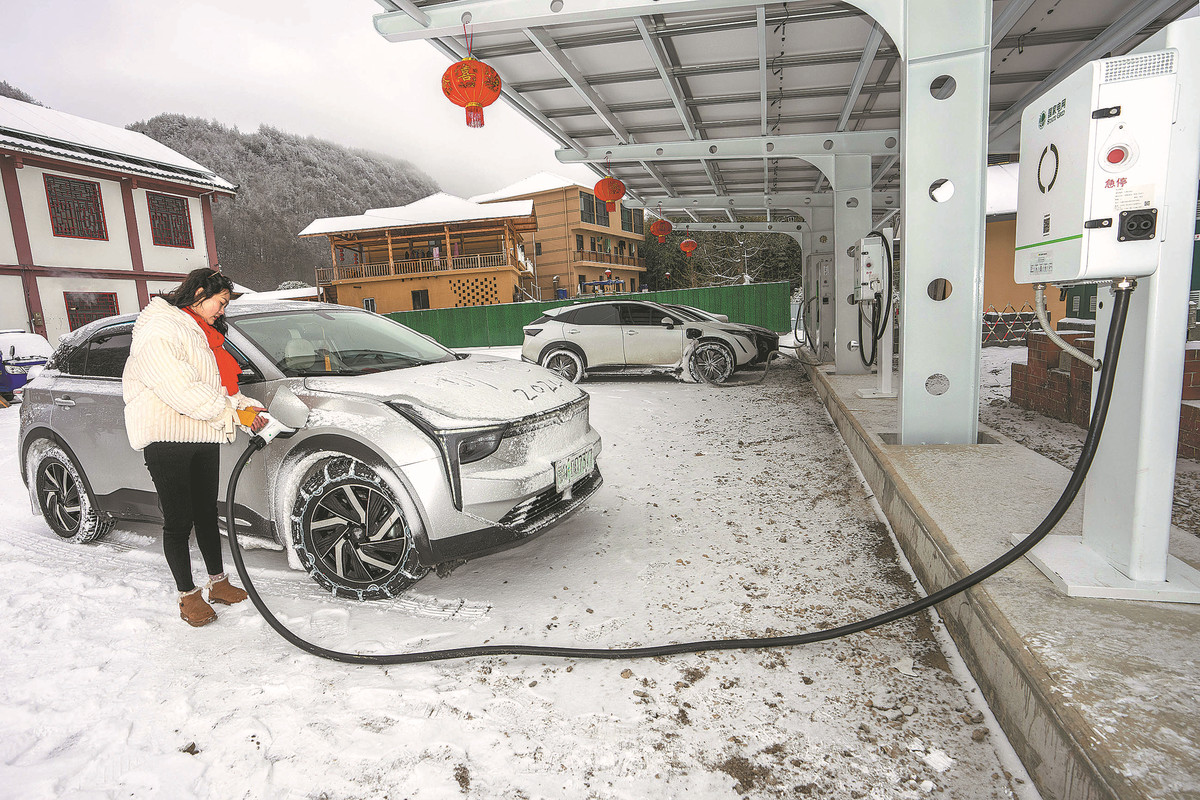
China's rural thoroughfares, once dominated by the droning of traditional internal combustion engines, are now far from cacophonous amid the ongoing quiet revolution of electric vehicles.
Encouraged by government initiatives and incentivized policies, residents in the vast expanses of China's countryside are increasingly making the switch to EVs, which industry experts believe will be the new frontier for electric mobility in the nation.
China's rural regions are expected to provide a new source of growth for what is already the world's biggest EV market, as new EV sales in small-sized Chinese counties and towns are still far behind first-tier cities, said Cui Dongshu, secretary-general of the China Passenger Car Association.
"As cities have taken the lead in adopting clean energy solutions, rural regions, fueled by government incentives — including subsidies and favorable policies — are emerging as the next growth point, switching from traditional internal combustion engines to electric alternatives," Cui said.
"As the overall market structure gradually improves, promoting the widespread adoption of new energy vehicles in county and rural markets represents a significant market opportunity and a vast untapped market," he said.
Figures released by the China Association of Automobile Manufacturers show that sales of NEVs in China's non-urban areas accounted for just 4 percent of total auto sales in rural regions in 2022, significantly below the industry-wide level of 25.6 percent.
While the proportion increased from 4 percent to 17 percent in 2023, a significant jump, it is still a considerable distance from the 40 percent penetration rate in first-tier cities, with substantial room for further development, the association said.
The cumulative volume of charging infrastructure nationwide reached 8.596 million units as of December, marking a year-on-year increase of 65 percent, according to the China Electric Vehicle Charging Infrastructure Promotion Alliance.
China EV100, an industry think tank, estimates that demand for motorized travel in rural areas will stimulate a car market with a scale of 500 billion yuan ($69.5 billion) by 2030.
The car ownership rate in rural areas of China will be close to 160 vehicles per thousand people by then, with a total ownership exceeding 70 million vehicles, according to a report by the think tank.
The Chinese government has been rolling out targeted measures to facilitate the electric revolution in the countryside.
The State Council, China's Cabinet, called for efforts to accelerate the construction and installation of charging facilities in rural areas in May. As part of the country's rural vitalization efforts, the government expects to equip all counties with charging stations and all villages with charging piles soon.
The government also extended its preferential purchase tax policy for NEVs to the end of 2027 and released a guideline to support people in rural areas in purchasing and using NEVs, focusing on boosting the construction of charging facilities.
Jiang Linru, a researcher at the China Electric Power Research Institute under the State Grid Corp of China, said the policy is "unprecedented" and will substantially accelerate the development of rural EV development.
Eyeing the massive potential, local governments are already promoting the development of charging infrastructure in rural areas, facilitating the widespread use of EVs while situating charging stations along highways and within rural communities, aiming to alleviate concerns about charging accessibility.
Zhejiang province, for example, has announced plans to build more than 2.3 million charging stations by 2025, with no less than 900,000 in rural areas, to meet the charging needs of over 4 million NEVs.
It currently boasts more than 1.65 million NEVs, including over 350,000 units in rural areas. The province has almost completed building an NEV charging service network, in which vehicle owners can find charging poles in rural areas within an average driving distance of five kilometers, three kilometers on the outskirts and one kilometer within city limits.