


Narrative arc set in stone










Circles of influences
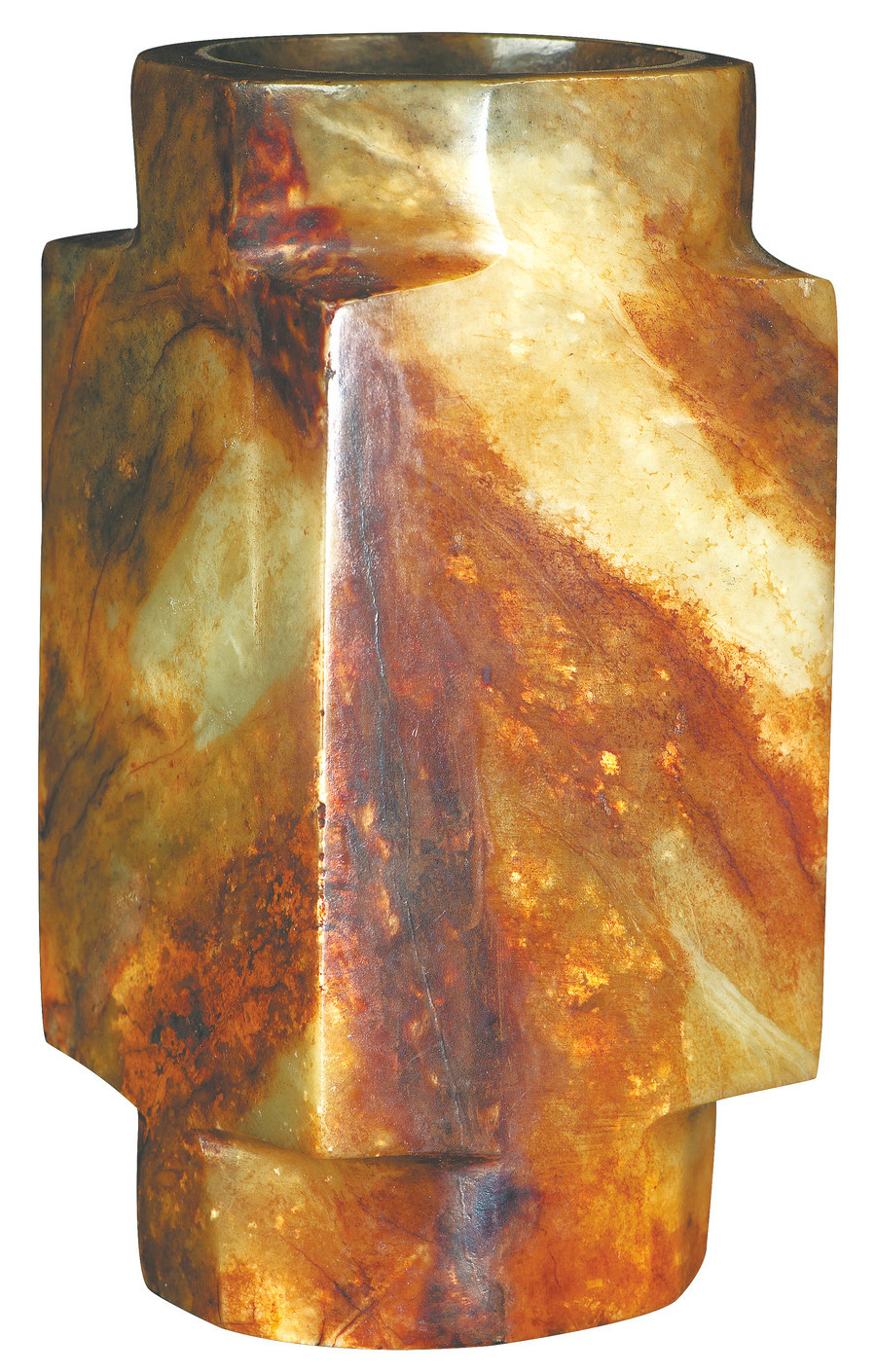
Reflecting on the differing views concerning the origin of jade cong and their westward — or eastward — spread, Zuo believes that a lot more archaeological evidence is needed before "we can arrive tentatively at any conclusion".
"Chances are we may never be totally convinced one way or the other, since the very nature of such exchanges is that it was a two-way street. And, what actually happened must have been infinitely more complicated than what we could possibly gather from all vestiges of the past," he says. "What we do know, however, is that the cumulative total of these cultural interactions extended across both time and space. And it included the formation of a whole set of rules governing the use of ritual jades, articulated for the first time in the book Rites of Zhou."
Although the book was once tentatively attributed to a younger brother of the founder of the Zhou Dynasty (c. 11th century-256 BC), these days, a greater number of scholars believe that it was written somewhere between the 5th and 3rd century BC. In it, the author came up with the concept of six archetypes of ritual jade, which, apart from the prismatic tube that is cong, also included bi, a disc with a hole in the center, which Teng believes was born out of ancient people's observation of the sun's journey across the sky.
Another two types are hu, which took not only the shape of a tiger but also its pronunciation in Chinese, and huang, which often resembled a double-headed dragon or — on fewer occasions — a tiger. (For those in the know, the arch or half-ring shaped huang is highly evocative of one ancient character that had been etched on oracle bones during China's Shang Dynasty between the 16th and 11th century BC, meaning "rainbow".)
Teng believes that her theory applies here. "The jade hu and huang, connected to the worship of animal-spirits, were mainly found at prehistoric sites in eastern China," she says. "As to bi, although they were much more ubiquitous during the period, the bigger ones that were clearly ritualistic rather than ornamental seem to have made their first appearance in Miaodigou culture around 3500 BC, where they were buried separately from the jade cong."
"The two were later combined in Qijia culture, clearly serving as two of its dominating forms of ritual jade as they both expressed the cosmological views of the people," she says.
On top of these four, the Zhou people added another two: gui and zhang, the shape of which indicated that both had developed from weaponry. "The symbolic significance of the jade gui and zhang attested to the ascending role of an army in a society, as that society became a powerful state," says Zuo.
Zuo was talking about Xia (c. 21st century-16th century BC), considered by most to be the first dynasty in traditional Chinese historiography. One of the most recognizable types of ritual jade associated with Xia is known today as yazhang, or "toothed zhang" thanks to the two rows of small teeth jutting out from right above its handle. (It's worth noting that although the academic world has debated over whether direct link had existed between the yazhang of Xia and the zhang as listed by the Rites of Zhou, all agree that both symbolized military power.)





