Greening Africa










China's green cooperation with the continent will help address climate change and contribute to the construction of a high-quality community with a shared future
With the highest concentration of developing countries, Africa is the continent that is most visibly affected by climate change, although African countries account for only about 4 percent of total global carbon emissions, the lowest total and per capita emissions in the world.
According to a report by the World Meteorological Organization, the State of Climate in Africa 2022, over 110 million people in Africa were affected by climate-related disasters in the past year, which resulted in economic losses exceeding $8.5 billion. In 2023, Africa was hit by several extreme weather events, including the longest-lasting intense tropical storm Freddy, which resulted in severe disasters in Malawi, Mozambique and Madagascar. The secondary impacts of climate change are also accelerating, especially in social, economic and security areas.
Frequent extreme weather events have caused a 34-percent decline in current agricultural production growth rates in Africa compared to 1961, with the entire continent's GDP potentially shrinking by 15 percent by 2030. Furthermore, with the increasing number of displaced populations due to climate disasters, the risks of humanitarian crises erupting in the Horn of Africa, the Sahel region and the African Great Lakes region are steadily increasing. Therefore, it is imperative for Africa to explore resilient climate governance approaches to achieve its inclusive and sustainable development, as depicted in the African Union's Agenda 2063.
In recent years, under the leadership of the Committee of African Heads of State and Government on Climate Change, African countries have not only unified their voices on global climate governance issues but also stepped up green development, focusing on implementing climate mitigation and adaptation. Guided by development plans such as the AU Green Recovery Action Plan (2021-27) and the AU Climate Change and Resilient Development Strategy and Action Plan (2022-32), African countries have developed their road maps for energy structure transformation and agricultural modernization based on their nationally determined contributions. For example, South Africa has set a target to reduce its reliance on coal power from the current approximately 80 percent to 59 percent by 2030. Kenya has committed to increasing its clean energy usage to 100 percent by 2030.
However, effective climate governance in Africa still faces significant funding gaps. Due to the procrastination by developed countries, global climate financing plans formulated at the United Nations' climate change conferences such as COP16 and COP21 have not been effectively implemented. As the continent with the highest poverty rates, Africa is currently facing a more severe climate financing gap. According to statistics from the African Development Bank, Africa's climate financing demand is estimated to reach a staggering $2.8 trillion from 2020 to 2030, with an additional $1.3 trillion needed annually to advance sustainable development goals. According to statistics from the High-Level Forum on Financing Energy Transition in Africa held at the Sharm el-Sheikh Climate Change Conference, or COP27, Africa can only access about 3 percent of global climate financing, with only 14 percent coming from the private sector. The continent is facing an annual funding gap of up to $90 billion. Additionally, according to estimates by the ECDPM, an independent think tank in Europe, if the progress of climate financing implementation remains slow and the problem of uneven distribution is not fundamentally addressed, Africa's annual climate financing gap could reach $200-400 billion by 2030, becoming one of the major obstacles to social and economic development in Africa.
Furthermore, measures such as the European Union's Carbon Border Adjustment Mechanism and the bloc's imposing of carbon taxes essentially serve as trade barriers under the guise of green development, which worsens Africa's disadvantaged position in trade with Europe. Even the United States, by tying "value-based diplomacy" to climate issues, advocates mini-multilateralism in climate governance in Africa.
Therefore, strengthening cooperation among African countries is becoming a top priority for Africa's participation in multilateral cooperation on global climate governance. In September 2023, Africa held its first climate summit and issued the Nairobi Declaration, which called for increased financing and technical assistance for Africa's climate change adaptation efforts. It emphasized the importance of broad participation and enhanced adaptability in the African region for building mutual trust between the Global North and the Global South and global cooperation in crisis response.
In September 2023, following South Africa, the AU was formally admitted as the second African member of the G20, further expanding the representation and discourse power of developing countries in global governance. The AU's accession to the G20, backed by the Global South, will drive the African climate governance vision to become a key agenda for promoting the construction of a more reasonable global climate governance order.
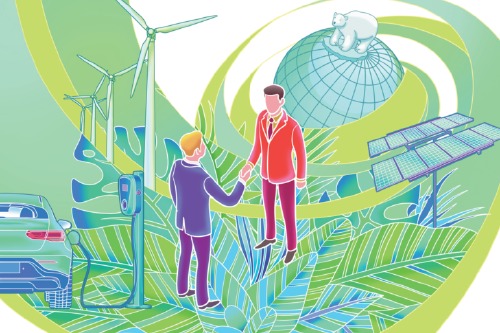
As the world's largest developing country, China has always seen supporting Africa's response to climate change as an important part of China-Africa cooperation. Under the framework of the Forum on China-Africa Cooperation, China has made green development a focal point of its 10 cooperation plans and eight major initiatives for cooperation with Africa. China was the first major economy to formulate a framework for climate cooperation with Africa through the release of the Declaration on China-Africa Cooperation on Combating Climate Change. Taking Africa's low overall carbon emissions as a starting point, China prioritized the energy transformation in Africa and the development of the continent's modern agriculture to enhance its capacity for climate risk and disaster management. China has implemented hundreds of clean energy generation and power grid projects in Africa, such as the De Aar Wind Farm in South Africa, the Garissa Solar Power Station in Kenya and the Nyabarongo II Hydropower Plant in Rwanda. In the field of agricultural modernization, China actively participates in the construction of the Common African Agro-Parks, coordinating aid to African agricultural demonstration centers, and assisting African countries in cultivating characteristic agricultural industries in a market-oriented manner. Key efforts include promoting the production and storage of staple food products such as hybrid rice, cassava, and soybeans, which has led to agricultural cooperation demonstration projects such as the Wanbao Agricultural Park in Mozambique and the hybrid rice planting demonstration program in Kihanga, Burundi. These efforts enhance Africa's agricultural resilience to natural disasters and contribute to food security for African populations.
In the context of the accelerated integration of the Belt and Road Initiative with the AU's Agenda 2063, China-Africa green cooperation will serve as a vivid interpretation of the Global Development Initiative, promoting joint efforts between China and Africa to address climate change and contribute to the construction of a high-quality China-Africa community with a shared future.
The author is deputy director of the Security Studies Division at the China-Africa Institute. The author contributed this article to China Watch, a think tank powered by China Daily.
The views do not necessarily reflect those of China Daily.
Contact the editor at editor@chinawatch.cn.