Govt report releases signs of high-quality development









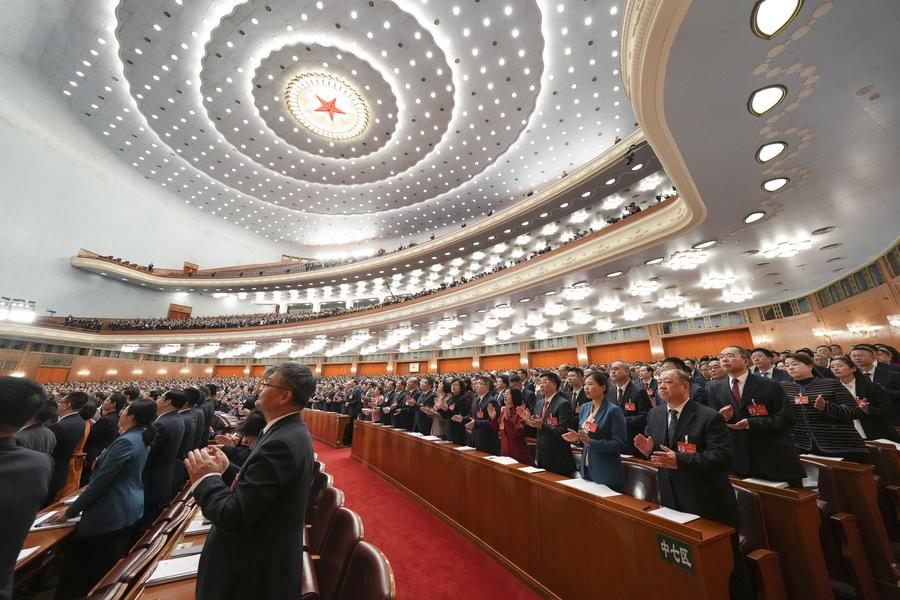
On Tuesday morning, Premier Li Qiang delivered the government work report, summarizing the government's work in 2023 and outlining the government's objectives for 2024. The report aligns with the principles of the Central Economic Work Conference held at the end of last year, emphasizing the prioritization of economic growth as a key government focus.
Many foreign observers claim they find it difficult to understand China's policy-making because the country's economic policy seems to have no clear goals.
In advanced economies, the government's ability to manage the economy is very much limited to monetary and fiscal policies whose goals are well defined — monetary policy mainly helps keep prices stable and employment rate high, while fiscal policy is mainly aimed at managing demand. But the Chinese government has more responsibilities than its Western counterparts, not least because it has to fulfill different goals and formulates its economic policy for a year or a five-year plan period accordingly.
China's economic development model is in transition. In the past, exports and domestic investments were the main economic growth drivers. But over the past decade, the government has been promoting high-quality development — development that does not prioritize high-speed growth and, instead, promotes domestic consumption- and innovation-driven development.
Of late, the government has also begun promoting a new means to boost productivity — new quality productive forces, which needs to increase total factor productivity. As such, the speed of capital accumulation retreats to a secondary importance.
Other changes have followed these developments. For example, the central authorities have become more alert to debt. They have learned lessons from the consequences of the stimulus package of 4 trillion yuan ($586 billion at the 2008 exchange rate), which was announced right after the global financial crisis broke out in 2008.
That stimulus did accelerate growth but it also increased local government debt. And the Chinese people, by nature, do not like debt. They prefer tightening their belts to borrowing from others in times of difficulty. The Chinese government shares the same philosophy.
The Chinese authorities have also learned lessons from the recent record inflation in Western economies. During the COVID-19 pandemic, Western governments handed out large amounts of cash to families and companies, as well as increased their expenditure. This led to rising inflation. And the Chinese people also dislike inflation, prompting the government to take measures to keep inflation low.
Controlling local governments' debt has thus become one of the key objectives of the central government in recent years. The central authorities are determined to not bail out local governments. Heavily indebted provinces are not allowed to borrow anew, because it would further increase their debt. In response to local budget shortfalls, local governments have been asked to "live a tight life".
The central government's policy on the real estate sector follows the same logic. Many China watchers tend to liken today's China to Japan of the 1990s, because like Japan in the 1990s, China's real estate sector has declined sharply since mid-2021. But such China watchers miss the point, for they fail to understand the causes of the real estate sector's decline. The decline is not a consequence of burst bubbles, but a result of the central government's deliberate move to control the disorderly expansion of the sector, because the top authorities are worried about rising debts — the real estate sector consumes a lot of resources and creates too much debt.
China's short-term economic performance depends on the importance the central authorities attach to different goals. Over the past several years, it has become clear that the central government does not attach the same importance to high-speed growth that it did in the past. The Central Economic Work Conference in December 2023 signaled a shift toward growth, though, for it called for government policy to "seek progress while maintaining stability" and "establish the new before abolishing the old".
"Stability" here means stabilizing growth, and "to establish the new" means laying a sound economic foundation for high-quality development.
Premier Li Qiang reiterated the government's commitment to this objective in the government work report, which sets this year's growth target at around 5 percent. While this doesn't appear to be an aggressive target, given that it is consistent with last year's, the planned fiscal and monetary policies are evidently more aggressive than those implemented last year. The central government deficit will increase by 180 billion yuan compared to the previous year's budget, and special-purpose bonds for local governments will increase by 100 billion yuan. Additionally, the government plans to issue ultra-long special treasury bonds to fund public investments.
The inflation target has been set at around 3 percent, and "aggregate financing and monetary supply will align with the projected economic growth and CPI increase." The relatively high inflation target is noteworthy given recent CPI performance, signaling the potential for more aggressive monetary policies in the year ahead. With these measures in place, this year's growth may indeed exceed 5 percent.
The author is Liberal Arts Chair Professor at Peking University.
If you have a specific expertise, or would like to share your thought about our stories, then send us your writings at opinion@chinadaily.com.cn, and comment@chinadaily.com.cn.