Multipolarization gaining traction across globe
Growing number of nations favoring approach to international relations that could create a fairer world









In the eyes of many foreign diplomats and policy analysts, working toward "an equal and orderly multipolar world" has become a catchphrase and a key goal emphasized by Chinese diplomats in speeches, readouts of meetings and signed articles in recent months.
Siddharth Chatterjee, the United Nations resident coordinator in China, has witnessed how China has prioritized global multipolarity and shored up multilateralism.
"China's leadership is crucial to resurrect the whole spirit of multilateralism," he said in a recent interview with China Daily.
He stressed that the world's efforts on multipolarity "have to meet at one place, and that is why the United Nations is there".
"The work that China is doing both at the headquarters in the UN and as a country is remarkable on all counts, and I am really happy that we can look at 2024 with real hope," he added.
While some researchers and officials in Europe and the United States are still debating the definition of multipolarity, Beijing and its partners have been seeking to make the concept better understood over the past few decades.
One of the many examples is a joint communique issued by China and Indonesia in December 1999. It says both sides agree that "multipolarization is a general trend in establishing a more just and balanced world order".
Boosting global multipolarity has also been mentioned by Beijing in official meetings with France, Russia and the European Union.
At the end of last year, the urge for "an equal and orderly multipolar world" — together with "a universally beneficial and inclusive economic globalization" — was made clear at the Central Conference on Work Relating to Foreign Affairs.
Held in Beijing from Dec 27-28 and chaired by President Xi Jinping, who is also general secretary of the Central Committee of the Communist Party of China, the conference is a high-level meeting held every five years to chart the course of foreign policy. It was attended by many key diplomats, including ambassadors based abroad.
"An equal, orderly multipolar world" means that "every country or grouping of countries find its own place" in the global multipolar system, Foreign Minister Wang Yi explained in an article published in Qiushi, a flagship magazine of the CPC Central Committee, in January.
Wang underlined the need to "put an end to the traditional narrative that always relates multipolarity to only a few major countries", adding that multipolarity should become a process of countries seeking "unity, dialogue and cooperation rather than division, confrontation and conflicts".
To better explain the concept to the rest of the world, Chinese ambassadors based overseas, including those who also serve as members of the 14th National Committee of the Chinese People's Political Consultative Conference, have published articles on the subject recently.
Zhang Hanhui, a member of the 14th National Committee of the CPPCC and China's ambassador to Russia, said that the world today is "no longer a world in which only a few major countries have the final say".
"Solidarity, dialogue, cooperation and a win-win approach are all that the international community has in mind and is looking forward to," he wrote in an op-ed published in a Russian newspaper earlier this year.
"As the world's largest developing country and a member of the Global South, China has always practiced its vision of global governance featuring extensive consultation and joint contribution for shared benefits," he said.
"China does not seek hegemony, expansion or spheres of influence, it opposes the monopolization of international affairs by only a few countries, and it advances world politics toward fairness, justice, equality and sustainability," he added.
Lasting pursuit for equality
China's desire for an equal, orderly multipolar world has been responded to by like-minded nations, including those in Africa.
During a state visit to China by Sierra Leone President Julius Maada Bio that ended this month, the two governments issued a joint statement.
The two sides agreed that "it is necessary to uphold the equality of all countries regardless of their size, large or small, oppose hegemony and power politics, work for an equal and orderly multipolar world and a universally beneficial and inclusive economic globalization".
When rolling out its diplomatic actions to advance the building of a multipolar world over the past decades, Beijing "has been consistent and faithful in seeking equality, mutual learning among cultures and rejecting hegemony", according to members of the CPPCC National Committee.
China's efforts in seeking exchanges and mutual understanding among cultures "carry forward and develop the fine traditions of Chinese diplomacy and the landmark Five Principles of Peaceful Coexistence it proposed", said Liu Xianzhong, a member of the 14th CPPCC National Committee and director of the Department of Russian History and Culture at the Institute of Russian, East European and Central Asian Studies of the Chinese Academy of Social Sciences.
He noted that when it comes to China-Russia relations, both Beijing and Moscow uphold the idea of friendship handed down by generations and win-win cooperation.
"The two countries stick to the principles of non-alignment, non-confrontation and non-targeting of third countries," he said.
When approaching relations with the United States, China upholds the three principles as put forward by Xi — peaceful coexistence, mutual respect and win-win cooperation.
"Mutual respect means respecting each other's social systems and development paths; core interests and major concerns; and each other's right to seek development," Liu said.
The Belt and Road Initiative, on which China has worked with numerous countries since 2013, "transcends differences in cultures, social systems and varying stages of development, and creates a new path for interaction among countries", he added.
When explaining why China supports seeking equality in a multipolar world, Wu Jianghao, a member of the 14th CPPCC National Committee and China's ambassador to Japan, pointed to a landmark document signed by Beijing and Tokyo more than 40 years ago rejecting hegemony.
In 1978, the leaders of China and Japan signed the China-Japan Treaty of Peace and Friendship, which Wu said "serves the fundamental interests of the two peoples".
"The treaty clearly underscores rejecting hegemony, and it solemnly states that China and Japan do not seek hegemony and they oppose attempts by any other country or grouping of countries to establish such hegemony," he said.
According to Wu, seeking equality in a multipolar world means "opposing the monopoly of only a few countries in international affairs, and effectively promoting the democratization of international relations".
"In response to a series of major issues and challenges in today's world, China and Japan should not forget the original aspiration of the treaty," he said.
The envoy highlighted the need for Japan to maintain strategic autonomy, and he urged both nations to "jointly stand by the purposes and principles of the UN Charter and adhere to the universally recognized basic norms of international relations, and practice genuine multilateralism".
Rejecting confrontation
While co-chairing the 25th China-France Strategic Dialogue in Paris with French President's Diplomatic Counselor Emmanuel Bonne last month, Foreign Minister Wang reiterated that Beijing "regards Europe as an important pole in the multipolarization process".
"China supports Europe in strengthening its strategic autonomy and holding its future in its own hands," the Foreign Ministry quoted Wang as saying in a statement.
In a video speech to a reception in January celebrating the 60th anniversary of the establishment of China-France diplomatic relations, Xi said the two sides should "jointly advocate an equal and orderly multipolar world and a universally beneficial and inclusive economic globalization".
Lu Shaye, a member of the 14th CPPCC National Committee and China's ambassador to France, said the two important proposals put forward by Xi "are of China's solution to a series of major challenges in today's world, and fit very well with the current world situation".
"The two proposals also rhyme with some of France's foreign policies," he noted.
As part of its efforts to promote a multipolar world, Beijing looks to strengthen cooperation with Paris in the international and multilateral arena and jointly promote the resolution of some international issues, including some hotspot ones, he said.
Speaking of the lingering Ukraine crisis, Lu said, "We have always been advocating peacemaking and promoting talks, and we are also against some countries' adding fuel to this crisis.
"China believes that the conflicts and wars in today's world are not conducive to the progress and prosperity of humanity," he said. "The end point of any war is the negotiation table, and it is better to talk sooner rather than later."
He noted that when it comes to the Russia-Ukraine conflict, China's viewpoints and positions are not always on the same page with parties such as Europe and France, but "it doesn't matter".
"We can seek common ground and put our differences aside. If everyone's common goal is peace, let's work in that direction," he said.
Speaking on the EU, Lu said that China has always regarded it as a comprehensive strategic partner.
However, the EU's three-sided definition of China — a partner for cooperation, an economic competitor and a systemic rival — "is actually ambivalent", he warned.
"The Chinese culture believes that, 'Since I treat you as a friend or as a partner, I will not do anything unfavorable to you, and I will not take you as a rival and stab you in the back'," the envoy said.
"Despite the differences between Chinese and Western cultures, the Chinese side is willing to continue to cooperate with the EU side," he added.
A fairer world
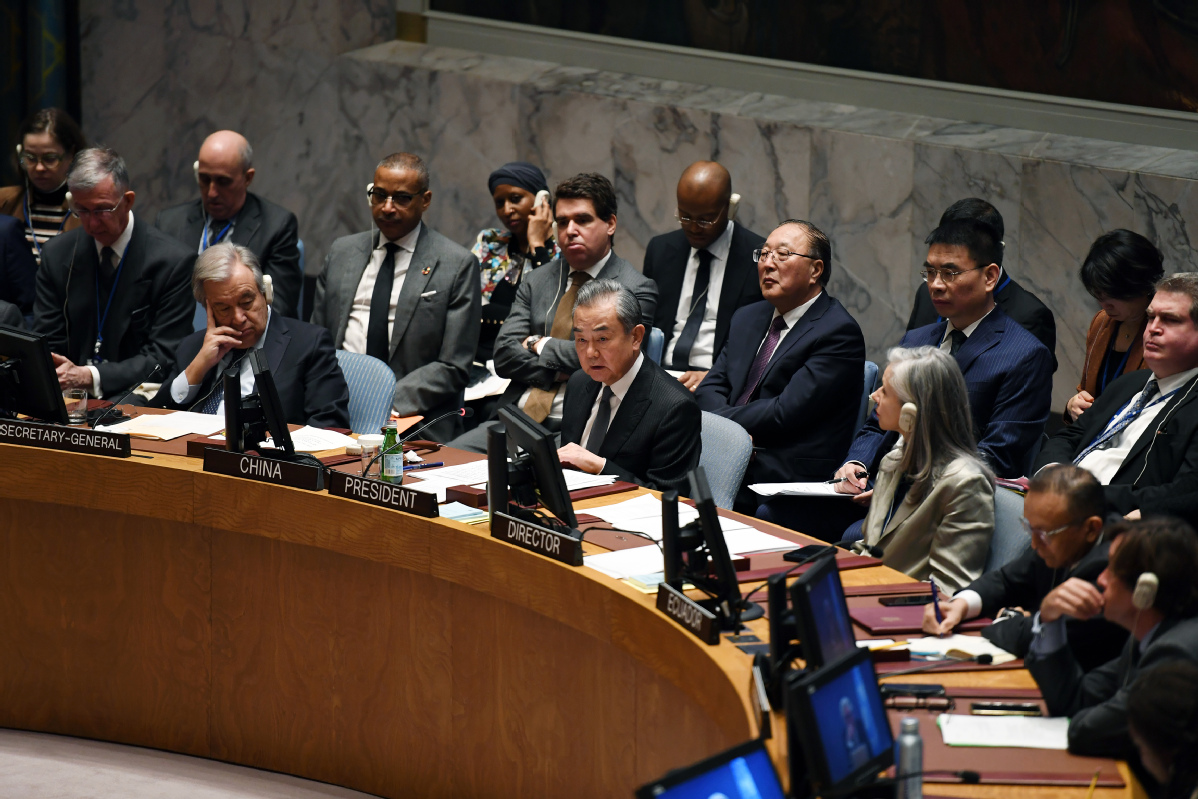
Recently at the UN headquarters in New York, the world has seen how hard China's representatives have worked with colleagues from many member states to seek a resolution at the UN Security Council for a ceasefire in Gaza.
Zhang Jun, a member of the 14th CPPCC National Committee and China's permanent representative to the UN, told China Daily that as the country advocates an equal and orderly multipolar world, it "firmly upholds and practices genuine multilateralism, and contributes solutions and takes actions to address global challenges".
"China shares the same future through thick and thin with other developing countries, and it safeguards the common interests of developing countries and the Global South," he said.
When asked about how China firmly safeguards international fairness and justice, he referred to the ongoing Palestine-Israel conflict.
Since its outbreak, Beijing has "made unremitting efforts to facilitate a cease-fire and an end to the war, and has always stood on the side of justice and human conscience", he said.
Liao Liqiang, a member of the 14th CPPCC National Committee and China's ambassador to Egypt, noted that China has earnestly implemented the Global Security Initiative, actively urging peace and promoting talks, and "constructively participating in resolving global and regional hotspot issues such as the Palestine-Israel conflict".
He noted in an article published in January that President Xi has on many occasions articulated China's principled position on the current Israeli-Palestinian situation, and that Beijing has released a position paper on the resolution of the conflict.
"China will put forward more Chinese proposals for solving the world's hotspot and difficult issues," Liao said.
UN Secretary-General Antonio Guterres has praised the country as "a pillar of the multilateral system" on multiple occasions in recent years.
"China is playing an increasingly important role in leading the way forward, upholding justice and promoting cooperation in UN affairs, and the world is witnessing an increasingly different China," said Zhang, China's top envoy to the UN.
He stressed that no matter how the international situation changes, China will "always fulfill its duties and assume its purpose as a major country".
"China will work with other countries to promote the development and improvement of the global governance system and move forward toward the goal of building a community with a shared future for mankind," he added.
"May the world come out of the mist of turbulence and uncertainty at an early date, and humanity usher in a harmonious and bright future," he said.