6-year-old Laotian girl treated in Guangxi









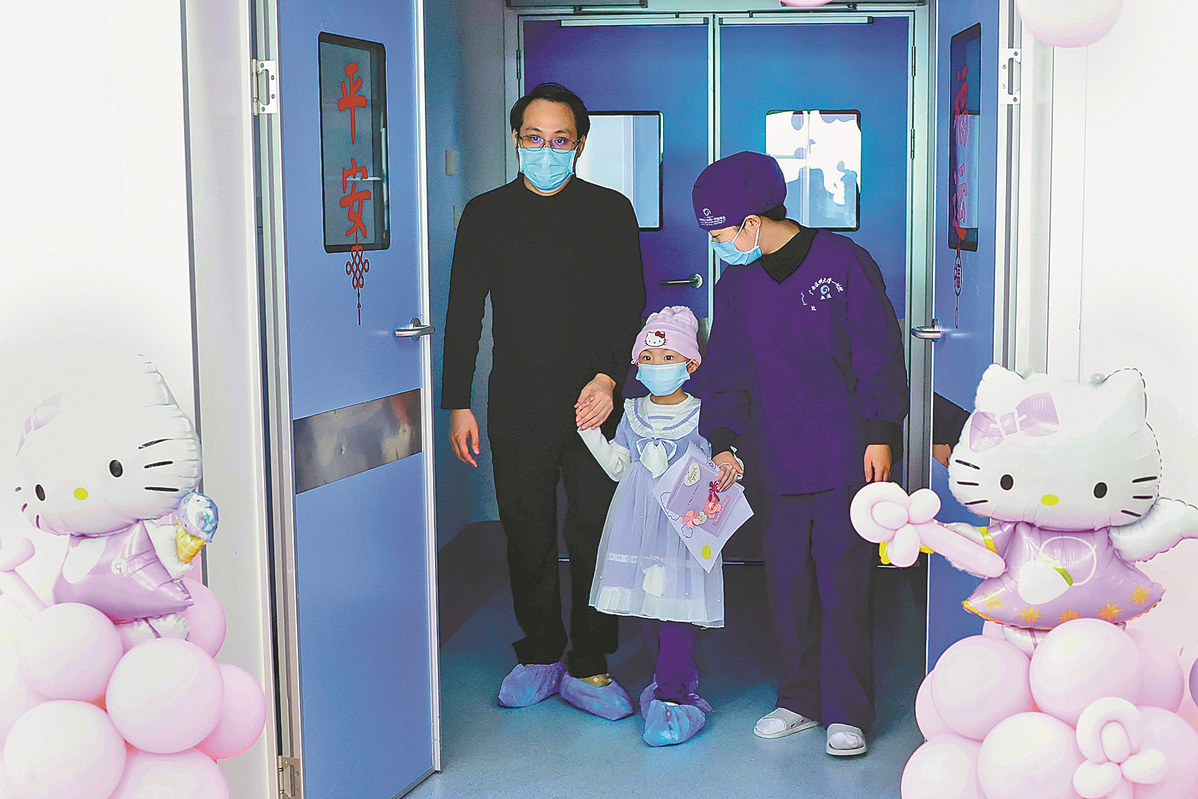
With all checkup indicators found to be normal, Nina was discharged from the hospital in Nanning, capital of Southwest China's Guangxi Zhuang autonomous region, on March 7.
Around three months ago, the 6-year-old Laotian girl successfully underwent a hematopoietic stem cell transplantation at the First Affiliated Hospital of Guangxi Medical University in Nanning.
Nina, who only gave her first name, was born in Laos in 2018 and was diagnosed with severe beta-thalassemia.
Thalassemia is an inherited blood disorder that causes the body to have less hemoglobin than normal.
The disease is common in countries along the Mediterranean coast, as well as in India, Southeast Asia and regions of China such as Guangdong, Hainan and Sichuan provinces.
"Patients with severe thalassemia need monthly blood transfusions to sustain their lives. After repeated transfusions, iron deposits in multiple organs, commonly known as 'iron overload', actually represent a form of 'chronic iron poisoning', which can cause serious damage to organ function and even lead to heart failure, endangering life," said Liu Rongrong, chief physician of the hospital's hematology department.
Over the years, Nina has been undergoing regular blood transfusions and iron chelation therapy.
"Allogeneic hematopoietic stem cell transplantation is currently the only method to cure severe thalassemia," Liu said.
Since the 1990s, the hospital's hematology department has been conducting hematopoietic stem cell transplants for various blood system diseases. In 2012, it pioneered non-relative hematopoietic stem cell transplantation for thalassemia in the region, and in 2016, it managed to complete the first haploidentical hematopoietic stem cell transplantation for severe thalassemia.
In May 2023, Nina's family contacted Liu to inquire about hematopoietic stem cell transplantation. Later, Nina and her father were found to be a match for the haplotype allogeneic hematopoietic stem cell transplantation.
On Nov 17, after comprehensive examinations and other pre-transplant preparations, Nina and her father were admitted to the Hematology Stem Cell Transplantation Ward of the hospital.
During this period, Nina experienced gastrointestinal reactions, recurrent high fever, rash and perianal inflammation. But with careful treatment and nursing by the medical staff, she successfully overcame these challenges, and the complications gradually came under control, with all indicators stabilizing.
Nina's hematopoietic stem cell transplantation was the first time such a procedure was performed for a foreign patient with thalassemia in Guangxi.
"The success of Nina's treatment marks a milestone for us as a family. She will grow up like a normal child and is poised to achieve her full potential," said Nina's father.
Zhang Jie, director of the International Medical Department at the hospital, said that in the next phase of the transplant recovery process, the hospital will organize meticulous follow-ups and home management interventions to help Nina grow up healthily.
"Guangxi and the ASEAN countries have similar disease profiles, and medical cooperation has unique geographical advantages," said Chen Junqiang, president of the First Affiliated Hospital of Guangxi Medical University.
According to Chen, the hospital launched the China-ASEAN Cross-border Medical Cooperation Platform in 2020. As an open platform for ASEAN patients, it can provide "one-stop" cross-border medical services, including patient appointments, international remote consultations, cross-border medical transfers and international payment settlements. It also supports the languages of the 10 ASEAN countries.