



To clear the road ahead
Negotiation between the EU and China to agree on EV cooperation and competition should be possible









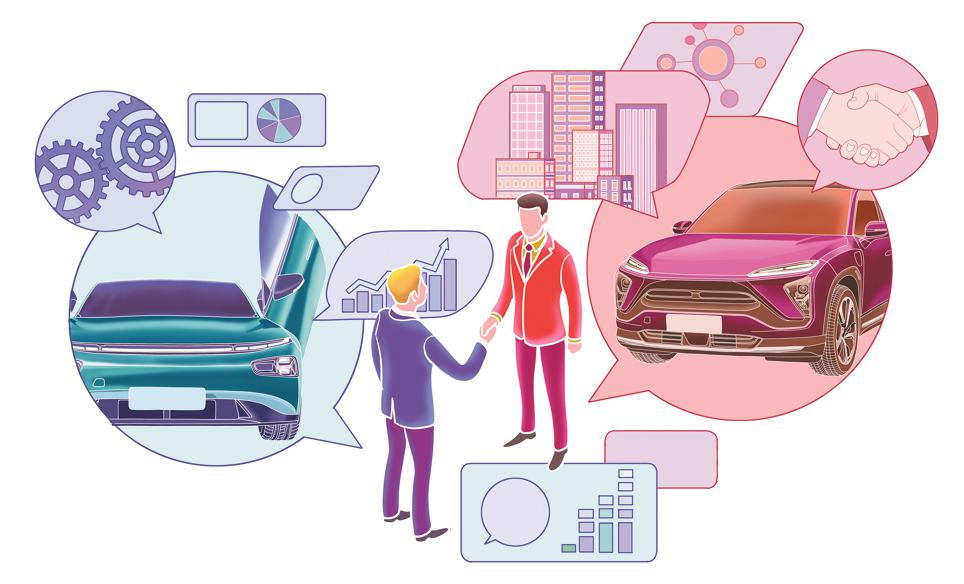
During the past weeks, giant ships carrying thousands of Chinese electric vehicles (EVs) landing in Europe have created angst among the top European Union policymakers and automobile manufacturers. BYD in particular has been making inroads in the European market by offering competitive and stylish models. With the rising "alarm", the European Commission Directorate-General for Competition is preparing to launch an investigation into Chinese EVs as part of a probe into state subsidies prohibited by the World Trade Organization. If proved, punitive tariffs will be imposed to protect European EV makers.
But maybe there is a way to manage conflict. After all, as the world decarbonizes, demand for EVs will rise further, and Chinese cars could contribute to speeding up the energy transition.
Authorities in Beijing, including China's ambassador to the EU Fu Cong, have called the EU's probe "unfair" while other Chinese officials and industry watchers say it is "pure protectionism". Regardless, the probe is underway, with scheduled verification visits. Such probes are not unusual. In the not-so-distant past, similar inquires have been applied to key goods, including solar panels and textiles from China. The EU itself, among other powers, also provides subsidies to semiconductor manufacturers to keep the West ahead of China in the race for cutting-edge technology.
But one can foresee that if punitive measures are taken, China will take countermeasures. Tit-for-tat measures might follow that could escalate into economic confrontation and a subsequent protracted trade war. It would become the second after the US-China trade war, triggering further de-risking or decoupling, sending the wrong signal to each other's consumers and to the rest of the world. That would be a gross mistake at a time of increasing international uncertainties.
In principle, there are viable approaches to resolve the issue. One is the contingency formula ensuring there is enough steam to enable successful European competition for some time. The "Renault formula" for example proposes designing cheaper models as consumers in Europe seem keen on well-designed and functional EVs without unnecessary frills, and cutting logistic costs, as the French company sees itself able to keep about 80 percent of its supply chain within 300 kilometers of its production sites. Announcing talks to collaborate with another traditional giant such as Volkswagen on a low-cost EV project would enable competition with EVs from China, it has been reported.
But a significant number of the EU carmakers claim that due to Chinese EV makers' exceptional competitive edge, such a strategy might not be enough. The European Automobile Manufacturers' Association (ACEA), representing the 15 major Europe-based automobile manufacturers, argues that they are insufficiently backed by European governments, whose decarbonization strategy has obliged them to produce the battery vehicles at which their Chinese competitors excel.
It might seem unavoidable for the EU Commission to collide with the Chinese authorities sometime this or next year. But there are some more considerations for maneuvering. The possibility of Donald Trump winning the US presidential election and what that might entail needs to be considered in the equation. It would likely bring disruptive geopolitical unpredictability in free trade and globalization.
Now that the 1990s and early 2000s hyper-globalization period is moving into a post-hyper-globalization era, the need to adjust global rules is apparent. Reforming the World Trade Organization might take a long time as there are many different interests. During the WTO 13th Ministerial Conference (MC13) in Abu Dhabi, on March 2, there was no agreement to launch deliberations on key challenges (including industrial subsidies and the environment).
One feasible solution is the Comprehensive Agreement on Investment (CAI) that was concluded in principle on Dec 30,2020. Following almost seven years of negotiations, it was saluted as evidence of Europe's strategic autonomy providing the formula for an equilibrated level playing field so often advocated in recent years. Furthermore, it was proclaimed that it was better to have a joint agreement with China and not 27 bilateral investment agreements to avoid the possibility of "divide and rule".But in March 2021, just three months later, EU parliamentary approval for the Agreement was derailed by issues unrelated to trade and investment.
One of the most reasonable ways to move ahead would be to intensify dialogue, particularly at the high and middle levels to address economic, trade and green issues, with a sense of urgency.
Seen from Spain, what could Madrid and Beijing do to inject vitality and confidence into EU-China relations? Having celebrated 50 years of diplomatic relations last year and being set to commemorate 20 years of their Comprehensive Strategic Partnership Agreement in 2025, the two sides have various fields for cooperation. One case in point to highlight is the Strategic Projects for Economic Recovery and Transformation (PERTE). PERTE's most recent and vanguardist project is the one approved in late February by Madrid to world leading green-tech company Envision Group from Shanghai, one of the beneficiaries of the Electric Vehicle PERTE initiative with 300 million euros ($328.2 million) in aid, of which 200 million corresponds to subsidies and the remaining 100 million euros is loans. Envision Group has announced it has begun constructing a battery gigafactory in Caceres, Southern Spain, in the first half of the year. Spanish Prime Minister Pedro Sanchez has saluted the project and his confidence in the investment attractiveness of Spain in the green transition. The Spanish formula deserves study across Europe.
Meanwhile, the more we wait for the EU to properly define what "de-risking" is, the more the risks will lead us to descend into decoupling. One of the various interpretations in Europe is that "de-risking" is indeed a narrative that leads to decoupling rather than to a clear path of managing risks, and in this sense, it is potentially a self-fulfilling prophecy.
The lack of a clear definition translates into investing uncertainties. Let's be clear, Chinese competitive companies, like any competitive enterprises, are always ready to cooperate. Another thing is when top-level action is taken by the EU, without a proper perspective, it sweeps away, like an avalanche, a good part of industries and investments rendering impossible to appreciate the consequences ahead.
Now it is up to Brussels, plus the EU member states' capitals, and Beijing to keep the multidimensional bilateral picture at stake at balance and proceed accordingly. The message should be that there is enough space to compete under heaven.
The author is director of the Dialogue with China Project and former global expert in the United Nations Alliance of Civilizations. The author contributed this article to China Watch, a think tank powered by China Daily. The views do not necessarily reflect those of China Daily.
Contact the editor at editor@chinawatch.cn.





