Fish farms turn murky waters clear in Liaoning
Province winning battle against algal blooms in its lakes and reservoirs with solution that also generates commercial revenue









Urbanization
March 22 marks the 32nd World Water Day, and the week starting March 22 is China's 37th China Water Week.
Established by the United Nations, World Water Day aims to raise awareness about the global water crisis and the need for access to clean water for all. Each year, the day focuses on a specific aspect of fresh water, such as water scarcity, water pollution or water conservation, in order to promote action and international cooperation to address water-related challenges.
Liaoning's approach is a departure from conventional methods used to handle algal outbreaks such as through costly mechanical removals, or using chemicals including algicides or herbicides.
Algal blooms surged in China as it rapidly industrialized, according to the Ministry of Ecology and Environment.
The expansion of populous urban areas around lakes and reservoirs has in some cases led to sewage discharged untreated, causing eutrophication. Nitrogen, phosphorus and other pollutants from fish farming have also contributed to the process.
A major instance was an algal outbreak in 2007 in Jiangsu province's Taihu Lake, the third largest freshwater lake in China that supplies drinking water to hundreds of thousands of households in the city of Wuxi. The water quality deteriorated so much that it began to smell and could not be used. Bottled water was quickly snapped up in the city despite price gouging.
Liaoning's practice has come on the back of China stepping up its national food security efforts by diversifying its food sources. In 2017, the central authorities urged at the annual rural work conference that officials establish a "macro food perspective" and seek food supplies from outside conventional areas of agriculture. Grassland, forests, the ocean and even microorganisms, are listed as potential food sources to meet the country's growing need for nutritious sustainment.
The push to develop a "macro food perspective" and diversify the country's food sources was reiterated at the most recent central rural work conference held in December.
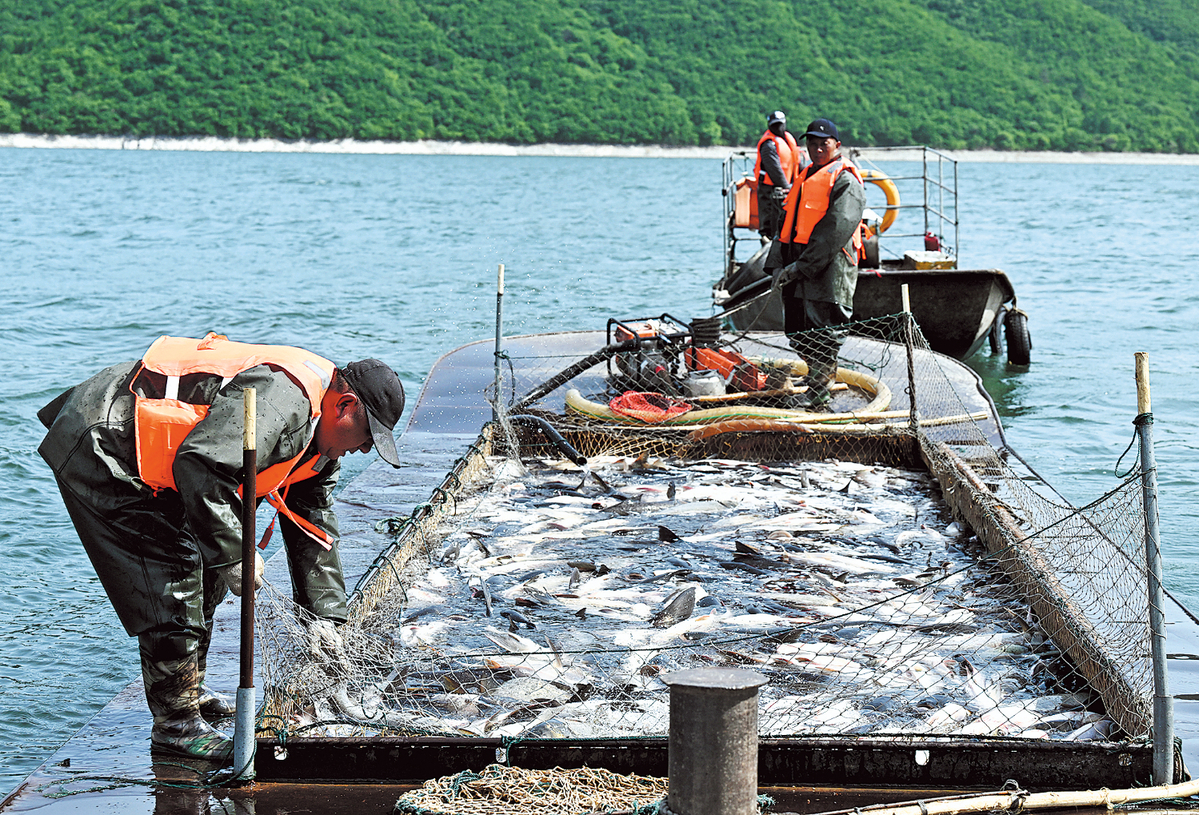
The group said raising fish in its reservoirs is in line with the central government's directive, and is a newly gained duty in the new era. However, it stressed that environmental protection is the absolute priority, and it will attempt to foster a fish farming business that will not strain the environment or interfere with its main tasks. The group noted it had selected species that live in zones of different depths so that waterborne pollutants are fully utilized and not a single area could become overcrowded.
As the financial outlook of reservoir fish farming brightens, the group has run into new problems such as a rise in illegal fishing due to insufficient monitoring. Some vendors have even passed off inferior quality products as reservoir catches, hurting the reputation of the genuine article.
To make the fish business sustainable, the group has worked with police to combat the illegal fishing. It has also worked with research bodies to introduce new species with higher added value, which makes counterfeits easier to spot while boosting revenue. The group said it is aiming to go beyond 4,000 tons of fish caught a year and increase the annual revenue to no less than 60 million yuan.
"With living standards increasing, consumers now prefer organic fish raised in open waters," the group said.
"Our fish business has a bright future ahead."






- 10 dead and 84 injured in explosion at steel plant
- China unveils flexible urban planning rules to improve lives, foster new industries
- Ex–China Construction Bank executive gets 18 years for bribery, loan violations
- First batch of eco-friendly pioneer zones for construction of beautiful countryside unveiled
- Woodpeckers, finches captured in Jilin winter scenes
- Mainland reiterates 1992 Consensus as foundation for resuming cross-Strait dialogue