



When will US consumers be free to choose EVs?









Milton Friedman, the leader of the Chicago school of economics, made a famous speech about a pencil in a 10-hour PBS broadcast series called "Free to Choose" in 1980. The Economics Nobel Prize winner held up a pencil and explained how even a simple object like a pencil takes people's efforts and resources from across the world to make. When Friedman delivered the speech, trade accounted for only about 37 percent of the total global GDP.
Today, trade accounts for 63 percent of the global GDP. But the increase in trade's share of global GDP has also increased trade frictions and sanctions.
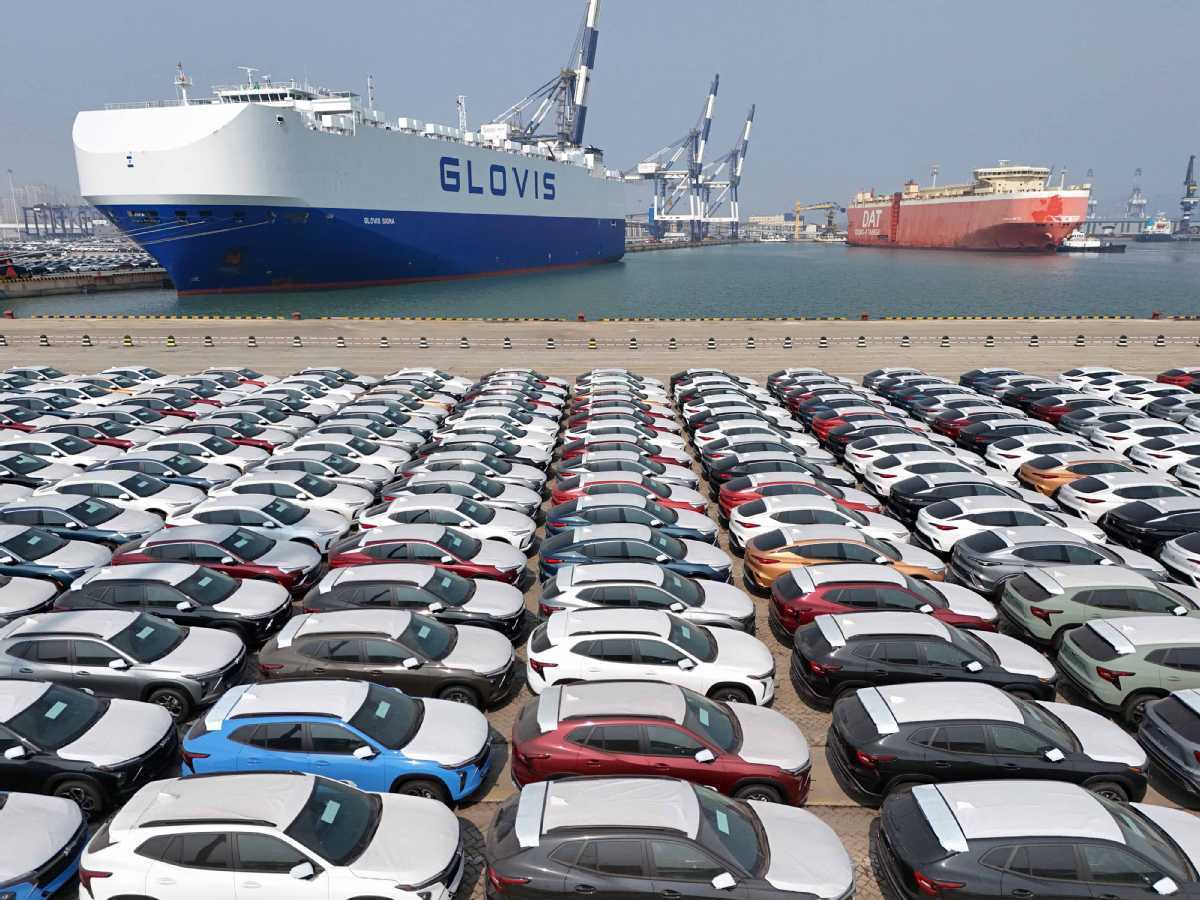
The US Department of Commerce has started an investigation to determine whether Chinese-made technologies, apps and tools posed a threat to US national security. But the so-called data security risks the US administration seems worried about can be addressed by implementing effective policies and regulations on cross-border data flow. But instead of finding a real and sensible solution to the problem, some US officials and congressmen are eager to block the import of Chinese-made EVs. The real reason behind all this is of course economic.
A recent Alliance for American Manufacturing report describes the EV competition as "China's existential threat to America's auto industry". Its argument, like all previous arguments in favor of blocking foreign goods from entering the domestic market, is all about domestic workers' job security and how imports would hurt the domestic industry. If that argument were true, we would have seen millions of US citizens losing their jobs and the US economy stagnating over the past 30 years when US imports from China increased by 3,800 percent. But that is obviously not the case.
According to economic theories and empirical evidence, voluntary trade can benefit both the importer and exporter. Adam Smith, the father of modern economics, supported free trade and criticized protectionism. Forty years after the publication of Smith's The Wealth of Nations, David Ricardo laid down the foundation of neo-classical theory by putting forth the law of comparative advantage in his book On the Principles of Political Economy and Taxation, which says that even a country which is good at making everything (in absolute terms) can benefit from free trade, and countries will specialize in their respective areas with comparative advantage.
Moreover, recent research shows the Chinese economy's integration with the world economy boosted the US' service trade. The US trade deficit gradually turns into surplus as Chinese cities exposed to trade liberalization send more and more students to study in US universities. This is a perfect example of comparative advantage, and explains why service trade with foreign countries will not kill jobs as some politicians claim. Instead, trade will create new demands and jobs.
If the US' moves targeting China and Chinese companies are not an economic issue, they have to be a political issue. With the presidential election less than nine months away, swing states such as Michigan and Ohio with their auto industries and Ford and General Motors factories happen to be some of the main political factors for candidates to consider.
It is fair to say that by restricting the movement of data across borders, the US will not only pose a serious threat to the global digital economy but also undermine its own ability to maximize the economic and social benefits of data-reliant technologies such as artificial intelligence. Worse, escalating trade tensions and decoupling from China will indeed hurt China, but they will deal a bigger blow to the US economy.
According to a report, titled "The Impact of China PNTR(Permanent Normalized Trade Relations) Repeal and Increased Tariffs on the US Economy and American Jobs", issued by the US-China Business Council and Oxford Economics in November 2023, the US economy suffered an estimated loss of $121 billion in output (0.5 percent of GDP) and 245,000 jobs due to the 2018-19 trade war. The report also said that an increase in US tariffs "would likely" cause up to 300,000 net job losses by 2028, by which time US households could suffer a loss of $11,100 a year in real income. Against such a gloomy background, it is unfortunate that 44 years after Friedman's speech on pencil, American consumers are still not "free to choose".
Wang Yaojing is an assistant professor at the School of Economics, Peking University; and Xiao Qian is deputy director of the Center for International Security and Strategy, Tsinghua University.
The views don't necessarily reflect those of China Daily.
If you have a specific expertise, or would like to share your thought about our stories, then send us your writings at opinion@chinadaily.com.cn, and comment@chinadaily.com.cn.





