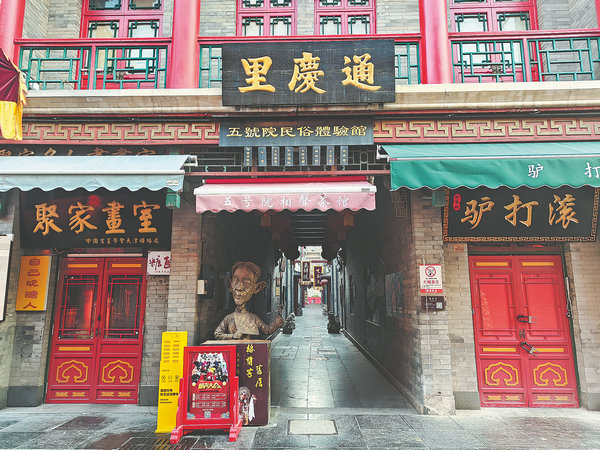
Ever since New Year's Day, 1986, when the Tianjin Ancient Cultural Street first opened to the public under its new name, the block has been a site of festivity and entertainment for Tianjin residents and tourists alike.
Its history, however, predates the formal establishment of Tianjin as a city, and its cultural and historical significance endures to this day.
Across Chinese cities, Tianjin is the only one with a record of its exact founding date. On Dec 23, 1404, Emperor Chengzu of the Ming Dynasty (1368-1644) officially established the city, giving it a name meaning "the emperor's ferry dock", because of the region's role as a key waterway interchange.
"Tianjin is a major city that has flourished under the dual influence of the Beijing-Hangzhou Grand Canal and the Haihe River, featuring both river and maritime transportation," says Zhu Yang, dean of the cultural heritage college at the Tianjin University Research Institute of Architectural Design and Urban Planning.
"The Tianjin Ancient Cultural Street, located in Nankai district, lies between the old Tianjin city and the Haihe River. Where two branches of the Grand Canal converge with the river, this is the cradle of Tianjin."
According to Zhu, the block first took form around the Jin (1115-1234) and Yuan (1271-1368) dynasties, as evidenced by the Tianhou Temple, the core structure of the block that was built during the latter period.
In ancient times, the city mainly served in an administrative and military capacity, and the vibrant commercial areas were located outside the city walls, especially near the confluences of waterways around the city. By the Ming and Qing (1644-1911) dynasties, the cultural street area has become a major hub for merchants.
When the project of establishing the Tianjin Ancient Cultural Street first commenced in 1985, the focus was to protect the local historical sites and renovate contemporary buildings to reflect the antique elegance and tradition of Tianjin's architectural styles.
"A history of over 600 years has shaped Tianjin's distinctive architectural style, which seamlessly blends influences of the past and present, the East and the West, unique folk customs at festive occasions, as well as a rich cultural heritage evident in everyday life, from cuisine and clothing, to objects for household use," says Zhang Hongpeng, director of the block's management committee.
"The Haihe River has witnessed centuries of water transportation, and the Tianjin Ancient Cultural Street serves as a hub for Tianjin's time-honored brands, handicrafts, specialties and folk culture, making it a cultural emblem of the city."
Included in 2007 as one of the first-batch 5A tourist attractions in China, the highest rating of its kind, the site now boasts 200,000 square meters of diverse commercial and cultural venues.
The historical buildings in the area include the Tianhou Temple, the Yuhuang Temple, a Taoist temple built in the Ming Dynasty, and Tongqingli, a residential complex built in 1913 that combines Chinese and Western architectural styles.
Several museums have been established that use these venues to showcase traditional culture, including a folk customs museum established at the Tianhou Temple, a museum of embroidery art, and a museum of Chinese shoe culture.
One of the directors in the block's recent upgrade project, Zhu says that each iteration of its planning has prioritized the preservation of historical buildings and the block's original layout, with an emphasis on utilizing these buildings to accommodate tourism, cultural, commercial and folk activities.
"Throughout its planning and construction phases, the cultural street has consistently focused on serving both local residents and tourists. Culture is its defining feature, and folk activities and products beloved by the public are its highlights," Zhu says.
On Feb 1, President Xi Jinping visited the Tianjin Ancient Cultural Street, inspecting the goods for the Spring Festival holiday season, as well as the protection and utilization of the historical and cultural block.
In response to Xi's call for the preservation and utilization of such blocks, Zhang says that the management committee aims to establish the block as a platform to showcase and promote traditional Chinese culture.
"We will preserve the ancient buildings, promote traditional culture, as well as provide comprehensive and enhanced services to bring a better experience to visitors," Zhang says.
"More activities will be organized to present traditional culture, folk customs and the essence of Tianjin, in order to enrich people's lives. We will attract more intangible cultural heritage elements and time-honored brands to open up branches here, so that more young people can see with their own eyes how traditions are being passed down."
Zhu explained that, to enhance the experience for both visitors and residents, environmental upgrades will be adopted throughout the block, including optimizing the quality of public spaces, such as squares and pavements, introducing greenery and improving the street signs.
Infrastructure and emergency prevention facilities will be enhanced to ensure the safety of the area, and modern technological methods are also going to be implemented to expand its reach and visibility.
"Tianjin Ancient Cultural Street has effectively combined heritage preservation with cultural experiences, standing out as an excellent example of the integrated development of culture, commerce and tourism," Zhu adds.
"A block of historical and cultural interest should embody an authentic history, a well-preserved outlook and a bond with contemporary life, and also guarantee a high-quality experience for residents, shop proprietors and tourists."
CHENG YUEZHU and YANG CHENG in Tianjin