



Universities' shift to Xiong'an serves dual purpose









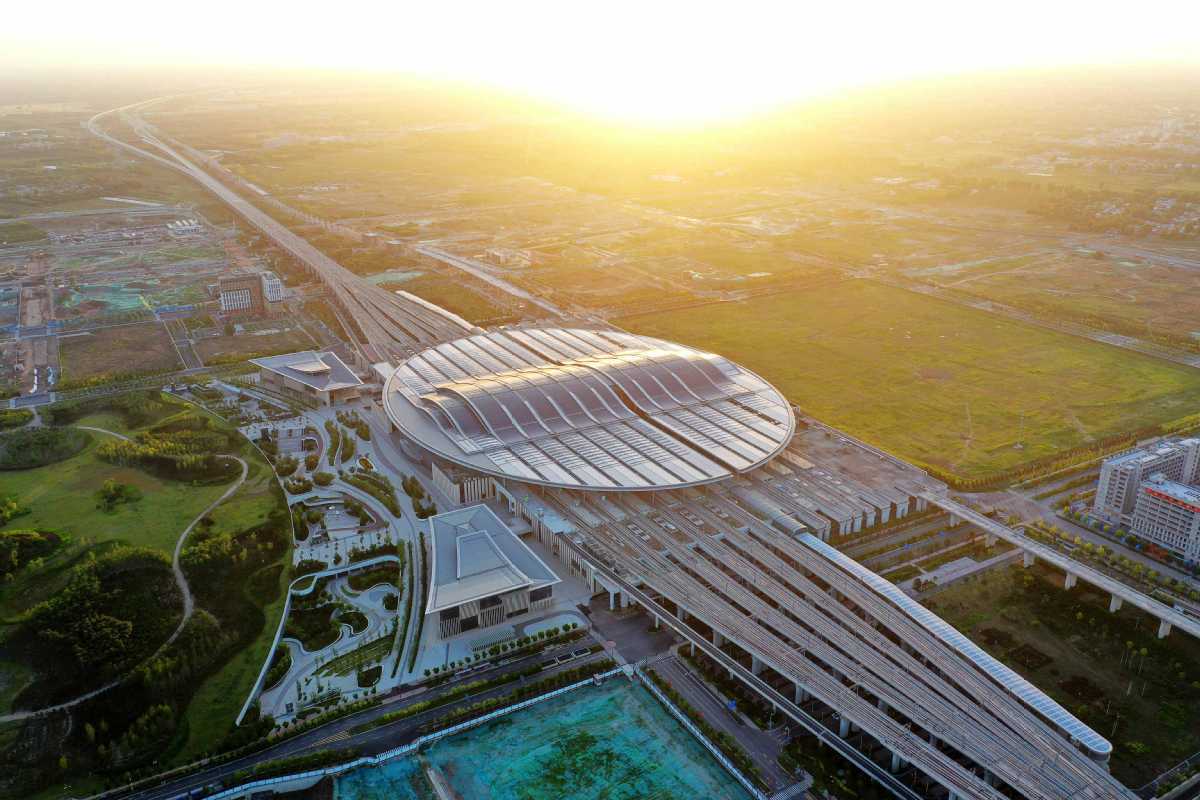
In February, the 10th anniversary conference for the coordinated development of the Beijing-Tianjin-Hebei region announced that four universities-Beijing Jiaotong University, Beijing University of Science and Technology, Beijing Forestry University and China University of Geosciences (Beijing)-have started work on their campuses in Xiong'an New Area. As per the Ministry of Education's plan, 15 Beijing universities are expected to build campuses in Xiong'an.
The announcement sparked a debate, with many in academia saying the relocation of the 15 universities' campuses is a strategic move to ease the population pressure on Beijing and balance the uneven distribution of educational resources in the Beijing-Tianjin-Hebei region. But some media outlets argue that the plan is not to relocate the universities per se to Xiong'an but to set up their new or additional campuses there, raising doubts whether the plan will ease the population pressure on Beijing and address the problem of uneven distribution of educational resources.
To fully comprehend the issue, we have to understand why the top leader announced the establishment of Xiong'an in 2017. Xiong'an is a crucial component of China's policy for coordinated development of the Beijing-Tianjin-Hebei region, and serves a dual purpose: relieving Beijing of non-capital functions and curing the ills associated with large cities while nurturing a regional growth pole to promote high-quality development.
The first part of the goal, officials say, can be achieved by shifting Beijing's higher education institutions, corporate headquarters, financial institutions, research institutes, medical institutions, public agencies, and among others, to Xiong'an. To realize the second part of the goal, an innovative ecosystem has to be built in Xiong'an so it can accommodate these institutions and foster an environment conducive to innovation.
In fact, with many developed countries trying to regain their competitive edge, which they have been losing since the beginning of economic globalization in the 1990s, building an innovation-oriented ecosystem has become a big challenge for governments across the world.
Therefore, relocating the universities to Xiong'an will not only alleviate the population pressure on Beijing but also, and more importantly, allow the new city to leverage the universities' key role of connectors in building an innovation-oriented ecosystem and promoting high-quality development.
First, the concentration of higher education institutions in the capital makes their relocation to Xiong'an a scientific decision. Beijing is home to more than 90 universities, including 34 universities included in the "double world-class project" that account for nearly a quarter of the national total. These universities are concentrated in Haidian, Chaoyang and Changping districts of Beijing, with the three districts collectively accounting for 60 percent of the universities in the capital and hosting most of the universities directly affiliated with the Ministry of Education. As such, the establishment of branch campuses of the 15 universities in Xiong'an will certainly reduce the population pressure on the central urban areas of Beijing.
Second, the establishment of universities branch campuses in Xiong'an will help build an innovation-oriented ecosystem there. Successful innovation-oriented ecosystems require a connector, usually a cluster of universities or research institutes, large enterprises, local governments and/or other institutions. Studies show such ecosystems, thanks to the information technology revolution, have helped transform the United States' "rust belts" into "smart belts".
The European Union's "European University Initiative", too, is aimed at establishing "industry-university-research-innovation" alliances centered on universities.
Furthermore, the initial focus of Xiong'an's absorption was on central enterprises' headquarters, because 69 of the top 98 central enterprises' headquarters are located in the capital. But the Ministry of Education's policy of "one university, two campuses, coordinated development" promotes the building of new campuses of universities in Xiong'an to align with the industrial and technological development needs of the new city as well as the rest of the country, leveraging the universities' role as connectors to create new types of research and development institutions and facilitate the formation and development of an innovation-oriented ecosystem.
And third, the construction of new types of R&D institutions will have a demonstrative effect on the development of Xiong'an. Such institutions can overcome the horizontal barriers between universities, research institutions, local governments, enterprises, clients and service institutions. Many Chinese provinces have accumulated a wealth of experience in the construction of new types of university R&D institutions. The Research Institute of Tsinghua, Pearl River Delta, jointly established by the Guangdong provincial government and Tsinghua University, is a case in point.
The four universities that have started building campuses in Xiong'an have formed the Xiong'an University Collaborative Innovation Alliance. With the increase in the number of universities shifting operations to Xiong'an, the innovation alliance will expand, giving birth to physical R&D institutions. As an innovation-promoting consortium, it will inspire researchers and potential innovators to share resources, obtain mutual benefit, and promote common development.
The establishment of new types of university R&D institutions will not only prompt more central enterprises to relocate their headquarters to Xiong'an but also encourage market-oriented relocation of non-capital functions to the new city.
The views don't necessarily reflect those of China Daily.
The author is a professor at the Japan Institute of Hebei University.
If you have a specific expertise, or would like to share your thought about our stories, then send us your writings at opinion@chinadaily.com.cn, and comment@chinadaily.com.cn.





