



China, Sri Lanka forging stronger bonds









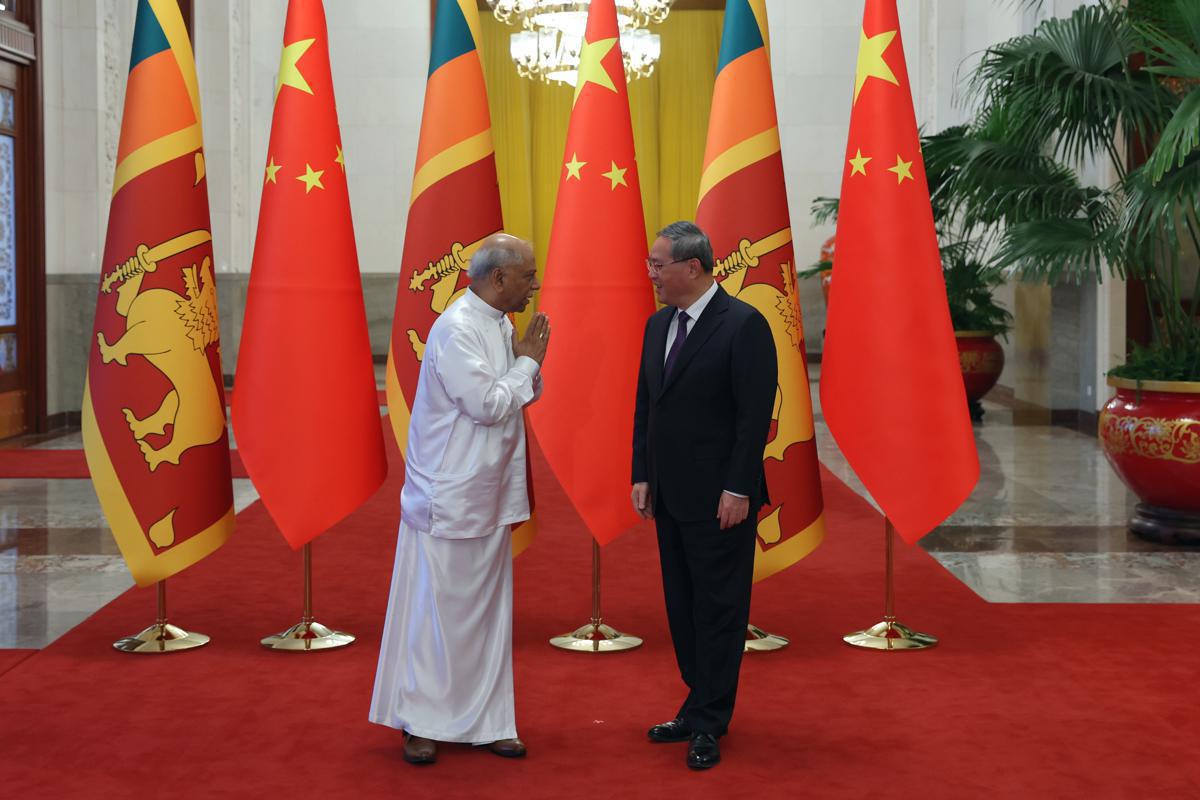
In ancient times, Sri Lanka was the center of trade in the Indian Ocean and is now an important partner for China in South Asia. More recently, Sri Lanka's Prime Minister Dinesh Gunawardena, paid a six-day visit to China, from March 25-30.
In October 2023, Sri Lanka's President, Ranil Wickremesinghe, attended the third Belt and Road Forum for International Cooperation in China. President Xi Jinping had an in-depth exchange of views with him and arrived at an important consensus on developing China-Sri Lanka relations.
Gunawardena's visit continues the trajectory of this consensus of friendly and supportive bilateral relations. He met President Xi and Premier Li Qiang and other top Chinese officials, besides attending the Boao Forum. The visit confirmed a new chapter in the relationship between Sri Lanka and China, amid the changing strategic landscape in the Indo-Pacific region.
Fostering economic collaboration within BRI framework
Sri Lanka is still struggling to recover from the economic crisis it faced in 2022. China is one of Sri Lanka's largest creditors. Central to the discussions during Prime Minister Gunawardena's visit was the exploration of avenues for bolstering economic collaboration between the two countries. China has supported Sri Lanka in debt relief, humanitarian emergency assistance and in extending financial assurances to help Sri Lanka obtain the IMF Extended Fund Facility Arrangement. Gunawardena highlighted the opportunities available for investment in Sri Lanka, including in the Colombo Port City and Hambantota Industrial Zone, which are flagship infrastructure projects of the Belt and Road Initiative in Sri Lanka.
China's assistance in infrastructure development contributes to the economic growth and connectivity of Sri Lanka in the long run. Beginning in 2014, the Colombo Port City project has been under construction for 10 years. It is the largest foreign direct investment project in Sri Lanka to date and the Sri Lankan government regards it as a "lifeline" for economic recovery. After its completion it will become a high-end urban complex integrating finance, tourism, logistics and information technology in South Asia. The Colombo International Container Terminal, also invested in by China, currently brings more than 40 percent of traffic to the Colombo Port, making it one of the busiest ports in the world.
The state visit President Xi paid to Sri Lanka in September 2014 was a historic landmark in China-Sri Lanka relations. Since then, Sri Lanka has actively been participating in the Belt and Road Initiative, which offers many opportunities to further advance infrastructure development and economic prosperity in Sri Lanka. In addition to infrastructure development, BRI has extended to new areas such as "Green Silk Road", "Health Silk Road" and "Digital Silk Road", which provide multiple channels of cooperation in agriculture, health care, clean energy, environment and the digital economy between the two countries. E-commerce in Sri Lanka has grown rapidly over the past years. In 2023, Sri Lanka developed a digital economy strategy that plans to expand Sri Lanka's digital economy from 3.5 to 15 percent by 2030. This will be a promising area that welcomes Chinese expertise and investment.
Reaffirming ties in the spirit of Rice-Rubber Pact
China assured continuous support to Sri Lanka's efforts for political and socioeconomic development. The spirit of the Rubber-Rice Pact, signed in 1952, five years before the establishment of diplomatic relations between the two countries, got special mention when Xi met Gunawardena.
The Rice-Rubber Pact was the first trade agreement signed by China with a non-communist country. Under the agreement, Sri Lanka supplied natural rubber and China reciprocated with rice at a time when both countries suffered difficulties buying the two items respectively from the international market.
The Pact was initially only for a period of five years but was renewed on six occasions and in effect for 30 years until 1982. It was the most beneficial and successful trade agreement negotiated by Sri Lanka and China appreciates this action of Sri Lanka offering natural rubber during an era when other rubber-producing countries declined its supply to China because of pressure from western countries.
President Xi has said that China is willing to work with Sri Lanka to carry forward the spirit of the Rubber-Rice Pact, which is characterized by "independence, self-reliance, solidarity and mutual assistance", to consolidate political mutual trust, expand practical cooperation, and advance the high-quality Belt and Road cooperation.
Addressing common challenges
Prime Minister Dinesh Gunawardena's visit to China underscores the enduring commitment of Sri Lanka and China to strengthening their strategic cooperative partnership across multiple fronts. A number of bilateral cooperation documents were signed in industrial investment, standardization, livelihood assistance, agriculture, media and other areas this time. China will encourage more competent Chinese enterprises to invest and do business in Sri Lanka, and is willing to increase imports of quality agricultural products from Sri Lanka. Sri Lanka will provide a favorable investment and business environment for Chinese enterprises and accelerate preferential policies for integrated development projects in Colombo Port City and the Hambantota Port.
In addition to enhancing economic ties, Prime Minister Gunawardena's visit provided an opportunity for both nations to address common challenges and concerns. As members of the international community, Sri Lanka and China face common concerns such as sovereignty and territorial integrity, climate change, maritime security, and regional stability. By deepening their strategic cooperative partnership, and signaling their commitment to pursuing an independent foreign policy and multilateralism, Sri Lanka and China seek to contribute to a more balanced and inclusive regional order in the Indo-Pacific.
Maritime affairs are important between the two countries. According to the Joint Statement, they will strengthen their coordination and exchanges in fields including disaster prevention and mitigation, maritime rescue, relief and research, maritime domain awareness, marine biological diversity, maritime personnel training and capacity building.
The scale of the brain drain leaves a worrying gap in Sri Lanka's economic recovery. The South Asian country faces a lack of professionals in areas such as IT, medical staff and engineering. Both sides expressed a readiness to further enhance exchanges in the education sector, as well as to strengthen personnel training and scientific exchanges. The China-Sri Lanka Joint Center of Science and Education under the Chinese Academy of Sciences will begin operation, making it an important step in this direction.
Conclusion
Prime Minister Dinesh Gunawardena's diplomatic visit to China signifies a reaffirmation of the enduring bonds Sri Lanka and China share, grounded in peace, mutual respect and the Five Principles of Peaceful Coexistence. As Prime Minister Gunawardena returns from his diplomatic sojourn, the seeds of friendship and collaboration sown during his visit are poised to bear fruit in the people of China and Sri Lanka, shaping the trajectory of mutually supportive bilateral relations and contributing to a more prosperous and interconnected world.
The author is a research fellow at the Institute of the Belt and Road Initiative, Tsinghua University. The views don't necessarily represent those of China Daily.
If you have a specific expertise, or would like to share your thought about our stories, then send us your writings at opinion@chinadaily.com.cn, and comment@chinadaily.com.cn.





