



It's 'protect power lines, love birds' for State Grid's Jiangsu company









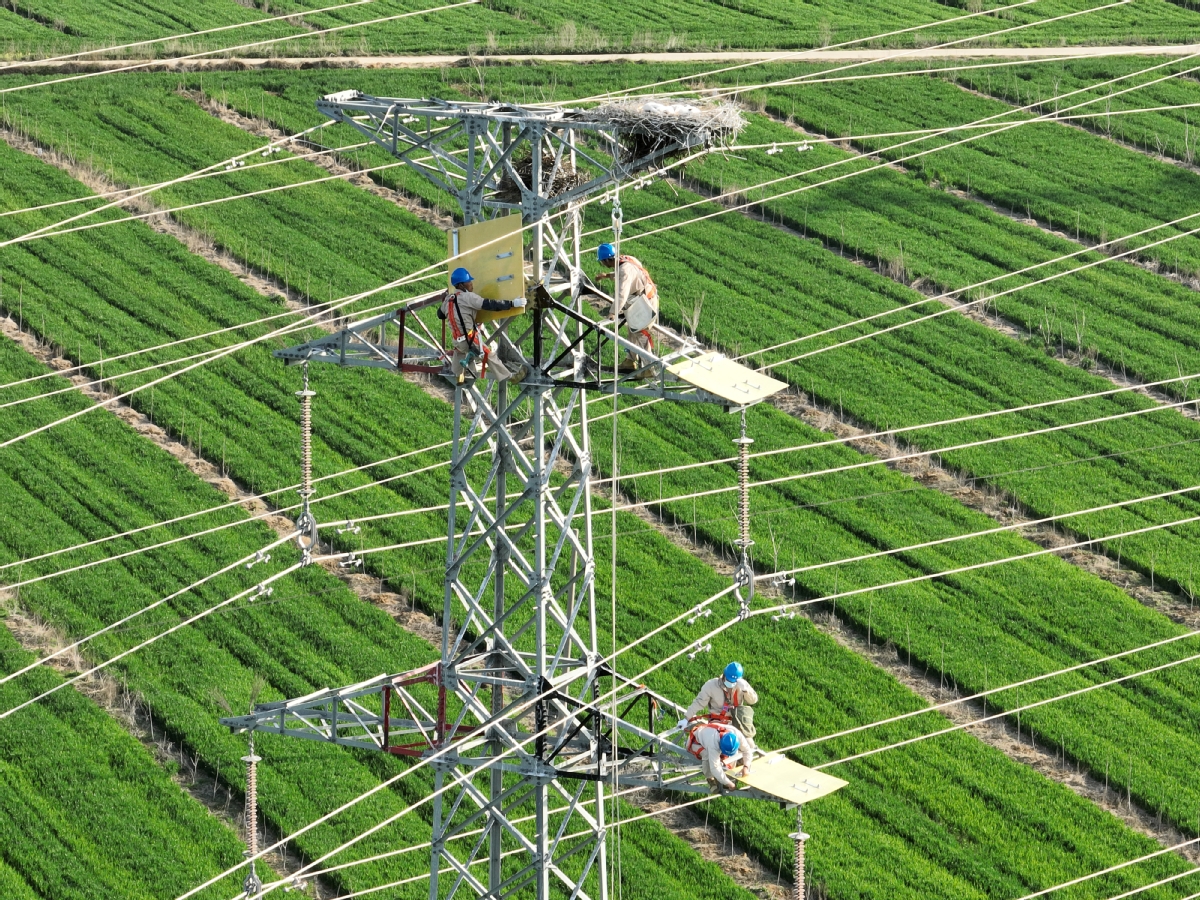
The Hongze Lake Wetland, spanning some 50,000 hectares in the prefecture-level city of Suqian in Jiangsu province, draws nearly 1 million migratory birds to breed and winter every year, making it a veritable avian paradise.
The birds, comprising some 234 species, include eight first-class nationally protected species, such as Oriental white storks and red-crowned cranes, and 32 second-class nationally protected feathered friends like reed parrotbills and baikal teals.
Zhang Xiumin, chief of the Natural Ecology Division at the Suqian Ecological Environment Bureau, said the settlement of Oriental white storks shows the ecological environment is getting better in Suqian — one of the country's first national innovation bases for practicing the concept that "green mountains and clear water are equal to mountains of gold and silver".
"In early March, we found a couple of Oriental white storks nesting on an iron tower connecting 220 kilovolt transmission lines. Last year, they gave birth to five baby birds here," said Zhang Jie, a staffer from State Grid Suqian Power Supply Co.
As beautiful as the birds are, they are sometimes a potential threat to local energy security, as their droppings and nesting materials can fall on high-voltage power lines, leading to short circuits and other malfunctions.
Zhang Jie said that the Oriental white storks and other rare birds like to nest on "isolated trees," for which they likely take the towers, and local power transmission structures have become their preferred abodes.
He added that the birds' nesting materials are diverse, and include branches, wires and woven bags, which are prone to fall on high-voltage lines. Meanwhile, droppings landing on insulated porcelain caps can cause discharges, leading to power failures. Short circuits or other failures along the lines can also be fatal to birds.
To solve the problem of "birds competing with power lines", Suqian Power Supply Co of the State Grid — which shoulders a dual task of safeguarding the nation's energy security and being an economic lifeline — has installed more than 300 protective barriers on nesting towers to prevent droppings and nesting debris from falling onto electrical wires and causing shorts.
To help better protect these birds, Suqian Power Supply Co also set up the first migratory bird rescue station in the wetland, together with the establishment of a "Protect Transmission Lines and Love Birds" volunteer team.
The station is located under an artificial bird nest of two square meters, and is equipped with first aid materials such as iodine, bandages and scissors, as well as sufficient food and water supplies.
Li Mofeng, captain of the volunteer team, said that so far, they have identified three suitable habitats to build "standalone villas" for birds with 18-meter-high concrete poles, attracting Oriental white storks to make nests there.
"Once injured birds are found, our rescue station can play a role similar to that of an ambulance, providing rapid medical treatment and ensuring their safety," Li said.
This is a green mode of friendly coexistence between rare bird species and power transmission lines, and also a standardized rescue process of "patrol-protect-rescue", Li said.
He said the volunteer team consists of 30 people who are mainly power line inspectors, monitoring power supply lines and the surrounding environment through manual inspection or by using cloud platforms. Once they find injured or endangered birds, they can initiate emergency assistance.
Wang Songzhu, Li's colleague, said they are very happy to begin the work, and it was a great thing to see the birds grow in number.
Wang said that since 2022, three Oriental white stork couples have nested on transmission towers, giving birth to 11 chicks.
Wang stressed that they will fully leverage the role of the rescue station and work with local authorities, promoting the job of protecting transmission lines and birds alongside biodiversity protection.
- Linyi residents contribute to green energy transition
- Spring farming, rural vitalization spurred on by safe, stable energy supplies
- China's virtual power plants pave way for green energy transition
- Nation seeks win-win for carbon reduction
- State Grid Weihai Power Supply enhances farmers' livelihoods



















