


Chu, a vassal state in China over 2,000 years ago, left a lot of charming legends in history. Thanks to new discoveries at a key site, its stories can be told more vividly today.
One of the largest-scale Chu state tombs with the highest rank and most complex structure dating back to the late Warring States Period (475-221 BC) recently underwent an excavation, which is expected to help promote understanding of a once powerful state in its final days, cultural heritage experts and authorities said on Tuesday at a news conference in Huainan, Anhui province. The news conference was held by the National Cultural Heritage Administration.
The Wuwangdun Site, located in Huainan, includes a cemetery surrounded by a moat, covering an area of about 1.5 square kilometers.
In the cemetery, there are pits for chariots and sacrificial items as well as tombs accompanying the No 1 tomb, the largest, which is believed to be that of the cemetery's owner, said Gong Xicheng, a researcher at the Anhui Provincial Institute of Cultural Relics and Archaeology and head of the archaeological team.
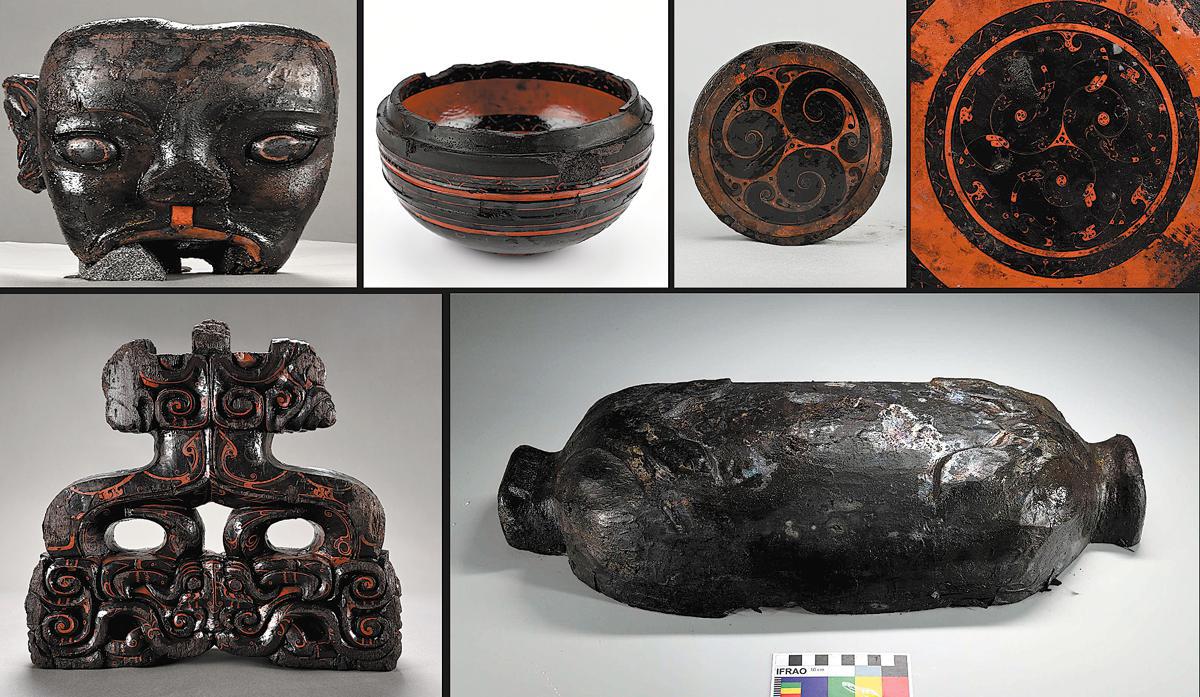
Zhang Zhiguo, a researcher at the National Centre for Archaeology, said the research team had succeeded in unearthing fragile artifacts such as burial chamber cover boards, bamboo mats on the boards and lacquer items.
Meanwhile, Wu Pingchuan, head of Huainan's publicity department, said there are plans to build an archaeological ruins park to better showcase the archaeological findings.
The Wuwangdun tomb had been robbed multiple times, and the local police retrieved more than 70 cultural relics in recent years.
As a result of these robberies, the tomb had been severely damaged. This led to concerns that there had been changes in the environment for buried artifacts, and a rescue excavation was carried out at the site in 2020.
The No 1 tomb has burial chambers arranged in the shape of a cross, with eight side chambers around a central one, according to archaeologists. The top of each chamber is covered with four layers of planks. Ink inscriptions were found on the cover boards, indicating the functions of each chamber, said Gong from the Anhui Provincial Institute of Cultural Relics and Archaeology.
Cultural relics unearthed from chambers include bronze ritual artifacts, daily utensils, wooden figurines and musical instruments, Gong added.
As a powerful vassal state, at its height Chu once ruled a vast area along the middle and lower reaches of the Yangtze River. The state lasted for about 800 years before it was conquered in 223 BC by Emperor Qinshihuang, who later established the first united dynasty of China.
King Kaolie of Chu moved the state's capital eastward to Shouchun, now Shouxian county in Huainan, in 241 BC, to distance it from the rising Qin state to its west.
Eighteen years later, Chu was defeated by Qin, making Shouchun the state's last capital, and the Wuwangdun tomb is about 15 kilometers from the Shouchun city ruins, said Gong.
Last year, the Huainan city government built an archaeological building, which houses 11 conservation laboratories for the study and protection of lacquerware, textiles, organic and inorganic materials, low-oxygen sterilization, relics analysis and testing, and material storage.
"The facilities have provided strong support for the archaeological excavation and conservation work of the site," said Zhang from the National Centre for Archaeology.
A highlight of these efforts is the extraction of bamboo mats on the top of burial chambers' cover boards. Experts analyzed the mats' size and preservation, and applied a method of spraying menthol on their surface for reinforcement and then extracting the mats one by one.
So far, 78 bamboo mats have been extracted, with each one measuring approximately 45 centimeters in width and the longest one around 7.5 meters. The total area of the extracted bamboo mats exceeds 200 square meters, said Zhang.
"This is currently the largest-scale ancient bamboo mat extraction project conducted worldwide. It has also formed a technical method for the on-site reinforcement and extraction of bamboo mats, as well as their packaging, transportation and protection," Zhang said.
"The Wuwangdun No 1 tomb has a huge size and is the largest Chu state tomb we have excavated to date," said Gong. He explained that it was sealed off with an earth mound, which had a diameter of over 130 meters at the bottom, and the burial pit exceeded 400 square meters.
"It serves as an important example for studying the construction techniques of large-scale tombs during the late Warring States Period," he said.
"Moreover, since the tomb was from a crucial period when the feudal state system was disintegrating and the formation of a unified country was imminent, it provides systematic information for our studies on the formation of a unified country and its culture during the Qin (221-206 BC) and Han (206 BC-AD 220) dynasties," said Gong.








