Giant FAST radio telescope embraces international exchanges









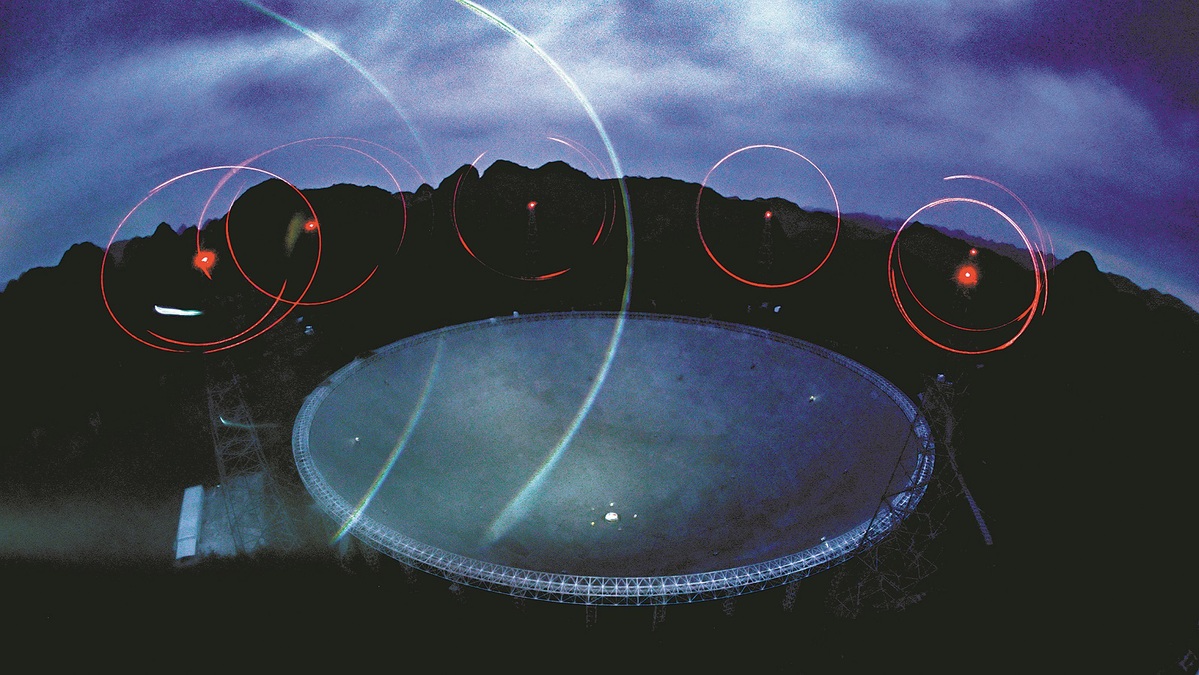
GUIYANG — China's Five-hundred-meter Aperture Spherical Radio Telescope (FAST), the world's largest single-dish radio telescope, has identified more than 900 new pulsars since its launch in 2016.
That's more than three times the number found by foreign telescopes during the same period, Han Jinlin, a scientist at the Chinese Academy of Sciences' National Astronomical Observatories, said on Wednesday.
One of the important implications of pulsar research is to provide cosmic coordinates for possible future interstellar travel, Han said.
FAST started formal operations in January 2020 and was officially opened to the world in March 2021.The telescope provides astronomers around the globe with a powerful tool to uncover the mysteries and evolution of the universe, said Jiang Peng, its chief engineer.
Scientific cooperation
British astronomer Ralph Eatough, who has been interested in Chinese culture, history and literature since he was young, said he felt extremely lucky to be able to travel to China and join the FAST research group, with its members being very welcoming.
With a doctorate in pulsar astrophysics from the University of Manchester, Eatough works as a pulsar astronomer at the observatories and takes charge of pulsar data processing and time-frequency system optimization.
He said pulsars are extremely compact remnants of massive stars that, while spinning extremely quickly (sometimes hundreds of times a second), emit beams of electromagnetic radiation that can sweep past the Earth — a bit like a cosmic lighthouse.
Thanks to its high sensitivity, FAST can detect very faint pulsars that were previously too far away to identify.
In the past few years, Eatough has joined Chinese scientists to perform many observations with FAST, searching for undiscovered pulsars and precisely measuring the properties of those it has found.
He has been searching for pulsars in the small satellite galaxies surrounding the Milky Way.
"These would be the most distant pulsars known, and it is only now with the sensitivity of FAST that we have the chance to detect them," Eatough said. "Such pulsars could tell us a lot about the unmeasured gaseous material that surrounds the Milky Way."
He said that opening up FAST to the world meant that astronomers can now perform experiments that were previously impossible with less sensitive telescopes, with a prime example being the potential to detect pulsars in other galaxies.
Sun Chun, the engineer in charge of FAST measurement and control, said it has received applications from 15 countries, including the United States, Germany and Japan, and approved nearly 900 hours for observation.
Tourism exchange
The telescope has also attracted many tourists from home and abroad since its inception.
Located in a naturally deep and round karst depression in southwest China's Guizhou province, it has a reception area the size of 30 standard soccer fields.
In February, 34 members of a French delegation, including students, young volunteers and staff members from the Secours Populaire Francais, a French NGO that fights poverty and exclusion, visited the telescope and the memorial hall dedicated to the late chief engineer of the FAST project, Nan Rendong.
It was the first time Florent Madrolle, a French translator, had visited China. "The size and the technology were very impressive," Madrolle said of the telescope.
Five kilometers from FAST, in the town of Kedu, the memorial hall has attracted many tourists and visitors eager to pay tribute to Nan.
Nan, who selected the site for FAST and oversaw its construction, died in 2017 at the age of 72. China honored him with several posthumous titles, including "role model of our times".
Technical innovation
Since its inception, the telescope has continued to make technical progress through the efforts of a team of scientists led by Jiang.
"I thought we would revise the design scheme seven or eight times, and didn't expect that the first version would be so successful, with its performance reaching the globally advanced level," said Chai Xiaoming, a senior engineer at the observatories.
She pointed at a silver-plated low-noise amplifier the size of a harmonica. LNAs, the core component of a telescope's receiver, previously had to be imported from other countries including the US, Sweden and Australia.
To master the key technology, Chai and her team spent nearly two years developing a high-performance domestic low-noise amplifier.
As soon as the prototype of the LNA was launched, it attracted the attention of the international astronomical community. The Brazilian BINGO project — focusing on baryon acoustic oscillations from integrated neutral gas observations — contacted the telescope's operation and development center, seeking to buy a batch of them.
Chai said that if the deal is clinched, it would be the first export of core components independently developed by the telescope's operation and development center.
The FAST project had no experience to follow and was destined to meet unprecedented challenges.
"No one told you what to do, and no one was sure what would work," said Jiang, adding that the construction stage was filled with trials and failures.
He said that if FAST was only regarded as a telescope or a piece of observational equipment, it would already suffice. But to maintain its leading position in the world, his team will make every effort to ensure it becomes even more stable and efficient.
The annual observation time of the telescope is about 5,300 hours, and it plays an important role in scientific research achievements.
In the near future, the telescope will provide members of the international astronomical community with new perspectives, allowing them to further explore the universe and try to find the unknown, and make greater contributions to helping human beings break into new fields of cognition, Jiang added.
Xinhua





- Deepening of Sino-Finnish ties stressed
- Over 7.3 million people recorded as registered organ donation volunteers in China
- China says Nipah outbreak poses limited risk
- PLA's aerobatic jets arrive in Singapore to take part in air show
- China's garbage sorting drive still has a long way to go in many cities
- Former Chengdu official Bao Hui under investigation