Bird experts survey Metog to better understand county's biodiversity
Blood samples taken in unspoiled Xizang could unlock details surrounding future discoveries of new and unique species in the area









Long-term interest
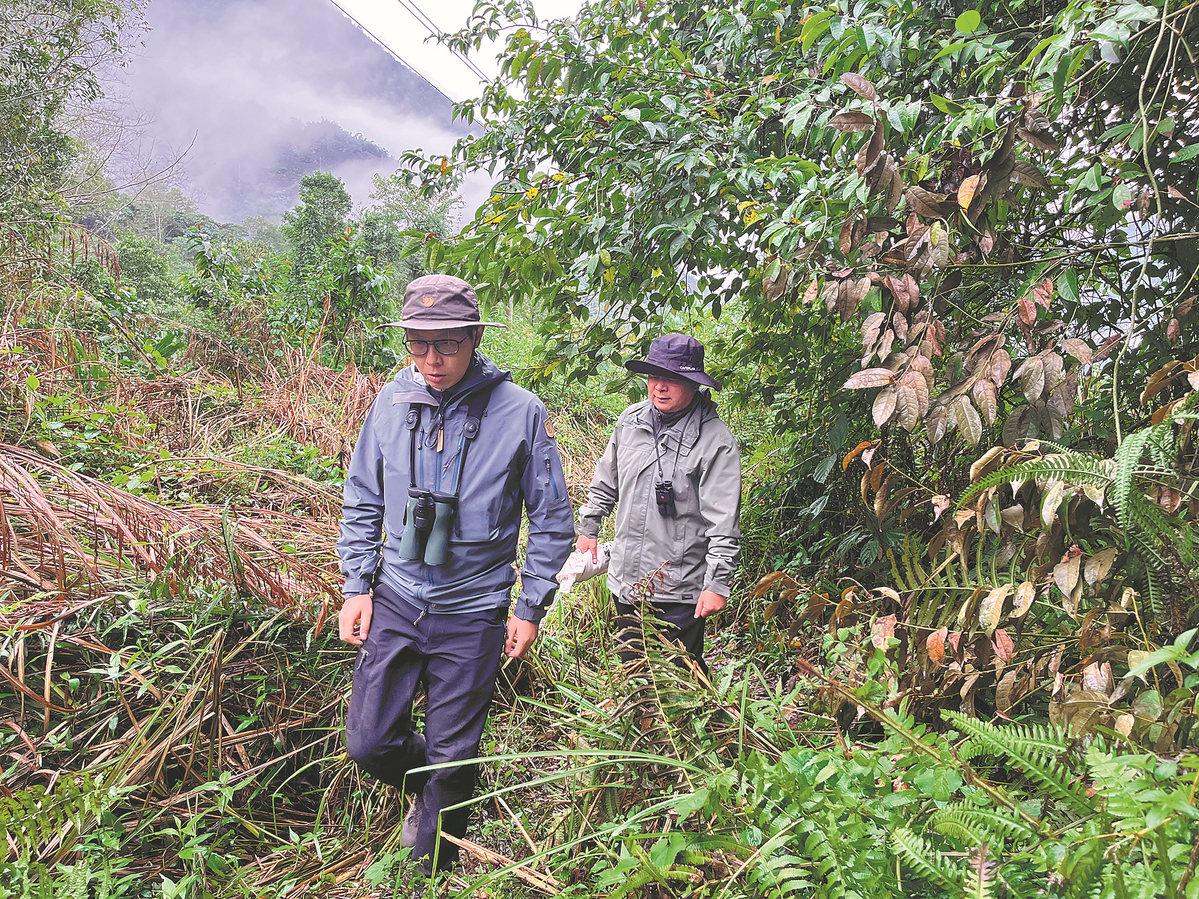
The pair has focused on Metog, an area known for its rich biodiversity, since studying for their doctorates at Beijing Normal University, inspired by their mentor, Zhang Zhengwang, one of the country's leading ornithologists.
Researchers from the university, including the two, have made several discoveries in Metog, including uncovering new records of birds for the country and the region, and have published research papers on the area's avian wildlife. "Metog is truly at the front line of discovery for us," Chen said."It has a great potential to add new members to the country's family of birds."
Joining Chen and Que were three of their students and three freelance surveyors.
To make sure that their two-week survey made the best of a bad situation, various methods were employed to survey the skies.
Besides using mist nets for catching, measuring and collecting DNA samples of wild birds, they also counted birds along roads.
The team, split into two, and traveling in four-wheel drives, set out on their respective tasks. Chen and the students focused their work on using mist nets for the survey. The three surveyors, Guo Dongsheng, Huang Ke and Li Bin, drove to different elevations along different routes to conduct their bird surveys.
Net duty
According to Chen, using mist nets is an essential method in conducting avian studies as it enables researchers to closely inspect and gather data on birds' health condition, age and gender and blood samples for further research.
Chen's research primarily centers on employing genomic and molecular methods to address various ornithological questions such as speciation and species divergence.
"Many bird species distributed in southeastern Xizang show distinctions from their counterparts in other parts of the country," he said."Historically, ornithologists would often classify a bird species found in the area as the southeastern Xizang subspecies of the species, mainly based on morphological variations.
"Genetic analysis allows us to determine whether two birds of the same species, previously regarded as distinct subspecies in two separate regions, are in fact two distinct species," he said. "Through genetic evidence, we can elevate a subspecies to the status of a new species. A small vial of blood collected from the birds can provide us with the means to conduct this type of research for many years to come."
Correct classification of a species is highly important to conservation, he added.
For example, after researchers upgraded the peacock pheasant distributed in Hainan province to a full species, named the Hainan peacock pheasant, based on genetic evidence in 2008, conservationists found it was already extremely rare on the island and immediately put the bird into the International Union for the Conservation Nature Red List as an endangered species.
The decision was made to base the survey in Drepung township, about 30 kilometers from the county seat of Metog, with an elevation of less than 1,000 meters.
Drepung, sometimes spelled in pinyin as Beibeng, is a gateway to many villages scattered over the county's 31,000 square kilometers.
"Given the chilly weather, we thought that most of the birds might still be lingering in the warmer, lower elevation areas, delaying their altitudinal migration to higher terrains,"Chen said.
From Drepung, Chen and his students drove to different areas to find survey sites- usually remote corners not far from roads but with few humans -to set up mist nets. They inspected every site regularly, eagerly anticipating the capture of wild birds in the nets and promptly extracting them.
"We monitored four net sites a day," said Wang Hui, a postdoctoral student. "More and it would have been too much work to handle."
They got up every morning at 7, and after breakfast they visited the net sites in turn. Each site would be visited four times a day, once in the morning, once around noon, once in the afternoon and once in the early evening.
Upon arriving at a net site, they would try to release the birds trapped in the nets as soon as possible and safely put them into sacks.
After a tour of the four net sites, they would return to their hotel and identify the birds, measure them, write their information in a log book and collect blood samples before releasing them.
"It was a truly tight schedule," Chen said. "Sometimes, we actually felt fortunate to see only several birds trapped in the nets at a site."
As well as having to work quickly, extracting the birds from the nets was no easy task."One day, there was a whole troop of white-breasted parrotbills, nearly 20, trapped in nets at a site," Wang said. The sparrow-sized birds move in groups and are known for their robust beaks.
"When we tried to free the birds from the nets, they pecked at us, which was truly painful," she said.
During their stay in Metog, the team set up mist nets at 10 locations, caught more than 70 species and collected blood samples from each species.






- Beijing eyes becoming a leading global hub for resolving intl commercial disputes
- China unveils a new AI meteorological model
- Beijing explores robots to support aging population
- Aid cadre decides to stay permanently in Xizang
- Inner Mongolia's two ports named national smart port models
- Ministry lodges stern representations with US over $11b arms sales plan to Taiwan