


Niche tourism sector gains healthy advantage in Shanghai
Hospital pilot program looks at ways to improve services for foreigners










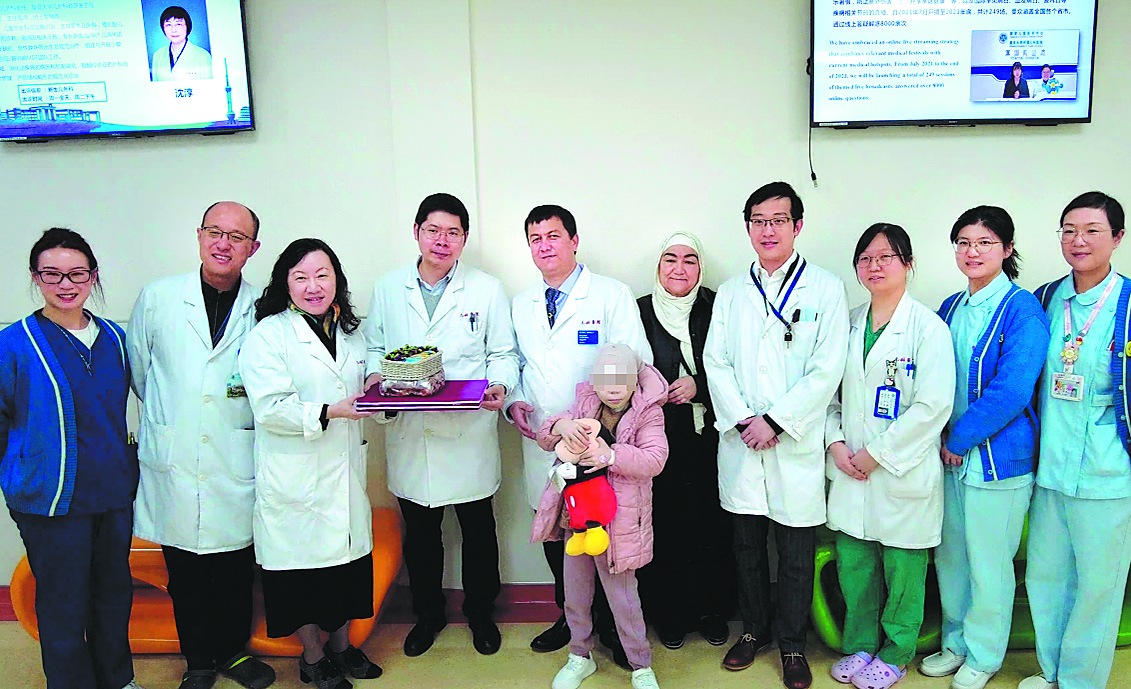
Sharing knowledge
Recalling the 2014 operation, Xia said it was a coincidence that the girl, Damia from Malaysia, was sent to Renji Hospital for her liver transplant. Her parents had friends who did business in Jiangsu province, which neighbors Shanghai, and doctors there recommended Renji Hospital for pediatric liver surgery. In the past, Malaysian families with a child in a similar situation would have sought medical treatment in Europe, the United States or Japan.
"The transplant surgery on the girl was quite successful. She recovered quickly and the cost was only one-fifth — including travel expenses — compared with that in a developed country," said Xia. Renji Hospital continued to handle cases from Malaysia as word spread throughout the patient community.
A team of liver transplant experts led by Xia later flew to Kuala Lumpur to meet their peers at the University of Malaya Medical Centre, where most of the children were taken for post-surgery checkups. The trip also gave the Chinese doctors the opportunity to visit the children.
"From their expressions, we could see how puzzled our Malaysian counterparts were when we first introduced our transplant techniques. They were all trained in medicine in the West and the ingenuity of Chinese doctors was incredible to them," said Xia.
A short time after returning to Shanghai, Xia organized a small academic symposium and invited a dozen experts from Southeast Asian nations to participate. They were also invited to tour the wards at Renji Hospital, and all of them expressed amazement at what they saw, Xia said.
In 2019, a group of 16 doctors and nurses from the University of Malaya Medical Centre completed training in pediatric liver transplants at Renji Hospital, which prepared them for running a similar program at the Malaysian hospital the same year.
"Many of my colleagues, including me, have a medical license to perform surgeries in Malaysia," Xia said. "Also, we still have children from Malaysia who come to our hospital in Shanghai for transplants every year."
Xia said this year he had also treated a French patient and another one from the Netherlands. "The country of origin of the patients is becoming increasingly widespread," he said.
Liver transplant surgeons from prestigious medical institutions and renowned pediatric liver transplant centers in countries such as the United Kingdom, Japan, South Korea, and Russia have received training at Renji Hospital, Xia said.
"This year we'll open our doors wider and welcome doctors from all over the world. We believe this will boost mutual exchanges and promote common improvement," he said, adding that the world's largest annual conference on living donor liver transplantations will be held in Shanghai in 2025.
Renji Hospital also has advantages in other disciplines, such as rheumatology, gastroenterology, and assisted reproduction, which can help it expand its influence and help more patients from home and abroad, Xia said.
While building strength in these areas, doctors need to take part in more high-level international exchanges and make their voices heard in the global arena, he said.
"Medical care is an ideal way to use China's soft power and spread Chinese culture. We reach out to alleviate people's diseases and pain and always receive a welcome. The Malaysian ambassador to China has come to our hospital multiple times to express gratitude and show support for bilateral cooperation," said Xia.
Reputation spreads
In January, the Shanghai Children's Medical Center received an e-mail from the parents of a 2-year-old boy from Poland who were seeking medical treatment for their son.
The parents wrote that the child, Buko, had been diagnosed with severe immunodeficiency caused by a genetic mutation. While receiving treatment in Europe, doctors discovered that he had a liver tumor.
Buko's parents learned about the Shanghai hospital on PubMed, a database of biomedical papers. They discovered that Shanghai Children's Medical Center ranked first in the world for treatment of hepatoblastoma, a rare childhood liver cancer, and had a series of papers published in top medical journals about the disease.
Buko was admitted to the Shanghai hospital in early February and underwent surgery within two weeks. The toddler has been discharged and returned to Europe for follow-up chemotherapy.
The boy was the first international patient the hospital had received after joining the pilot program for international medical tourism.
In addition to strong pediatric services, Shanghai also has great capacity in traditional Chinese medicine.
Construction to upgrade the international division at Longhua Hospital Affiliated with the Shanghai University of Traditional Chinese Medicine is underway. Chen Yuelai, president of the hospital and an acupuncture expert, said a group of loyal expats seeks regular TCM treatment from him.
In recent years, traditional Chinese cultural aspects such as tai chi, kung fu and acupuncture have grown in popularity internationally, and "this atmosphere has provided an unprecedented opportunity for TCM to go global," Chen said.
From time to time Longhua Hospital receives Western patients who have traveled to seek medical assistance for problems such as old sports injuries, he said.
A growing number of Japanese and Koreans who live in Shanghai have also come for TCM to treat chronic diseases and have therapies prescribed, Chen added.
Improvements ahead
The global medical tourism industry grew at an annual rate of 20 percent for 10 years before the COVID-19 pandemic hit, data from the Hainan provincial government, where the Boao Lecheng International Medical Tourism Pilot Zone is located, showed.
The data also indicated that less than a decade ago, local medical services had been unable to meet people's rising health needs, experts said.
More than 600,000 Chinese went abroad for medical tourism in 2016. About 40 percent were advanced tumor patients, 25 percent traveled for physical examinations, and 12 percent for plastic surgery, according to the data.
In 2017 alone, more than 50,000 individuals from the Chinese mainland traveled to the Hong Kong Special Administrative Region to receive human papillomavirus vaccine inoculations before they became widely available locally.
Shanghai first proposed developing medical tourism in 2019. A year later, a group of private medical institutions were selected for a pilot international medical tourism program. The city also pressed ahead with improving health insurance and medical payments to meet international standards.
Several medical experts said that the global medical tourism market is already largely established.
For example, the US has advantages in the treatment of severe diseases and cancer, while Japan has built a good reputation in cell therapy and regenerative medicine. Some Southeast Asian countries have attracted international patients with high-quality medical services and comparatively moderate prices. South Korea has created a name for itself in plastic surgery.
Improving medical workers' English-proficiency is an important factor in expanding Shanghai's medical tourism, one expert said.
Jin Chunlin, director of the Shanghai Institute of Medical Science and Technology Information, said that some countries, like India and Thailand, already have two clear advantages.
"Medical workers in those two countries are generally fluent in English, and the two countries have fairly mature and competitive tourism products. Also, they have strong features in medical tourism. For example, they are famous for their herbal remedies," Jin said.
Service levels could be improved by providing more doctor's appointments and polishing medical workers' etiquette.
Taking the lead from countries such as South Korea, other industry experts suggested China launch a preferential visa policy for those seeking medical treatment.










