Withstanding northern headwinds










Global South countries should jointly push for the building of a more reasonable and fair global climate governance system
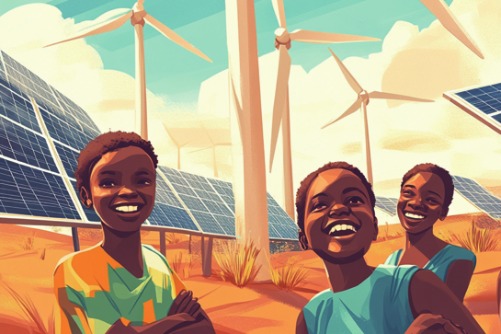
The Global South, a grouping of the world's emerging markets and developing countries, has become an important force in pushing the transformation of the global governance system. In the climate arena, Global South countries, which are ecologically fragile, have a pressing need to develop the economy and eradicate poverty, while being confronted with acute challenges from climate change.
First, Global South countries need to increase their say and influence in global climate governance. Although the rise of the Global South has given developing countries more say in the global arena, international climate governance is largely dominated by the West. Thanks to their technological strengths, developed countries enjoy an upper hand in fields such as emissions reduction calculation, adaptation capacity building, green technology application, and climate financing, thereby seeking climate deals that best suit their interests. In contrast, most members from the Global South have not yet established a climate science system, and have not received substantial help from developed countries in the transfer of green technologies.
Second, the Global South risks being divided in global climate governance. Since global climate governance was initiated in the 1990s, the theme of the climate arena had long been the "Global North versus Global South". However, the rapid rise of emerging economies and the consequential surge in their greenhouse gas emissions have divided the Global South. After the Paris Agreement was inked at the United Nations Climate Change Conference in Paris 2015, the North-South divide in climate governance has evolved into a more complicated landscape comprising three blocs — developed countries, emerging economies and underdeveloped countries.
In recent years, the United States-led developed world has sought to create divisions among Global South countries by isolating emerging economies, including China, from other developing countries. The strategy is designed to undermine the collective strength of the Global South, preserve the so-called rules-based international order, and impede China's growth. In response, Global South countries should jointly push for the building of a more reasonable and fair global climate governance system by upholding the principle of common but differentiated responsibilities in climate actions. Bearing in mind the principle of extensive consultation and joint contribution for shared benefits, the Global South ought to create a global climate governance system that meets the interests of the whole of humanity.
First, the Global South must uphold true multilateralism in global climate governance. It is crucial for the Global South to firmly safeguard the global climate governance system with the UN at the core, and build up consensus and pool strength by preserving the status of the Conference of Parties to the UN Framework Convention on Climate Change as the major platform for global climate cooperation, thus building a more reasonable and fair global governance system. The Global South should be vigilant against the false multilateralism being peddled by developed countries led by the US, which have resorted to mini lateral groupings and climate alliances to pressure emerging economies including China on climate issues.
Second, the Global South should achieve consensus in the global climate arena. The Global South comprises of over 150 countries, which account for 80 percent of the global population and 42 percent of the world's economic output. In recent years, Global South countries have gained increasing clout in the global arena, and become a key force driving the evolution of the international order. In climate negotiations, Global South countries have also earned a larger say. As a natural member of the Global South, China should lead other developing countries in upholding the global climate governance architecture with the UN at its core based on the G77+China cooperation model, and to speak with a unified voice, pushing for the creation of a more just and reasonable global climate governance system.
Third, the Global South needs to strengthen South-South cooperation in global climate governance. Global South countries share the same pursuit for independent and autonomous development, and call for greater justice and fairness in international affairs. Having similar historical experiences and facing similar development tasks, Global South countries also share the same aspiration for a more just and equal global climate governance system, which lays the foundation for South-South cooperation in climate actions. The Global South should enhance climate cooperation under mechanisms such as the G77+China, BASIC countries and BRICS, and better align these mechanisms with the UN-centered global climate governance system.
Last, the Global South should give better play to the role of the Green Belt and Road Initiative in leading the global climate governance, and balance economic development and environmental protection in countries involved in the initiative. It is also important for China and other developing countries to enhance policy, infrastructure, trade, financial and people-to-people connectivity.
The author is dean of the School of International Relations at Tianjin Foreign Studies University. The author contributed this article to China Watch, a think tank powered by China Daily. The views do not necessarily reflect those of China Daily.
Contact the editor at editor@chinawatch.cn.