



Parties of pact urged to address shortcomings









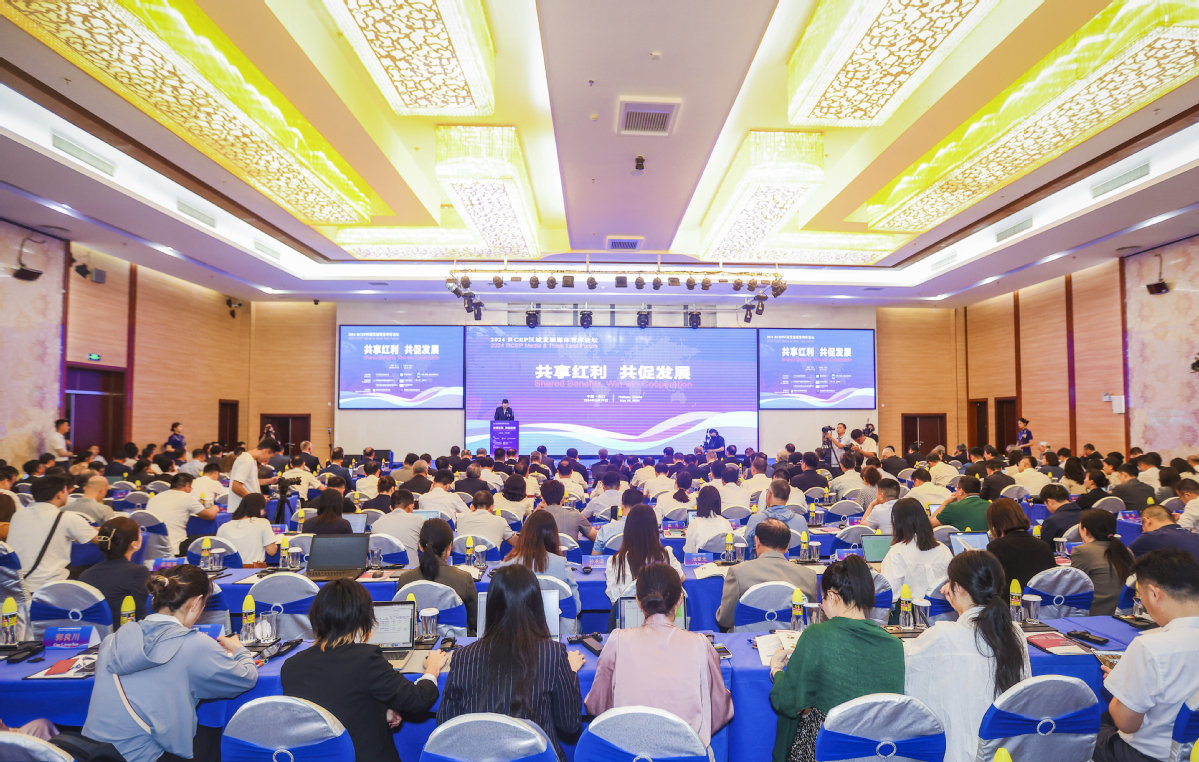
Global experts have called for further moves to enhance the effective implementation of the Regional Comprehensive Economic Partnership trade, the world's largest free trade pact, which will offer increasing opportunities for global stakeholders.
The remarks were made at seminars discussing improving the utilization rate of the RCEP's rules and advancing regional economic integration, which were held on Sunday on the sidelines of the RCEP Media & Think Tank Forum in Hainan province.
Ahn Choong-yong, professor emeritus at Chung-Ang University said, "While the RCEP agreement provides unified rules for origin and making progress in certification, it also has obvious shortcomings compared to the Comprehensive and Progressive Agreement for Trans-Pacific Partnership."
According to Ahn, the RCEP agreement lacks certain characteristics present in the CPTPP, including environmental and labor standards, and intellectual property protection. There is also less emphasis on digital trade in the RCEP agreement as well as a lack of investment protection.
Ahn noted that seven countries — Australia, Brunei, Japan, Malaysia, New Zealand, Singapore and Vietnam — are members of both the RCEP and the CPTPP, and that China has applied to join the latter. He called for more improvement in the RCEP trade deal to align with the level of the Asia-Pacific economic framework.
To make the RCEP more effective, Zhang Yansheng, chief researcher at the China Center for International Economic Exchanges, highlighted the importance of adhering to institutional opening-up and implementing existing measures on promoting liberalization and facilitation for trade and investment.
"The major countries in this region need to take responsibility and provide public goods, including capacity building, institutional development and network construction," he said. "A new opportunity also lies in green and digital transformation; the region must strive for that. And more efforts should also be made to deepen cooperation in various aspects to enhance total factor productivity."
The RCEP is a historic agreement that brings together 15 Asia-Pacific countries: 10 member states of ASEAN and five of their key trading partners — China, Japan, South Korea, Australia and New Zealand — representing about a third of global economic value.
Masahiro Kawai, professor emeritus at the University of Tokyo, said while the goals of the RCEP in terms of open trade are not as ambitious as that of the CPTPP, the RCEP members include many developing countries.
"That makes it a very inclusive free trade agreement," the professor said.
Looking to the future, he said more efforts should be made to further reduce tariffs in a shorter time frame to attract more countries to follow RCEP standards.
Zhao Jinping, former director-general of the Department of Foreign Economic Relations at the Development Research Center of the State Council, said one of the key tasks for the RCEP is promoting regional economic integration, with a focus on adding more members.
"Expanding the scope of RCEP membership beyond the region would be very beneficial for enlarging our circle of friends," he said.
Zhao's views were echoed by Chang Ka-mun, managing director of Li & Fung Development (China), which focuses on providing solutions for supply chain problems. Chang said participating governments need to increase efforts and promote the RCEP through various publicity activities, allowing more people and more companies to gain a better understanding of the agreement.
Zhao said he strongly supports the establishment of a secretariat for the RCEP, saying that doing so can encourage member countries to strengthen policy connectivity and coordination.



















