Giving China's 'other kung fu' a fighting chance









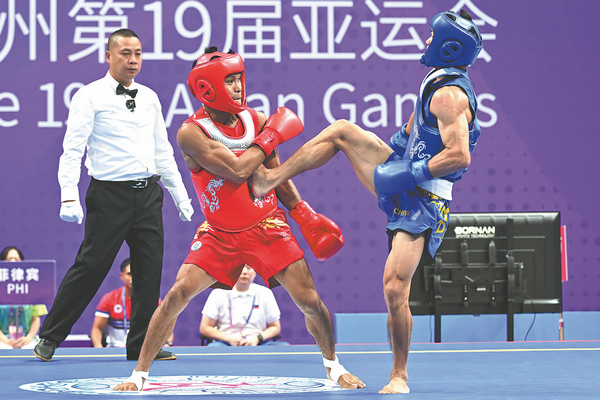
Chinese martial arts are hiding a secret weapon in plain sight. It's enigmatic enough that I have yet to meet a Chinese layperson who even knows it's Chinese. At the same time, paradoxically, it's an "open secret" that's gaining international prominence.
I've come to think of it as the "other kung fu" — sanda.
Unlike its superstar sibling, taolu kung fu, you won't see it in any martial arts movies but, increasingly, you will likely catch it on international TV broadcasts of actual fights.
Indeed, most English-language videos and articles about sanda celebrate its prowess yet lament its obscurity, with headlines like, "Is sanda the most underrated of martial arts?" "China's amazing fighting style you've never heard of"; "What's the difference between kung fu and sanda?"
Taolu and sanda are the only two competitive categories recognized by the International Wushu Federation, the main global body for Chinese martial arts, known as wushu in Chinese.
These disciplines share the same roots but have branched out in very different directions.
My 12- and 8-year-old children have studied both since age 3, and I just finished my first year of sanda. While my week is also packed with lessons in Muay Thai, eskrima — a Filipino martial art emphasizing stick fighting — and Brazilian jujitsu, I prioritize sanda, partly to promote it.
Today's taolu is virtually entirely aesthetic.
After the proliferation of firearms following the invention of gunpowder, taolu evolved into a visually dazzling folk performance art of choreographed acrobatic routines and stunning stunts, with and without weapons. Competitions are about rehearsing prescribed routines with precision.
Most masters even agree taolu wouldn't work in combat, but it sure looks cool!
Sanda is about literally beating an opponent. This applied fighting style, sometimes called "Chinese kickboxing", first began as a lethal full-contact combat system in dynastic China. It was adopted and modified by the Kuomintang and Red Army in the first half of the last century, and the People's Liberation Army still trains in it. This often-deadly sub-genre, which features chokes, elbow strikes and joint locks, is known as junshi sanshou, which translates as "military freestyle combat".
Following some Western boxers' deaths, China restricted combat sports for a period in the mid-20th century, until 1979, immediately after the country initiated reform and opening-up.
In a video on the YouTube channel Fight Commentary Breakdowns, heavyweight champion and head coach of China's first Sanda National Team, Qian Renbiao, recalls: "Whenever Chinese martial artists competed abroad back then, we'd be completely destroyed. The question was: Why couldn't Chinese martial arts win? Why weren't they combat-effective?"
This prompted sports authorities to host a national convention in Beijing.
"They invited all the famous kung fu masters. The changquan (longfist), tai chi and mianquan (cottonfist) guys were all at this convention. Everyone had an opinion," recalls Qian, who also attended.
"After much research, we decided to combine the Chinese and non-Chinese techniques and the modern with the old. That became yundong (sports) sanda.
"We added boxing. The kicks were from kung fu, taekwondo, karate and even Muay Thai. Chinese martial arts have great takedown styles. So, we codified 24 takedowns and how to do them within two seconds."
As one commentator put it, sanda is kung fu but, additionally, "what you'd see if you took really good boxing, really good taekwondo, some savate (French kickboxing), really good hybrid wrestling-judo, and you mashed them all together and created a system that's pretty good at everything and maybe not a specialist at any one thing".Actually, most agree its signature strike-to-throw takedowns are unmatched.
Former fighter and coach of Beijing's first team Mei Huizhi recalls in a YouTube video that he and other experts systematically collected the most effective fighting moves from each Chinese style and combined these with international combat sports.
"Sanda is the son of traditional Chinese martial arts," he explains.
By 1982, competition rules and techniques were codified. Sports sanda was born, and the first invitational tournament was staged in Beijing. Competitions and teams proliferated throughout the country and the world.
It's now a major sport in such international competitions as the Asian Games, and Dakar marks wushu's debut as a Youth Olympics category. Many people expect it'll become an Olympic event since the International Olympic Committee has officially recognized the IWUF.Concurrently, sanda is winning more attention in the MMA world through the likes of UFC champion Zhang Weili and her ilk.
Crowds love its two-minute rounds, which compel frantic battles, fierce takedowns and the spectacle of hurling opponents out of the leitai — the raised platform without ropes that has been retained from bygone centuries.
I, too, adore these enough to, along with my kids, put on the gloves and step into the amateur ring, to do our small part to carry this Chinese combat sport a little bit farther around the world and further into the future.
Hopefully, it will soon become appreciated as "another" rather than "the other" kung fu.
Contact the writer at erik_nilsson@chinadaily.com.cn