All-solid-state batteries rise in China's EV field
Disruptive tech seen giving nation edge with mass production likely by 2030









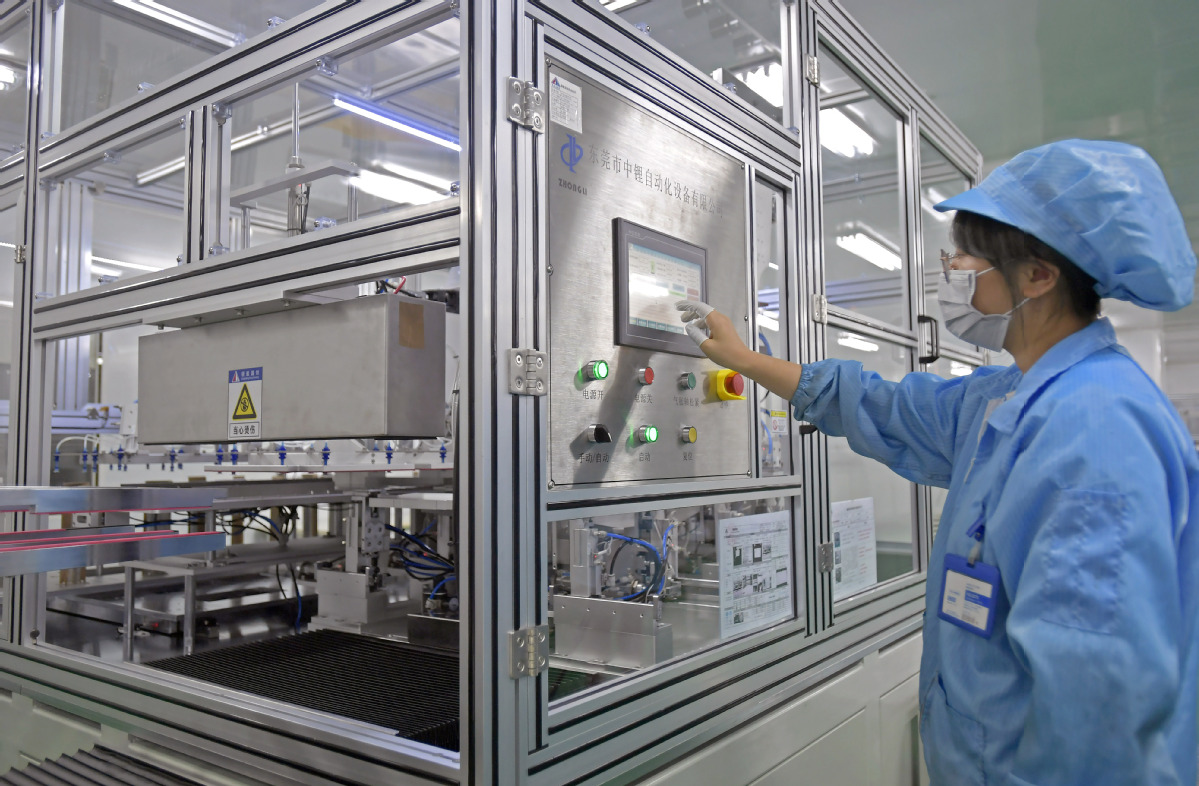
Accelerated efforts of both the Chinese government and the private sector are expected to lead to installation of all-solid-state batteries in electric vehicles by 2027 nationwide and mass production of such batteries by 2030 at the latest, said automotive industry insiders.
In China, all-solid-state batteries, especially sulfide-based ones, with an energy density of 400 Watt-hour per kilogram are finding favor now. Wh/kg is a reference unit that indicates the density of energy contained or storable in a body. All-solid-state batteries represent a disruptive EV technology, they said.
China will likely adopt a dual-track approach to the development of EV batteries. It will keep improving liquid lithium-ion batteries to "maintain advantages globally", while intensifying research and development of all-solid-state batteries, to "prevent disruption" by other countries, they said.
Zhou Anjian, a senior project manager at Shenlan Technology, a new energy vehicle technology company, and a former executive of automaker Changan Auto, said, "China's all-solid-state battery technology is nascent, but with the support of national projects, the sector will evolve rapidly to catch up with the levels of Japan and South Korea within three to five years.
"China is expected to achieve small-scale demonstration installations of all-solid-state batteries in vehicles by 2027, and mass production by 2030."
Polymer-based, oxide-based or sulfide-based EV batteries are three widely recognized varieties preferred by domestic automakers and battery makers, Zhou said.
Industry sources said the three varieties are in line with the country's goal to develop all-solid-state batteries. Chinese battery makers are particularly upbeat about the potential of sulfide-based batteries with an energy density of 400 Wh/kg.
All-solid-state batteries offer higher theoretical energy density and safety, and entail lower costs than lithium-ion batteries that currently dominate the EV sector. Hence, many countries consider them a potentially game-changing technology.
Japan, which has been striving to develop all-solid-state batteries since 2018, currently has the highest number of related patent applications. In June 2023, Toyota, a Japanese carmaker, set a target for itself to commercialize such batteries by 2027.
At a conference held by the China Automotive Battery Innovation Alliance late last week, Ouyang Minggao, a renowned battery expert and an academician with the Chinese Academy of Sciences, said that in China, the closest technical route to industrialization is the sulfide-based all-solid-state batteries. But the country is unlikely to bet on only one kind of battery.
Ouyang suggested that instead of producing only samples, China must strive to commercialize all-solid-state batteries with an energy density of more than 400 Wh/kg and 800 Wh/L before 2035.
"China must develop all-solid-state batteries, but the reason for such efforts should not be to subvert others, but to prevent other countries from subverting us. As long as all-solid-state batteries have a 1 percent market share in the market, the impact on us will be great," he said.
Since the second quarter of this year, the development of all-solid-state batteries has accelerated in China. A batch of automakers and battery firms have announced solid progress has been made in that direction.
Battery maker Sunwoda told China Daily that it has finished R&D of its all-solid-state battery with an energy density of more than 400 Wh/kg, and plans to mass-produce it by 2026, with an estimated production capacity of 1 gigawatt-hour. This is also the first time that the company disclosed momentum in its R&D of all-solid-state batteries.
Gotion High-Tech Co Ltd, another leading EV battery maker, also disclosed to China Daily that it aims to manufacture all-solid-state batteries in small quantities by 2027 and mass-produce them by 2030.
Ouyang said China, while developing all-solid-state batteries, should not abandon the current advantages in liquid lithium-ion batteries and needs to continue to optimize this type as China will rely on them for another 30 to 50 years.
Xu Yanhua, secretary of the China Automotive Battery Innovation Alliance, said that until 2030, the country's power battery industry will still be dominated by high-energy-density liquid batteries and lithium iron phosphate batteries. She cited a research report on the country's power battery development framework, released in collaboration with the Ministry of Industry and Information Technology.
"Around 2035, the proportion of lithium iron phosphate batteries will decline in the country and the proportion of solid-state batteries and sodium-ion batteries in vehicle applications is expected to increase to reach 10 percent or more," Xu predicted.
"Although the market share of China's power batteries is the largest, the level is not the highest. China faces great challenges in resource acquisition, technology, manufacturing, costs and applications globally."
Xu said China should focus on developing high-performance, low-cost power batteries and high-safety, long-cycle energy storage batteries, ensuring a stable supply of core battery resources, and boosting the capacity utilization rate to over 90 percent before 2035.