BRIdging a divide
Instead of taking sides in the conflict between China and the US or engaging in a trade war, Poland should try and mediate between the West and the East










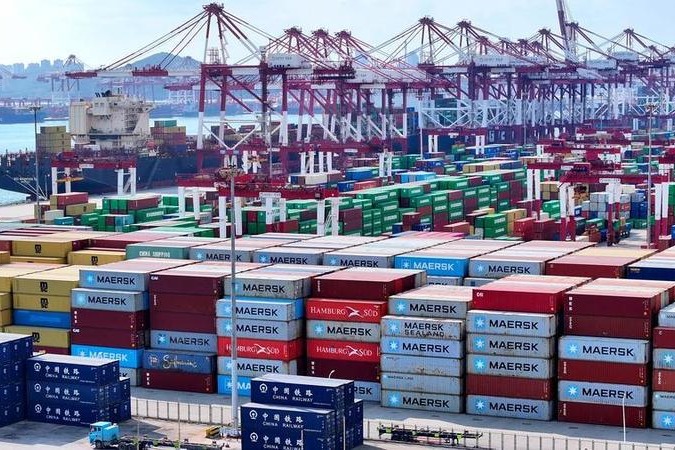
The China-Europe freight rail service, backed by the Belt and Road Initiative, recently reached a significant milestone by completing its 90,000th trip. This accomplishment highlights its vital role in stabilizing global supply chains and promoting economic growth along its route.
Over the past decade, the BRI has gone beyond expectations. It has attracted participation from more than 150 countries and over 30 international organizations. The initiative has driven nearly 1 trillion dollars in investments, led to cooperative projects, created job opportunities in partner countries, and significantly contributed to lifting thousands of people out of poverty.
Now, the BRI is not only the largest infrastructure investment project in the world, but also a tool for enhancing China's international standing and influence, particularly in the Global South.
I have always believed that the BRI is never purely an act of charity. However, it often aids development in the countries where China invests by offering soft loans. There are elements of China's development assistance that support countries that are lagging behind, such as Bangladesh and Tanzania.
Notably, the BRI, with its emphasis on connectivity, poverty reduction and job creation, has been contributing significantly to several United Nations Sustainable Development Goals.
The BRI and other global initiatives such as the Global Development Initiative, Global Security Initiative and Global Civilization Initiative should be recognized as China's contributions toward meeting global development goals. If all nations were as responsible and accountable as China, we could have achieved the SDGs set by the United Nations from 2015 onward. Unfortunately, none of the 17 UN goals have been fully met. For example, one goal is to eradicate extreme poverty, which China has already achieved.
Some Western countries are becoming increasingly nervous about China's expanding influence, prompting them to compete more aggressively. This competition has led to initiatives such as the Biden administration's infrastructure development projects under the framework of the Partnership for Global Infrastructure and Investment and the European Union's "Global Gateway "project. These efforts are not acts of charity, nor are they forms of imperialistic exploitation; rather, they are driven by political and economic considerations.
Undoubtedly, there is competition between the BRI and other projects. This competition is a beneficial side effect. It has already occurred, is ongoing, and will likely continue in the future. In my view, this is a positive development, as it fosters progress in lagging countries and helps many people escape poverty.
To some extent, EU leaders and Brussels' bureaucrats lack a deep understanding of the true nature of the BRI. Rather than fostering Sino-skepticism or discouraging Eastern European countries from accepting Chinese loans and investments, the EU and Beijing should consider establishing a joint working commission. This body could integrate potential Chinese investments under the BRI framework with EU co-financed infrastructure projects. Instead of making hostile competitions, I would suggest pragmatic cooperation: you are from Beijing, we are from the EU, let us discuss what we can do together for the sake of infrastructure development. China says, I would like to build this railroad. The EU says OK, but do not touch this airport, because that is what we want to invest in. Such an approach will result in two investments instead of one. Currently, there is a lack of such coordination, which is an area where the BRI should strive to improve in the future.
Therefore, the next step of the BRI should involve coordinating with other initiatives, such as those of the United States, the EU and smaller programs of countries such as Japan or Australia. This marks a new chapter for the BRI, where competition and cooperation intersect. Understanding the intentions of other initiatives and striving for compatibility rather than competition is crucial, with a focus on benefiting the people in the countries involved.
Another aspect of improving the BRI can be in the arena of social and environmental by-effects of the Chinese co-financed projects. This includes considerations such as inclusivity, addressing income inequality, and protecting the natural environment. China should not provide lending for any projects if there is no sound guarantee that the countries will be able to serve the debt in a sensible, sustainable way.
Poland should play a bigger role in mediating between the West and the East. Rather than viewing the world as being divided between opposing factions led by the US and China/Russia, I believe in a more nuanced perspective. I see the world as consisting of two interconnected parts: the Euro-Atlantic and Eurasian regions, with the EU belonging to both. Poland, as a member of the EU and NATO, with its rich culture, history, and security concerns, is an integral part of the Euro-Atlantic community. Simultaneously, Poland also shares ties with Eurasia.
Hence, Poland should refrain from taking sides in the conflict between China and the US or engaging in the trade war. Instead, Poland should adopt a more proactive approach diplomatically and politically to foster moderation and pragmatism in relations between the West and the East.

The author is a director of Transformation, Integration and Globalization Economic Research (TIGER) at Kozminski University in Warsaw, former deputy prime minister and minister of finance of Poland and distinguished professor of the Belt and Road School of Beijing Normal University. The author contributed this article to China Watch, a think tank powered by China Daily.
The views don't necessarily reflect those of China Daily.
Contact the editor at editor@chinawatch.cn.