Patient capital more essential and appropriate for China









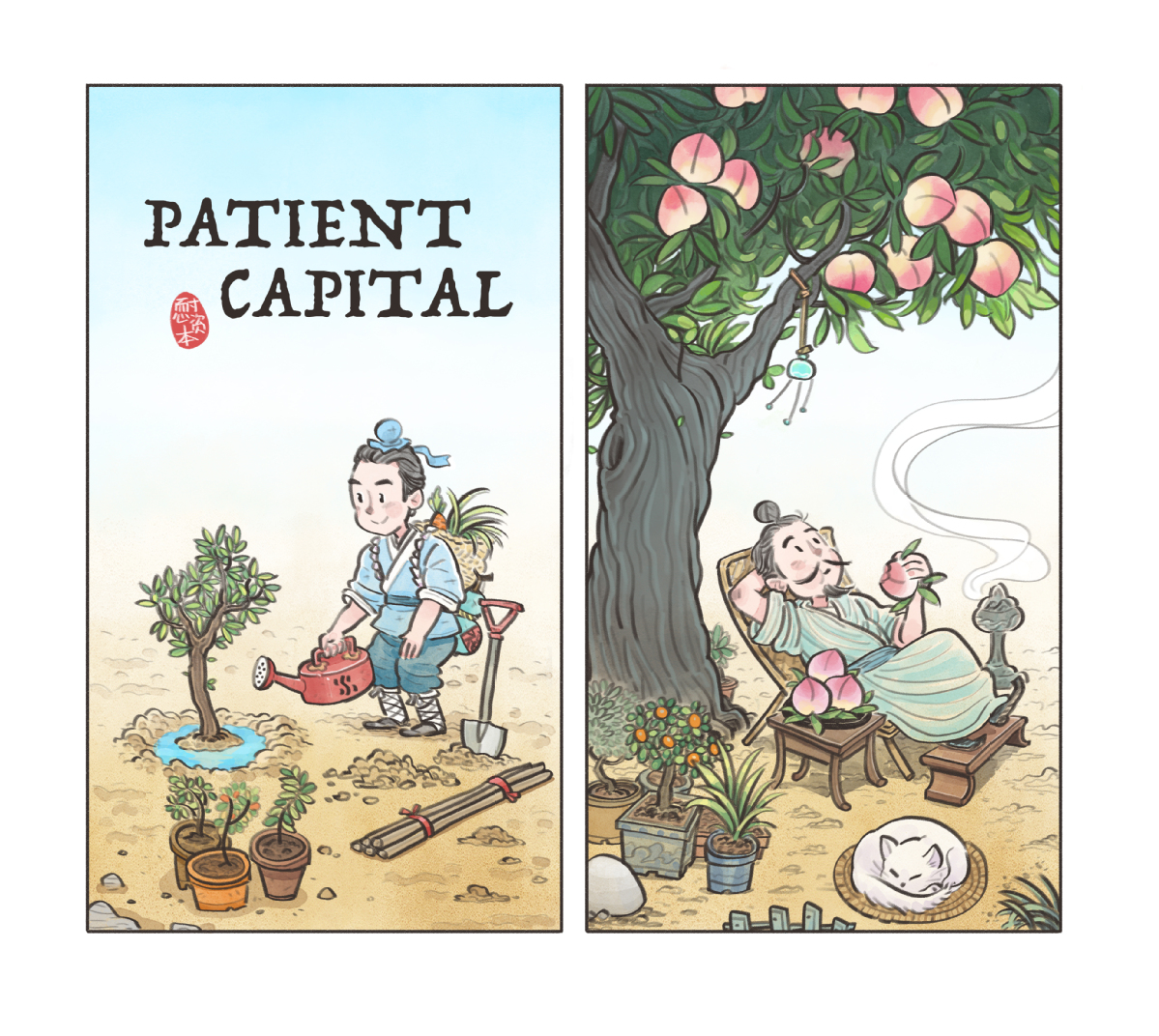
The nation's top leadership vowed to "actively develop venture capital investment and strengthen patient capital" at a meeting of the Political Bureau of the Communist Party of China Central Committee on April 30. The financial term "patient capital", or capital that focuses on long-term investment, has attracted widespread attention.
Compared with short-term speculative capital, this type of capital pursues long-term returns and usually involves start-ups, infrastructure projects or projects that take a longer time to generate benefits. We were the first economists in the country to introduce and advocate this concept, raising it in a 2017 article.
From the perspective of new structural economics, our article pointed out that long-term patient capital investment in infrastructure that addresses and eases growth bottlenecks can increase investment demand over the short term and cope with economic downturns, and can improve the potential and quality of economic growth over the long term. Such investment is akin to "killing two birds with one stone", and is conducive to stabilizing the economy and employment in the short term, and facilitating long-term high-quality development down the road.
In the article, we also pointed out that compared with other countries, China has a relatively high savings rate, a cultural tradition of long-term thinking and abundant sources of patient capital. It will become one of China's comparative advantages to make good use of this patient capital based on our cultural heritage.
Our idea of using patient capital to invest in infrastructure that eliminates bottlenecks in economic growth as a response to the economic downturn caused by crisis shocks is a summary of China's approach and experience in responding to the Asian Financial Crisis in 1998. Affected by the crisis over a quarter century ago, China's exports, investment, economic growth and employment plummeted. The Chinese government had put forward the goal of "guaranteeing an 8-percent GDP growth", issued construction bonds and made large-scale investment in construction of highways at the time to stabilize growth.
As a result, the total length of China's highways increased from 4,800 kilometers in 1997 to 25,100 km in 2002. The country's economic growth quickly recovered to north of 8 percent, and achieved an average annual high-speed growth of 11 percent from 2002 to 2008. As infrastructure bottlenecks were eliminated, the increase in retail prices of goods over the same period remained at a low level of 1.8 percent.
At that time, the mainstream international macroeconomics community was influenced by the "Ricardian Equivalence Theory "and generally opposed "Keynesian "infrastructure construction as a response to the economic crisis. They believed that although infrastructure construction increases employment, it also increases government debt, with the public expecting the government to increase taxes in the future to pay off debts; to maintain the same level of consumption in the future, the public would increase savings while reducing consumption.
As a result, the government's investment demand would increase, and public consumption demand would decrease, and aggregate demand would fail to increase. The Ricardian Equivalence Theory advocates, therefore, believe that infrastructure construction, as a countercyclical fiscal policy measure, while increasing government debt, will not help the economy emerge from the crisis.
However, the theory of Ricardian equivalence is based on the implicit premise that the government's active fiscal policy is based on infrastructure construction featuring "digging holes before filling them", which cannot improve productivity.
What China has done is to build infrastructure to eliminate growth bottlenecks. Such investment can not only stabilize growth and employment, but also boost the economy and fiscal revenue, allowing the government to use the increased tax revenue in the future to repay the debt that was incurred during the infrastructure construction.
Such methods can overcome Ricardian equivalence.
When the financial crisis hit in 2008, Justin Yifu Lin, as the chief economist of the World Bank, advocated the use of infrastructure investment as a measure to cope with the recession caused by the crisis. We are delighted to see that the idea is increasingly gaining support in the global development community. The International Monetary Fund included the chapter — "Is it Time for an Infrastructure Push? The Macroeconomic Effects of Public Investment" — in its World Economic Outlook, published in October 2014, to recommend the use of infrastructure investment during economic downturns.
Infrastructure projects are characterized by large scale and long cycles, being capital intensive with high sunk costs, which take a long time to complete and generate benefits. The dwindling supply of long-term capital since the 2008 crisis has had profound adverse effects on infrastructure financing, economic growth and financial stability. In a paper published in Journal of Infrastructure, Policy and Development in 2017, based on the perspective of new structural economics, we criticized the prevailing neoliberalism for not distinguishing between long-term investment capital and short-term arbitrage capital, which treated capital as homogeneous. The perspective regards long-term development financing of patient capital as capital that is conducive to national stability and long-term development.
We believe that just as labor is heterogeneous due to different levels of human capital, capital is also heterogeneous, and we propose a distinction between "patient capital" and "non-patient capital". Lenders of patient capital are not interested in short-term arbitrage and are willing to see borrowers achieve higher development in the future, thereby obtaining favorable returns over the long term.
Examples of this thinking include parents investing in their children's education, venture capital investing in innovative projects with potential, entrepreneurs in the real economy making entrepreneurial investments, and capital owners injecting capital into unlisted equity of companies/projects.
Rather than focusing on short-term returns, these investors seek to reap long-term future benefits as their investment projects develop or scale up. Owners of patient capital are similar to equity investors, with a strong willingness to take risks. They are willing to invest money in the real economy, innovative projects, infrastructure and unlisted companies or unlisted projects for long-term gains.
In this definition, a "patient" period refers to 10 years or more. Who are the providers of patient capital? We consider them to include direct investors (foreign and domestic), entrepreneurs, venture capitalists, State pension funds, sovereign wealth funds (such as the Silk Road Fund), multilateral development banks (such as the World Bank, Asian Development Bank, Asian Infrastructure Investment Bank and New Development Bank), some national development banks, green funds, private infrastructure funds and buyers of long-term government bonds.
When facing a global economic crisis, China has been effective at mobilizing the comparative advantages of patient capital to release infrastructure bottlenecks to achieve a win-win situation. The country has also provided a large number of overseas loans through the Export-Import Bank of China and the China Development Bank to support infrastructure construction in countries and regions involved in the Belt and Road Initiative, and those in Africa and Latin America. These projects can help capital-scarce countries build public assets that address infrastructure bottlenecks. They include industrial parks, environmental protection, green energy and resource development projects, and promote economic growth, increase exports and create jobs.
The new multilateral or regional development banks and funds that emerged after 2015, such as the Asian Infrastructure Investment Bank, the New Development Bank, the Silk Road Fund and other unlisted infrastructure or sovereign wealth funds, are very encouraging, and have injected positive energy and momentum into the global economy.
In recent years, China has attached great importance to new multilateralism and shared Chinese wisdom, Chinese experience and Chinese solutions with other countries around the world, contributing to the global economy. Amid major changes "unseen in a century", only through cooperation can we work together to promote sustainable development and world peace.
The top leadership's advocacy of "strengthening patient capital" is also conducive to leveraging China's cultural endowment of long-term orientation, providing funds for the research and development of both emerging and future industries, the appearance of new quality productive forces, and the rise of green and sustainable development projects, thus contributing to the country's high-quality development.
Justin Yifu Lin is a former chief economist of the World Bank, honorary dean of the National School of Development at Peking University and dean of the Institute of New Structural Economics, PKU.Wang Yan is a senior academic researcher at the Boston University Global Development Policy Center, and a former World Bank senior economist.
The views don't necessarily reflect those of China Daily.