


Shipwrecks offer up their treasures










State-of-the-art tech
In 2023, the National Centre for Archaeology, the Institute of Deep-sea Science and Engineering of the Chinese Academy of Sciences and the China (Hainan) Museum of the South China Sea joined forces to form a team, which pooled expertise from various fields to undertake research, excavation and preservation activities linked to underwater cultural heritage. Employing cutting-edge deep-sea technology, the team utilized the scientific research vessels Tansuo 1 and Tansuo 2, alongside the manned submersible Shenhai Yongshi (Deep-Sea Warrior), for an archaeological expedition at the two shipwreck sites.
The long baseline positioning system, for example, has revolutionized the accuracy of positioning, navigation and labeling of positions, making mapping underwater terrain more precise. With the system, "we have increased the update rate of underwater positioning from the previous 60 seconds to 3 seconds, providing divers with real-time navigation reference without delays", said Chen Chuanxu, deputy head of the scientific department of the Institute of Deep-sea Science and Engineering.
The Shenhai Yongshi is equipped with three-dimensional laser scanning and high-definition cameras to capture panoramic images and create detailed 3D scans of the shipwreck sites' distribution area.
Precise positioning and 3D reconstruction of all artifacts at the sunken shipwreck sites are required for underwater archaeological operations, according to Chen.
"In the depths of 1,500 meters, these present new challenges to our previous techniques for underwater positioning and measurement," he said. "To meet the demand, upgrades were made to the manned submersible platform and detection payloads to integrate information such as position, altitude, speed and synchronized clock into a laser-scanning device for high-precision 3D mapping."
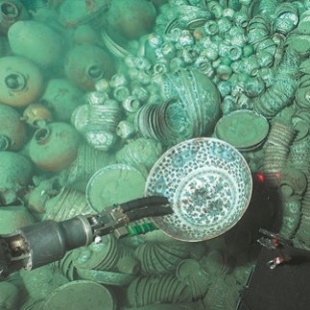
The Shenhai Yongshi is also outfitted with an enhanced manipulator system. "The traditional rigid material manipulator claws have been replaced with claws made of flexible materials, ensuring the stable extraction of underwater artifacts while preserving the precious details and patterns on the surface of the artifacts for further study and conservation," said diver Deng Yuqing from the Institute of Deep-sea Science and Engineering.
Extensive sampling of submarine sediment, seawater and marine organisms has also been carried out, providing data for environmental analysis and understanding of the ecosystem surrounding the shipwreck sites.
Since its presumable submersion in 1506, the gradual alterations within No 1 Shipwreck have intertwined with marine life and the micro-environment on the seabed. This symbiotic relationship has fostered the development of a distinctive underwater ecosystem, giving rise to a fragile ecological chain encircling the sunken vessel. "The retrieval and examination of samples, encompassing mud samples from the seabed, sediment from the ocean floor, and the microorganisms therein, represent pivotal measures in comprehending and conserving the shipwrecks for posterity," Song said. "Through the analysis of these samples, our objective is to amass scientific data that will assist us in effectively safeguarding these historical sites and the ecosystems enveloping them."
Over the past year, over 200 individuals took part in the collaborative team efforts for detailed data recording, precise photo stitching and the methodical execution of archaeological procedures. Across the three stages, the team established standardized protocols, enhanced processes and introduced innovative methodologies. "These developments have established a strong foundation for our future deep-sea archaeological expeditions, especially in the South China Sea," said Song.
The three stages of exploration "fully showcase the integration of China's deep-sea technology and underwater archaeology, marking a significant step forward towards international advanced levels," said Guan Qiang, deputy director of the National Cultural Heritage Administration.