



Universities should foster more quality talents









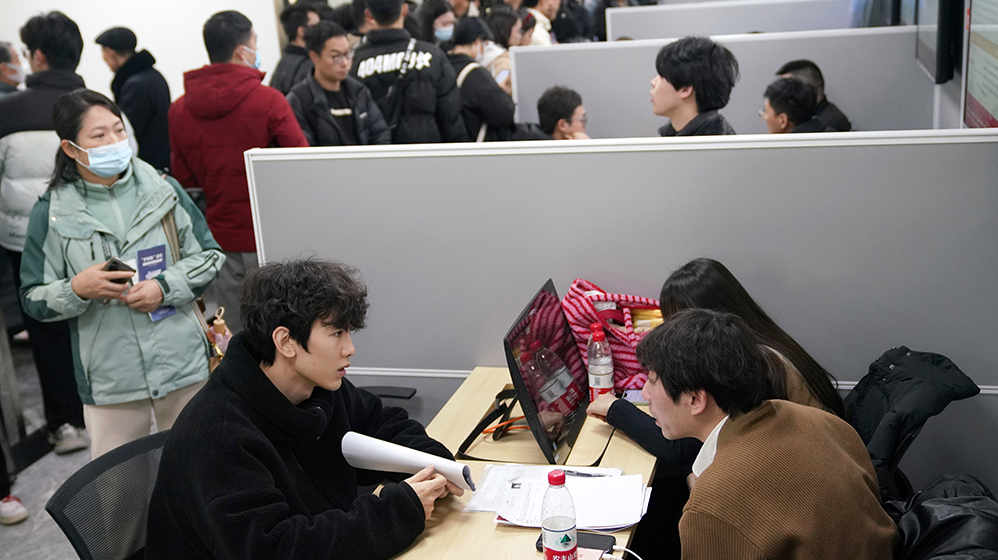
The Chinese leadership has stressed that to address the structural employment problem of imbalance between human resources supply and demand, efforts should be made to speed up the development of human resources, optimize structure and ensure reasonable distribution of goods and services. It should be noted that promoting high-quality development and creating enough jobs comprise the new orientation and mission of the employment work in the new era.
China's human resources development has reached a major turning point and faces structural contradictions. From a high population growth rate, China is experiencing negative population growth and rapid population aging, with population mobility shaping the population structure in both urban and rural areas.
The population decline leading to demographic changes will create problems for employment generation and population development. Yet China will continue to be the second-most populous country in the world despite the declining fertility rate. China still had 864.81 million people aged between 16 and 59 years in 2023, according to the National Bureau of Statistics. On the other hand, the Chinese Academy of Labor and Social Security estimates that by 2035 China's working-age population will decline to 788 million, meaning China's working-age population will still be double of the size of the United States' total population.
Besides, the deepening structural contradictions in the labor market have made it difficult to find skilled and highly skilled workers due to the shrinking working-age population. In contrast, some graduates cannot find suitable jobs because their majors make them unsuitable for certain professions which are necessary to propel China's structural transformation, while employment rates are declining in sectors such as financing, computing, vehicle manufacturing and some traditional industries.
Some new fields such as artificial intelligence, robot maintenance, new machinery manufacturing and digital upgrading require more workers. But educational institutions have not been able to come up with new curriculums which can meet the needs for industrial transformation and labor market shifts. An increasing number of graduates today prefer a stable job in a government department or State-owned enterprise despite the severe competition. Worse, it has become more difficult for arts graduates, as well as graduates from general universities, as opposed to prestigious universities, to find suitable jobs. Also, female graduates are less likely to find jobs than their male counterparts.
While college graduates face an increasingly difficult job market, many industries including manufacturing, clothing, catering, electronic processing and architecture can hardly find ordinary workers all year round. Employers in the eastern, central and western regions, too, face labor shortage. Chinese Academy of Labor and Social Security data show that 48.07 percent enterprises face labor shortage in the manufacturing sector, and 20.01 percent and 18.82 percent cannot find enough salespersons and services personnel.
Besides, skilled workers accounted for only 26 percent of the total workforce by the end of 2022, compared with 70-80 percent in advanced economies such as Germany and Japan. And estimates show that by the end of 2025, China will have a shortage of nearly 30 million workers in manufacturing.
Hence, efforts should be made to realize full employment. First, China should gradually integrate the primary, tertiary and service industries, establish a modern industrial system that matches the human resources, and increases employment in the services and agricultural sectors. And the college curriculum, especially for majors, should be changed to reflect the needs of industries, and regular training programs organized to train undergraduates and graduates in a way that they can meet the requirements of different industries.
Second, the government should consider revising the school system and boost education reform, as well as improve access to public services for migrant workers and help them find stable jobs in cities. It should also issue favorable policies to help overseas returned migrant workers start a business and older rural workers to find jobs closer to home, and the elderly people should support to resume work.
And third, there is a need to establish a high-level human resources market that is fairer, more unified, more effective and better regulated, and optimize the public service system to help create more jobs and ensure workers get access to the system. And the labor market barriers should be dismantled, and employment discrimination eliminated.
The author is an associate researcher at the Chinese Academy of Labor and Social Security.
The views don't necessarily reflect those of China Daily.
If you have a specific expertise, or would like to share your thought about our stories, then send us your writings at opinion@chinadaily.com.cn, and comment@chinadaily.com.cn.





