


Chinese cultural treasures recently returned from the United States









In 2009, China and the United States signed a key intergovernmental agreement on combating the theft and illegal trade of cultural relics. The document has been extended every five years since.
In the past decade, the US has returned over 440 cultural relics to China thanks to close cooperation between the two countries in related fields. Here is a list of important cultural repatriations in the past year or so.

Two panels of stone funeral beds (between the 4th and 7th centuries)
The two panels with decorative patterns in reliefs were painted in different colors and adorned with gold foil. They were transferred back to China from New York in May 2023.
The relics were seized by the Manhattan District Attorney's Office and US Homeland Security Investigations as part of a criminal case. The National Cultural Heritage Administration cooperated with the US to launch the repatriation process in April last year and soon reached an agreement.
The panels are of high historical, scientific and artistic value. They are considered to be originally from North China and installed on the front side of a stone bed. They demonstrate exchange among various civilizations along the ancient Silk Road. Its decorative patterns show a mixture of traditional Han Chinese elements and those of Zoroastrianism, a monotheistic religion from ancient Persia, like the exotic altar with flames. The panels were exhibited in the Palace Museum in Beijing last year.

Feng Xingshu Gui from the Western Zhou Dynasty (c. 11th century-771 BC)
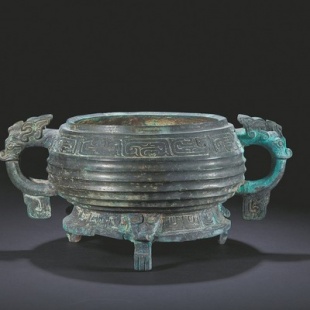
The 2,800-year-old bronzeware was sent from San Francisco to Beijing in January.
The vessel, known as gui, is 18 centimeters tall and 21 cm in diameter and weighs about 6 kilograms and is composed of a large bowl that has double handles in the design of a coil-nose animal face, resting on three feet shaped like those of an animal.
An inscription cast in the interior of the vessel reveals its identity — it was "crafted by (nobleman) Xingshu of the Feng (vassal) state, dedicated to his wife". It was excavated from a cellar in Fufeng county, Shaanxi province, in 1978 and was later housed in a local museum but was stolen in 1984 by burglars.
Decades later, Raymond King, an entrepreneur based in Portland, Oregon, found the relic in a New York apartment when he helped his mother clear out her belongings. When he referred it to Sotheby's auction house, he was told it was stolen from China.
Since the theft 40 years ago, China had never given up looking for it, and Interpol listed it as stolen art in 2017. The London-based Art Loss Register then put the item in its database. Consequently, when Sotheby's researcher contacted the register about the vessel, the register informed the Chinese embassy in London and was later connected with the National Cultural Heritage Administration in Beijing, which later initiated its repatriation from the US.
38 relics, mainly Tibetan Buddhist items from the Ming (1368-1644) and Qing (1644-1911) dynasties
The artifacts were returned to China from New York in April.
In March, the National Cultural Heritage Administration was informed that the Manhattan District Attorney's Office had seized 38 cultural relics while solving a smuggling case. These relics were believed to have come from China.
Among the returned relics are Buddha statues, ritual tools and religious ornaments. They are made of various materials such as bronze, clay, ivory and wood, and are crafted using techniques such as carving, sculpting and painting.
Experts believe the objects demonstrate diverse subjects, varied craftsmanship, rich content and exquisite production techniques, and are thus of significant historical, cultural and scientific value.

A Qing Dynasty official robe
A crimson silk robe was recently donated by US citizen Paul Hollister to the National Cultural Heritage Administration. On June 19, the administration allocated the robe to Shandong University Museum in Qingdao, Shandong province, to commemorate the enduring friendship between the Chinese and American people.
The robe once belonged to Hollister's great-grandfather, US missionary Watson McMillan Hayes (1857-1944), who was instrumental in the establishment of what is now Shandong University in 1901, where he served as a teacher.
Hayes dedicated his life to education in China, enduring hardships during World War II when he was captured by Japanese forces and interned in a concentration camp in what is now Weifang, Shandong, in 1942. Despite being offered the opportunity to leave the camp and return home by the International Committee of the Red Cross, Hayes chose to give that chance to younger individuals. He passed away in the camp in 1944, expressing his unwavering commitment to the education cause in China and his willingness to be laid to rest in a foreign land.
The robe is typical attire worn by ordinary officials during festive occasions in the late Qing Dynasty. Adorned with intricate embroidery featuring an array of decorative motifs, such as auspicious clouds, cranes, bats and longevity characters, the robe is a testament to the rich cultural heritage of the era.