Ecological gains reflect broad shift
Nation's transformation led by higher project thresholds, conservation efforts









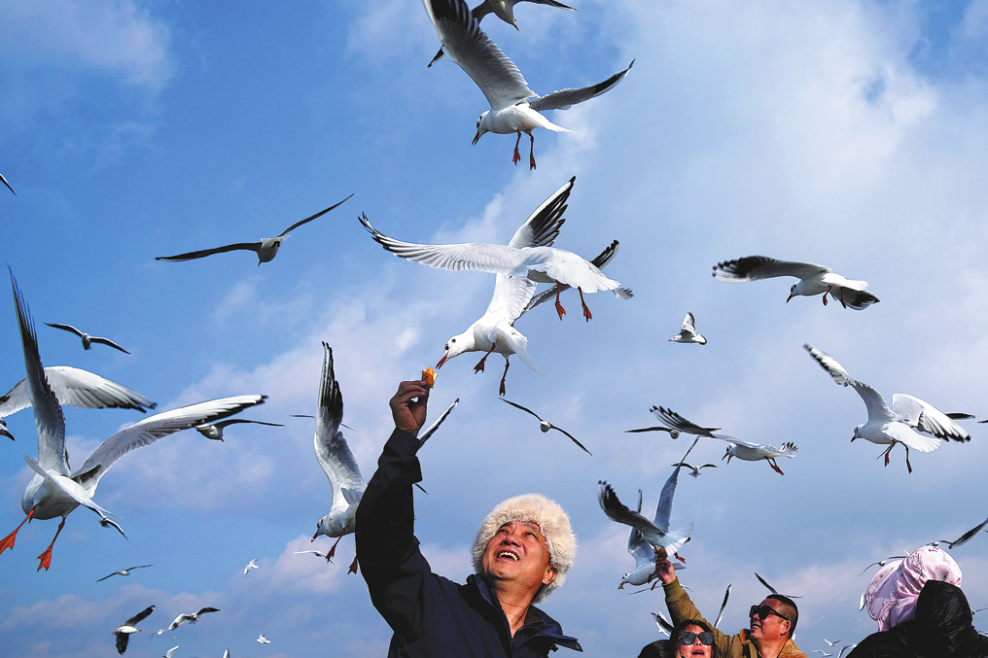
In the early days of Feng Jiang's tenure as a bird monitor at Chenhu Lake Wetland Nature Reserve in 2008, his routine was a laborious dance between nature and technology.
Armed with binoculars, the 41-year-old Feng would venture into the vast expanse of the 11,600-hectare wetland in Wuhan, the capital of Hubei province, his eyes sweeping across the landscape and sky.
What once involved a solitary camera capturing glimpses of the avian world in the park has now been transformed into a network of 31 cameras. Feng's work has also been made a lot easier thanks to a number of devices capturing the symphony of bird songs.
As Feng reflected on the past 16 years, he couldn't help but marvel at the profound changes that have swept through the park since the 18th National Congress of the Communist Party of China in 2012, which saw ecological civilization inscribed into the Party's Constitution.
Ecological civilization is a concept promoted by President Xi Jinping for balanced and sustainable development that features harmonious coexistence between humans and nature.
Feng said, "After the congress, I have noticed a clear increase in government support for our conservation efforts in the reserve, evident through enhanced funding and policy measures."
For example, the aquaculture enclosures that once vied for space on the water bodies of the park have been removed, and measures were introduced to compensate property owners within the reserve for any losses caused by wildlife.
Thanks to such measures, the area has been rejuvenated as a paradise for birds, with the foul odor of the once visibly polluted waters now a thing of the past, he said.
For Feng, the park's transformation serves as a microcosm of a broader shift in China toward valuing ecological benefits over mere economic gains.
"It's under the guidance of this philosophy that the series of conservation measures that led to the transformation were rolled out," he noted.
Feng's conclusion is consistent with the advocacy of the country's central leadership.
While addressing the Leaders Summit on Climate in April 2021, for example, President Xi emphasized the critical importance of prioritizing environmental preservation over short-term development gains.
Saying that "lucid waters and lush mountains are invaluable assets", Xi noted that to protect the environment is to protect productivity, and to improve the environment is to boost productivity.
"The truth is as simple as that," the president said, adding that "we must abandon development models that harm or undermine the environment, and must say no to shortsighted approaches of going after near-term development gains at the expense of the environment".
As the country advances the construction of ecological civilization, many local governments have raised the threshold for project introduction, rejecting ones that could be highly polluting.
Adhering to the principle that economic development must never come at the expense of the environment, the government of Xiantao, Hubei province, for example, rejected or discouraged over 50 heavily polluting industrial projects during the 13th Five-Year Plan (2016-20) period, the total investment for which would have been over 2 billion yuan, according to the Xiantao government.
Furthermore, Juungar Banner in the Inner Mongolia autonomous region, the country's largest county-level coal-producing area, with 58.2 billion metric tons of coal reserves, has nonetheless been making all-out efforts to promote the green transition.
Du Yanbin, deputy head of the banner, said, "Environmental protection is considered a crucial threshold for project introduction in the banner, and projects that are heavily polluting, cause permanent damage to the environment, or do not meet environmental standards are firmly rejected."
He added that during the 13th Five-Year Plan period, the banner rejected or discouraged more than 20 highly polluting industrial projects with a total planned investment of 50 billion yuan ($6.88 billion).
Juungar banner has optimized its industrial structure, vigorously cultivated and expanded industries related to energy conservation, environmental protection and clean energy, and promoted comprehensive resource conservation and recycling, Du said.
Amid such efforts, the construction of a demonstration project that will not only produce solar and wind energy, but also use the renewable energy to produce hydrogen, is nearing completion in the banner.
The project is expected to annually produce about 10,000 tons of hydrogen and generate 740 million kilowatt-hours of solar energy, reducing carbon dioxide emissions by about 594,000 tons, Du said.
The banner is also forging ahead with a project that consumes carbon dioxide to make arene, an important chemical widely used in medicine and pesticide manufacturing.
Hu Jun, director of the Research Center for Xi Jinping Thought on Ecological Civilization, said the robust development of green, low-carbon industries in China is becoming a new engine and new driving force for the country's economic development.
He said that last year, the added value of China's equipment manufacturing industry accounted for 33.6 percent of the total for industrial enterprises above a designated size, while the high-tech manufacturing industry accounted for 15.7 percent.
As of 2023, the country had seen its production and sales volume of new energy vehicles outpace all other countries for nine consecutive years, while its production of solar photovoltaic components led the world for 16 straight years, Hu told a recent forum.
He added that China's manufacturing capacity for wind turbine generators accounts for 60 percent of the global total, emerging as a new economic growth driver.
According to the Ministry of Ecology and Environment, since 2012, China has sustained annual economic growth exceeding 6 percent while maintaining an average annual energy consumption growth rate of 3 percent.
This achievement is underscored by a 26.8 percent decrease in energy consumption per unit of GDP, positioning China as one of the global leaders in rapidly reducing energy intensity, the ministry said.
China's ecological civilization process has won much international recognition.
Inger Andersen, executive director of the United Nations Environment Programme, emphasized ecological civilization as a "powerful concept", adding that "when leaders speak of lucid rivers and green mountains, that's a powerful notion that people can understand".
"So, I think those elements are important in also providing the imagination for people of what's possible in terms of protecting nature," she said.
Andersen especially lauded China's Shan-Shui Initiative, the massive ecological remediation drive that the country launched in 2016. The initiative, whose name translates as "mountains and rivers", is an ambitious, countrywide effort that aims to restore 10 million hectares of natural space, including mountains, forests, grasslands and waterways, by 2030.
To date, more than 6.7 million hectares of land have been restored, according to the Ministry of Natural Resources.
Andersen said the initiative is "hugely ambitious" and, in implementing it, China "is also creating green jobs". About 3 million jobs are expected to be created by 2030, she noted.
"When you see what before looked like the moon landscape and then afterwards looks just green and lush and amazing, you can see what human capacity and commitment can do," she said.
Xinhua contributed to this story.

- China's grain output hits new high in 2025
- Xinjiang ensures vegetable, fruit supply amid cold wave
- Chinese scientists develop self-powered device to speed up muscle repair
- Taiwan's leader Lai absent from first legislative review meeting of his impeachment
- New plant species with lemon fragrance discovered in China's Guizhou
- 21 civil servants face punishment over fatal 2024 coal mine accident in China's Yunnan