US' Xizang act malicious and malign









In the late 1940s, the United States took up the mantle from Britain and began agitating the “Tibet issue” on the international stage. In the 1950s and 1960s, the US supported the so-called International Commission of Jurists in releasing multiple “reports on Tibet”, propagating the notion that “Tibet was a de facto independent country between 1912 and 1950, and the people there have the right to self-determination”.
These reports fueled United Nations resolutions concerning Xizang. The campaign to promote the notion of “Xizang sovereignty” has been a persistent endeavor by Washington. On Friday (local time), US President Joe Biden signed into law the so-called “Promoting a Resolution to the Tibet-China Dispute Act”. This act presents a series of provocative propositions about Xizang’s sovereignty, historical status, geographical boundaries, and Chinese authorities’ contact and negotiation with the Dalai Lama.
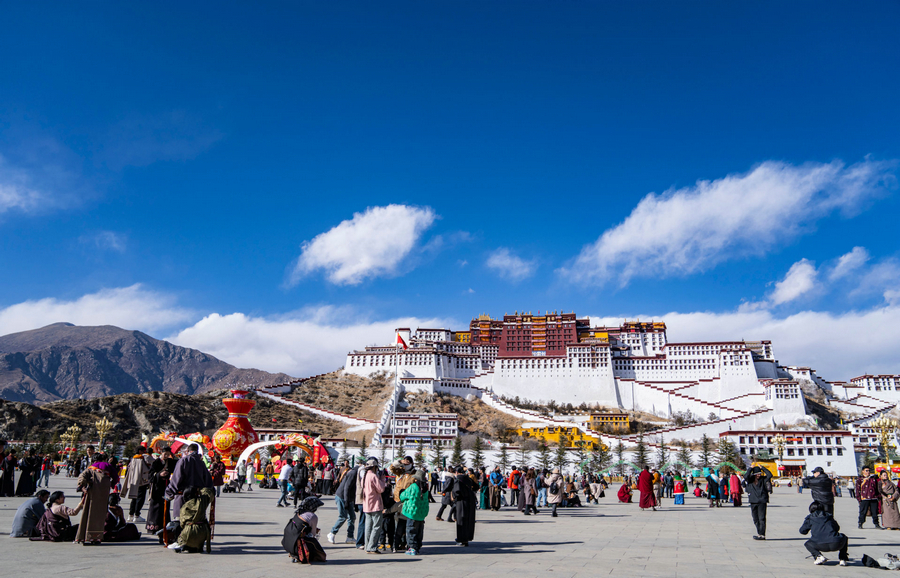
Today’s Xizang Autonomous Region enjoys social stability, stable economic development, improving living standards, cultural prosperity, and ethnic and religious harmony. However, some US legislators have tirelessly promoted the act with the aim of creating controversy where none exists. Their intention is to use a fabricated “dispute” to mask their real agenda of suppressing China.
The act distorts and abuses international law to legitimize itself. In recent years, Washington has increasingly introduced legislation targeting China. Since passing the first Xizang-related act in 1987, the US Congress has crafted over 300 Xizang-related bills, with about 60 becoming law. These form the so-called legal basis for US’ approach to the so-called “Tibet issue”. The recent act repeatedly claims China “violates” international law. It demands that “the Tibet-China dispute” be resolved according to international law and cites in a distorted and manipulated manner the United Nations Charter, the Universal Declaration of Human Rights, the International Covenant on Civil and Political Rights, and the International Covenant on Economic, Social and Cultural Rights to justify Xizang’s self-determination.
It is a historical truth that Xizang has been an integral part of China since ancient times and its governance is China’s internal affair. By trying to “l(fā)egitimize” the act citing international law, the US is endeavoring to internationalize the so-called “Tibet issue” using deception and the twisting and misinterpretation of international human rights documents to portray China as a violator of international law.
The act breaches fundamental principles to escalate the strategy of using Xizang as part of the US’ efforts to contain China. For a time, the “Xinjiang issue” was the focal point of US-led Western attacks on China. But that narrative waned as there were no grounds to support it. The US is now refocusing on Xizang with a revised narrative incorporating such fabricated issues as “boarding school education”, “mass DNA collection”, “forced labor”, “cultural genocide” and “arbitrary surveillance and detention”. The US’ “Tibetan Policy and Support Act of 2020” openly supported the so-called “central Tibetan administration” and omitted statements affirming Xizang as part of China in subsequent human rights reports. The latest act attempts to further undermine international recognition of the fact that “Xizang has been a part of China since ancient times”, falsely claiming the US government has never recognized Xizang as part of China since ancient times and asserting “Tibet includes some parts of Sichuan, Yunnan, Gansu, and Qinghai provinces”.
Countless historical documents attest to the fact that Xizang has been an inseparable part of China since ancient times. The international community has never recognized Xizang’s “independent status” or the legitimacy of the so-called “Tibetan government-in-exile”. The US act, seeking to present the illusion of Xizang as an “independent country”, is essentially a continuation of the US’ broader strategic game against China. The US is attempting to leverage the “Xizang card” to create new pressure points for China. The act aims to plunge Xizang into social turmoil, thereby undermining China’s sovereignty and territorial integrity and hindering its development. The act follows an established pattern of think tanks and scholars “revealing” information, the media reporting these “revelations”, politicians commenting on the media reports, and Congress then legislating in response.
The act emboldens “Tibetan independence” sentiments and supports the Dalai Lama’s separatist activities. It argues that the obstacle to further dialogue between the Chinese government and the 14th Dalai Lama is China’s conditions, such as recognizing Xizang as part of China. It calls for “substantive dialogue” between China and the Dalai Lama or his representatives without conditions.
These arguments aim to portray the Dalai Lama and his group as “l(fā)egitimate actors” and “victims”, increasing their “publicity” and “capital” for separatist activities and institutionalizing the so-called “Tibetan government-in-exile”.
Regarding contact and negotiation with the 14th Dalai Lama’s private representatives, the Chinese central authorities’ stance has always been consistent and clear. From 2002 to 2010, the central authorities conducted 10 rounds of talks with the Dalai Lama’s private representatives. However, the Dalai Lama lacked basic respect and sincerity, stubbornly adhering to his separatist agenda of “Tibet independence” “semi-independence” or “disguised independence” using Xizang’s sovereignty as a bargaining chip.
The so-called “Tibetan government-in-exile” is an illegal organization used by Western forces trying to split Xizang from China. It is devoid of any legitimacy. The true representatives of Xizang are the Chinese government and the Xizang Autonomous Region government. The “Tibetan government-in-exile” merely represents anti-China Western forces.
The act intensifies the US’ propaganda offensive, aiming to foment negative international public opinion about Xizang. It calls for US public diplomacy to counter alleged Chinese “disinformation” about Xizang, people in Xizang, and the Dalai Lama. It also provides funding for this “counteraction”, revealing the US intention to create an “information cocoon” and generate negative international sentiment about Xizang, inciting ideological confrontation, and exacerbating Western prejudice against China, thereby tarnishing China’s international image.
China’s position on Xizang’s sovereignty is based on indisputable historical facts, and reports on Xizang’s current situation and the well-being of its people are grounded in the reality of Xizang’s dramatic transformation over the past few decades, where people in Xizang enjoy unprecedented human rights. People of all ethnic groups in Xizang have first-hand experience of this reality, and numerous foreign media outlets have objectively reported on it, negating the notion of “disinformation”.
The author is an associate professor at the Human Rights Institute of the Southwest University of Political Science and Law.
The views don’t necessarily reflect those of China Daily.
If you have a specific expertise, or would like to share your thought about our stories, then send us your writings at opinion@chinadaily.com.cn, and comment@chinadaily.com.cn.