



World needs an 'ecological union' to fight climate change









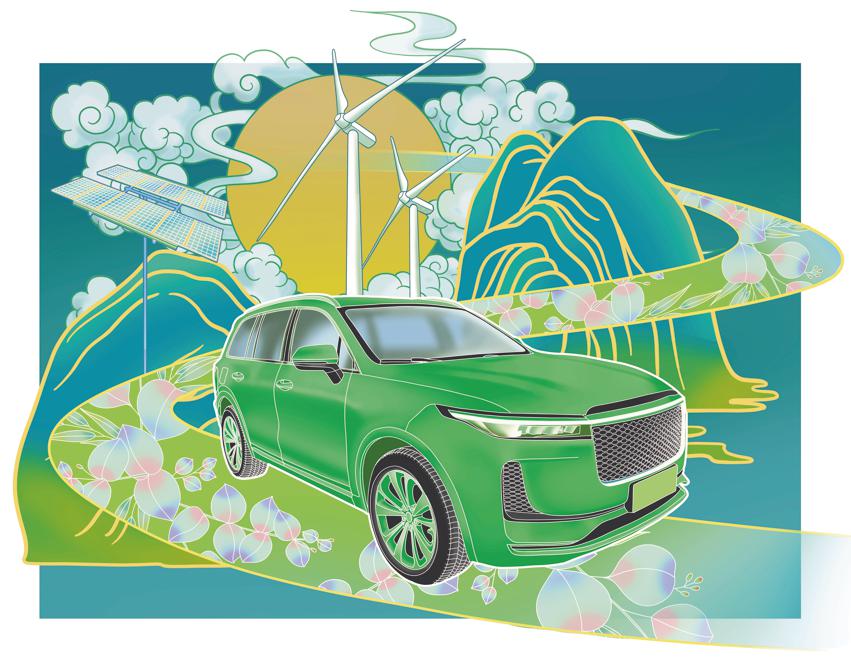
China is leading the world in green transformation of industry, driven by its dominant position in solar photovoltaic panels, high-quality yet low-cost electric vehicles (EVs) and EV batteries. Thanks to long-term policies of the government, and sophisticated, distinctive and innovative small and medium-sized enterprises, China's low-carbon transformation will help it to achieve high-quality development.
Yet two hurdles stand in the path of China's decarbonization. First, China is not alone in pursuing decarbonization, and many countries are not on track to realize decarbonization. Until all countries' decarbonization plans align with the Paris Agreement, limiting global temperature rise to below 2 degrees Celsius (let alone 1.5 C) will be impossible. Although commentators will continue to complain about China's overcapacity in green products, the real concern is the low global demand for such products. Second, while China has made remarkable strides in renewable energy and electric vehicles (EVs), it can further enhance its efforts to achieve climate targets by reducing its reliance on coal.
Indeed, China has the resources and political will to achieve its climate target of peaking its emissions before 2030 and realizing carbon neutrality before 2060.The same cannot be said of the lower-income countries.
Besides, global climate negotiations are stuck because countries such as India legitimately condition their decarbonization efforts on transfers from high-income countries (the historical polluters), but high-income countries like the United States have always refused substantial transfer.
There are two ways of breaking the deadlock in climate negotiations: moving on with high-ambition countries by accepting that some countries will not join ambitious climate agreements; and negotiating an agreement that involves substantial North-South transfers. High-income economies such as the European Union, however, would need to contribute financially.
Such economies may accept a deal for two reasons. One, because they are genuinely concerned about climate change and understand that the only way forward is by contributing to climate justice. And two, since the EU will most likely miss its 2030 climate target (the European Environment Agency estimates that at best the bloc can reduce emissions by 48 percent instead of the targeted 55 percent from the 1990 level), it could circumvent this failure by purchasing emissions allowances from other countries by providing them with due technology and financial transfers.
With diplomats and researchers from African countries, the EU, Brazil, China and India, we are working on a proposal of international climate policy that could suit the interests of most countries. Here is a summary of a work-in-progress proposal for an "ecological union".
In the short term, economies participating in the proposed "ecological union "would establish a uniform carbon price floor at 100 yuan ($13.75) per ton of carbon dioxide, which roughly corresponds to the CO2 price in China's carbon market. The exact price floor would be proportional to the temperature increase in the previous five years' moving average: when global warming ends, the price will be zero.
A share of the carbon price revenue raised in a given country would be pooled at the global level and rebated to participating countries in proportion to their population. The pooled amount would be proportional to the country's GDP, ensuring transfers from rich countries to poor countries: the farther above the global average per capita GDP, the more a country contributes and the farther below the global average, the more a country receives.
Besides, countries in the "ecological union" would commit not to tax the carbon content of imports from one another, and return the tax collected to the exporting country if they do so. This would neutralize the ecological union's CBAM for participating countries.
In the medium term, the "ecological union" would establish a global carbon market. Each country would be granted emissions rights proportional to its population as a benchmark. There would be some adjustments to the benchmark in line with specific needs and ambitions of certain regions. Especially, China and the EU would get emissions rights corresponding to their respective decarbonization plans.
This would give more rights than the benchmark to China, and less to the EU.Such adjustments would preserve the overall ambition of the "ecological union", helping it to meet the objective of the Paris Agreement.
Importantly, integrating all economies' emissions in a common market would guarantee that each economy respects its target. For example, if the EU ends up emitting more than it aimed for, this will be compensated by other economies emitting less than the world average and selling their emissions rights to the EU.Emissions reductions will take place where they are least costly. And transfers will flow from rich to poor economies, spurring growth and poverty reduction in lower-income countries.
Adrien Fabre is a CNRS researcher at the International Research Centre on Environment and Development in Paris; and Hu Bin is research director for Global Climate Governance, Institute of Climate Change and Sustainable Development, Tsinghua University. The views don't necessarily reflect those of China Daily.
If you have a specific expertise, or would like to share your thought about our stories, then send us your writings at opinion@chinadaily.com.cn, and comment@chinadaily.com.cn.





