Eating disorders are food for thought









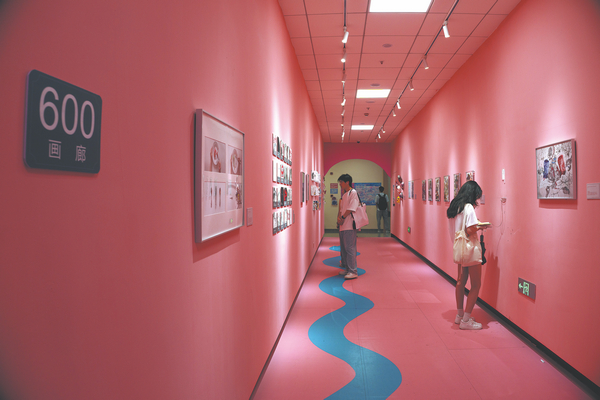
Exhibition puts spotlight on psychology, societal pressures, and pains of the relatives to raise public awareness, Zhou Wenting reports.
For most people, food is a source of nourishment and pleasure, but for a certain group of individuals, it becomes at worst a matter of life or death. For these individuals, when asked to use clay to represent what food is in their minds, many of the pieces they make are messy and distorted in color and shape.
The shapes mirror their mixed feelings toward food and are conflicted by strong dependence and resistance and boundless longing and fear.
Putting a focus on eating disorders, an exhibition at the Shanghai Mental Health Center has been displaying the drawings and clay works of eating disorder sufferers they made as art therapy during hospitalization. The exhibit also includes works created by artists currently or previously afflicted by the diseases.
Chen Jue, director of the Eating Disorders Treatment Center of SMHC, says that there is still much misunderstanding by the public toward eating disorders. "People may simply perceive such patients as those who don't eat well, make a fuss about diets, go to extremes in losing weight and have poor self-control.
"However, eating disorders are physiological disorders that are closely related to psychological factors. Although they manifest as eating-related behavioral problems, there are complex mental health problems behind them," says Chen from the center established in 2017, the first one specializing in the diagnosis and treatment of eating disorders in China.
The exhibition aims to help the public better understand the diseases and patients to show more tolerance and care, she says.
More than a diet issue
Experts explained that eating disorders are a group of psychiatric disorders characterized by abnormal eating behaviors and psychological disturbances accompanied by significant weight changes and challenges in physical and social functioning.
Eating disorders mainly include anorexia, bulimia and binge eating. Eating disorders are more common in adolescents and young women, with anorexia having a mortality rate of 5 to 20 percent, making it one of the most life-threatening diseases in the psychiatric field.
Anorexia usually includes a low body weight, intense fear of gaining weight and an unrealistic self-image. Anorexia often involves using extreme efforts to control weight and body shape, which may lead to systemic multiorgan complications caused by malnutrition that seriously affect normal life.
"Some patients even suffer from body dysmorphic disorder, characterized by inappropriate self-awareness of their body shape," she says. "A classical cartoon about the disorder depicts a slender person standing in front of a mirror who sees an obese body. So in their minds, they think that they're not slim and need to lose weight."
Some anorexia may develop into bulimia — bingeing, or eating a large amount of food in a short time, then, due to guilt, purging to get rid of calories. Purging can include vomiting, excessive exercising, not eating for a period of time, or other methods, such as taking laxatives.
"Families of such patients are in pain. They either eat too much or nothing and are out of control. Eating topics can throw families into turmoil and every meal turns the home into a battlefield," says Chen.
Women and young patients
The number of female patients suffering from eating disorders is universally far higher than their male counterparts. Chen says the ratio of female to male sufferers is larger than 10 to 1 in China.
"I believe a main factor is that social culture puts more pressure on women in terms of anxiety about appearance. It seems that women with pretty faces and slim figures are more likely to succeed. Therefore, some college students start losing weight in preparation for job interviews," says Chen.
A 19-year-old woman who finally ended her two-year fight with anorexia says that she believes the fact that female patients outnumber males is a result of societal expectations.
"One reason that I finally conquered the disease was that I became aware that the idea of thinness and weight instilled in women is detrimental to my health and how painful and difficult it would be to live with a body like that. But for many going through puberty, to conform to such standards of beauty becomes unshakable. I hope to help more women overcome these concepts," says the woman, using the alias Lam.
TV screens convey the message that celebrities are slim without exception to the public and nowadays new media, including short videos, accelerates the spread of such social pressures.
The international medical society acknowledges that people between 13 and 20 years old are the most affected by anorexia. But Chen says her youngest patient is only 7 and it is not rare to see patients as young as 11 or 12.
Kids with self-esteem
In 2022, as high as 77 percent of anorexia patients hospitalized at the Eating Disorders Treatment Center of SMHC were younger than 18, according to the center's statistics.
"Children nowadays are exposed to the internet world at an early age. People tend to beautify their photos before sharing them online and part of the process makes their faces and bodies slimmer," says Chen.
"Also, they will hear adults talking about going on diets and losing weight quite often. Gradually, they'll form a concept that a slim body shape means beauty, attention and self-discipline," she says, adding that extreme cases include some who lived on water for a week and fainted due to low blood sugar at school.
Doctors say that looking at personalities, anorexia and bulimia sufferers are usually demanding of themselves in many ways, which can lead to an extreme pursuit of a certain body shape, with a strong determination to achieve that goal.
"However, they also suffer from low self-esteem. The more inferior they feel about themselves, the more they will base their worth on things like body shape and weight because they think these can be controlled. When they lose a little weight, they may get the so-called praise of people, which helps them feel good," says Chen.
If hospitalized, eating disorder patients typically need to stay in the hospital for four to six weeks. Doctors will inform them that the behaviors are very harmful to their health and will stimulate their motivation for cooperation. Some patients, especially bulimia sufferers, become cooperative as they feel tortured by such a way of life.
Goodwill from strangers
The exhibition is beginning to harvest goodwill from the public. Some among the audience share their feelings in the message book at the center or online. Many people leave messages, hoping the sufferers can recover from the diseases soon and feel better. Some also encourage them to be healthy and never give up.
"The gallery allowed me to learn for the first time that patients with eating disorders are suppressing a lot of emotions and enduring hardships. I feel that they are very brave for fighting against the diseases," reads a message in the message book.
Zhang Qinwen, who participated in designing the exhibition and was once a patient for years herself, hopes the public can understand the essence of eating disorders through the form of art, but not ignore the pain due to the artistic expressions.
"What I want to say the most is to tell sufferers of eating disorders that everybody deserves love. And I hope that every bite they eat, they can taste happiness," says Zhang, who shared her personal experience of conquering anorexia online in 2019, and encouraged many.
Contact the writer at zhouwenting@chinadaily.com.cn