Medical LMs evolve, touch more lives
China's core AI industry worth 500b yuan, with over 4,400 related firms










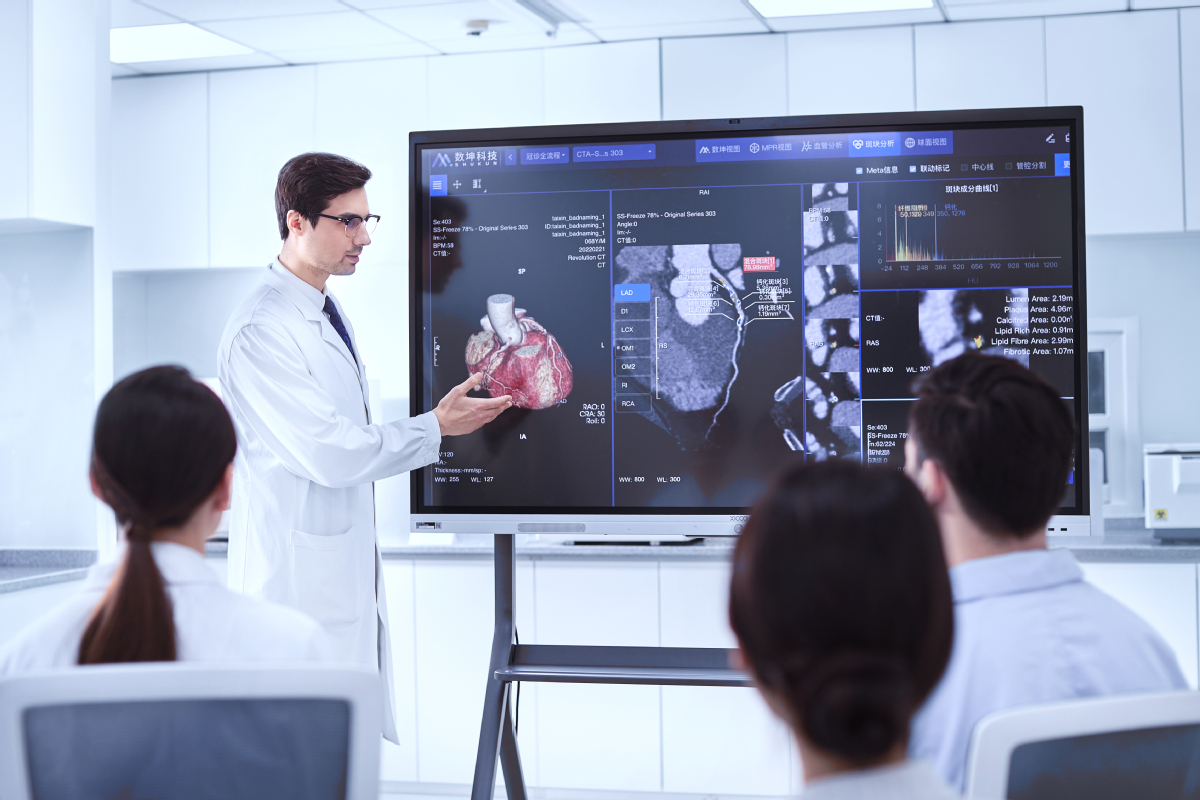
Currently, there is a wide range of application scenarios for medical LMs.
Researchers from Fudan University in Shanghai and the University of Massachusetts in the United States recently had their latest medical LMs take the US Medical Licensing Exam, and the results showed AI surpassing 70 percent of medical students.
In a study on the potential and limitations of clinical applications of medical LM, Nature, a world-leading multidisciplinary science journal, also acknowledged the prospects of medical LMs and was optimistic about its potential in producing imaging reports, completing protein sequences, and other tasks.
Doctors are maintaining an open attitude to the proliferation of medical LMs.
In the field of oncology, for example, most oncologists hold a positive attitude toward the application of AI, said a recent report conducted among healthcare professionals by Dingxiangyuan, an online health information services provider. Doctors, it said, are constantly understanding its true value through clinical practice and applications.
The demand for large-scale modeling technology from enterprises has risen accordingly.
According to US market consultancy Gartner's research earlier this year, over 60 percent of Chinese enterprises plan to deploy generative AI within the next 12 to 24 months, and healthcare is one of the most important application scenarios.
Talk around the application and commercialization of LMs in the medical field is ever present, but is it really helping doctors and patients?
"Speaking of AI, we physicians from the imaging department may be the ones that benefit the most. AI is able to replace our preliminary work, such as reading images in the first place and making primary assessments. However, we still need to read images and make diagnoses by ourselves," said a physician surnamed Qin, who works at Beijing Chaoyang Hospital, Capital Medical University.
Through big data and deep learning, medical LMs cut intermediate links, recommend diagnosis and treatment plans for doctors and patients, and enhance work efficiency to a large extent, said Zhang Shule, a columnist at people.cn, citing diagnosis and treatment as examples.
However, because of the complexity of many diseases, medical LMs are often not able to complete the entire diagnosis and treatment procedure.
"This pain point requires sufficient and vertically segmented big data accumulated for different cases, to provide deep learning models for diagnosis and treatment reference, in order to minimize the misdiagnosis rate of doctors. However, such a large amount of data cannot be accumulated solely by one city or province, and require nationwide data exchange and reference to foreign cases, which is somehow difficult to achieve," Zhang said.
Experts also said that the serious nature of healthcare, a lack of interconnectivity in data, and the industry's zero fault tolerance make the commercialization of medical LMs difficult.
Qu Fang, an investment consultant at Wanlian Securities, said: "Currently, there are several pain points in the commercialization of medical LMs. On the one hand, there are risks of patient data privacy leakage, including data creation, storage and transmission. Leaked patient data may run the risk of being used for illegal activities."
"On the other hand, there is a significant deviation in the accuracy of the model. At present, it is not possible to accurately apply LMs in clinical applications. The complexity of patient treatment is difficult to achieve through simple AI models. Each patient has a different constitution, and the development and treatment response to their symptoms are also different. While AI plays an important role in assisting analysis, more experienced doctors are needed to make judgments. The risks of technological iteration, and legal and ethical issues should also be noted," he added.
Currently, there is a lack of open-source medical big data globally, and AI companies have limited direct access to data.
However, as AI technology matures, a large number of hospitals are joining hands to create disease imaging and third-party testing databases.
Data volumes are showing exponential growth, and the difficulties AI companies face in developing new indications have sharply decreased, leading to an increase in the richness of medical AI products. The future scenarios of AI-assisted diagnosis will be more diverse, which can better assist doctors, experts said.
Bo Wenxi, vice-chairman of China Enterprise Capital Union and chief economist at wealth management firm IPG China, said that the market scale of medical LMs is expected to grow significantly in the next five years.
Specifically, subcategories, such as personalized diagnosis and treatment, drug R&D, assisted diagnosis, remote consultation, medical popular science, and smart device integration, are expected to show significant development.
Zheng Shanjie, head of the National Development and Reform Commission, the country's top economic regulator, said China will take solid steps to accelerate the development of new quality productive forces, boost industrial innovation via technological innovation, speed up the upgrading of traditional industries and foster emerging industries.
Zheng said the NDRC will constantly carry out practical measures, especially in the area of life sciences, high-end manufacturing and digital technologies, to facilitate companies doing business in China.