



Balancing an inflated membership









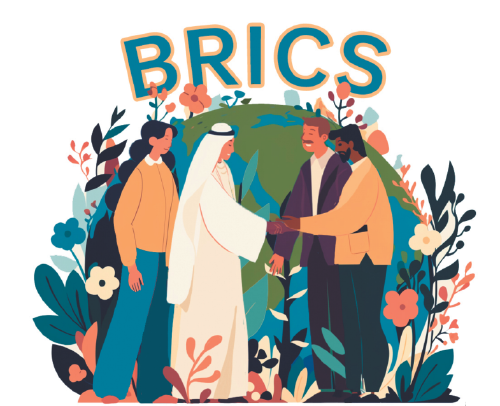
Ma Xuejing/CHINA DAILY
Successful handling of internal relations requires BRICS to become the center stage for global South-South cooperation, instead of a confrontational leverage against the US-led West
At the beginning of 2024, BRICS underwent a historic expansion. Notable among the newly accepted members are four countries from the Middle East — the United Arab Emirates, Egypt, Saudi Arabia and Iran. Algeria, Kuwait, Bahrain, Morocco, Syria, Tunisia, Sudan, Turkiye and other countries have also expressed their desire to join the group. The moves reflect a heightened emphasis on strategic autonomy and national security amid accelerated global and regional multipolarity and intensified great power competition. As Middle Eastern countries increasingly seek economic reform, political independence and diplomatic diversification in regional and global affairs, joining the BRICS is a step in keeping with their interests and strategic needs.
Economic development sits at the heart of the Middle Eastern countries joining BRICS. The economic might of BRICS nations and their ongoing deepening cooperation presents a much-needed leverage for the Middle Eastern members to develop their own domestic economies. In 2023, the five BRICS members accounted for 32.1 percent of global GDP, exceeding the G7 group's 29.9 percent. In particular, China remains the largest trade partner of the Middle Eastern countries. In 2022 alone, China's bilateral trade with the Middle Eastern countries reached $507.15 billion, with an average annual growth rate of nearly 15 percent over the past five years. These are all alluring factors to the Middle Eastern countries, who wish to diversify their oil-intensive economies and blunt the influence of Western sanctions through major trade and energy partnerships with the BRICS nations.
The entry of the Middle Eastern players also means gaining political and economic importance. Egypt, the UAE, Saudi Arabia and Iran are not only major powers in the Middle East but also heavyweights on the global political and economic stage. The combined population of these four countries is nearly 230 million, while their total land area is spread across 5 million square kilometers, strategically positioned at global transportation hubs. These nations possess abundant energy resources, with Iran, Saudi Arabia, and the UAE collectively holding 32 percent of the world's proven oil reserves and 25 percent of proven natural gas reserves, playing a crucial role in the global oil and gas markets. As regional powers and emerging major economies, these four countries have significant influence in the Middle East, Africa, Central Asia-Caucasus, the Arab-Islamic world, and among developing nations.
The BRICS countries have had development priorities complementary with the Middle Eastern powers, and without the political strings often attached to cooperation with other developed countries. Trade between India and the Gulf Cooperation Council, for example, continued to rise, with their bilateral trade volume reaching $154.66 billion in fiscal year 2021-22, which represented an average annual growth rate of 10.6 percent over the past five years. In comparison, in 2022, the trade volume between the United States and the Middle Eastern countries was $212 billion. China and India have also replaced the West as the most important crude oil export destinations for the Middle Eastern countries. Under the "OPEC+"cooperation mechanism, Russia has become a strategic partner of OPEC with the Middle Eastern countries as the main members.
Geopolitical considerations are also a factor. By gaining BRICS membership, the Middle Eastern countries hope to increase their presence in global affairs and expand their regional influence. Iran's entry is aimed at strengthening ties with China and Russia and leveraging BRICS to counter the US. Egypt's entry into the BRICS implies a desire to balance its regional roles in North Africa and the Middle East. The UAE and Saudi Arabia also want to leverage the economic power of the Global South to strengthen their own regional status.
While the joint entry reflects to some extent significant changes in the global governance system and a new understanding of the architecture for peace and development in the Middle East, the conflicting interests of each new member reflect a series of challenges that lie ahead of the expanded BRICS. For Egypt, Saudi Arabia and the UAE, the main challenge lies in how to deal with the discontent from the US and balance their identity as BRICS members and their status as allies and partners of the US. For Iran, joining BRICS signifies a further step in its "Look East Policy" and its relationship with China and Russia, which could potentially face opposition from pro-Western forces at home. For the BRICS cooperation mechanism itself, embracing many Middle Eastern Islamic countries will also bring about challenges such as integration.
In the future, BRICS needs to position itself with three major identities: a pioneer in global development, a leader of the Global South, and a major platform for global governance. The inclusion of the Middle Eastern countries will help further elevate the status of BRICS countries in global politics, economics, energy and finance. This will enhance BRICS' global representation in the Global South, promote global strategic balance, advance diversification in the international landscape, improve the global governance system, enable BRICS to play a greater role in West Asia, Africa, and the Islamic world, and address regional hotspot issues and challenges.
Integration and reorientation are the chief tasks for BRICS, which must balance the different interests and priorities of its inflated membership. It should be guaranteed that the new members consciously acknowledge and adhere to the key concepts and principles of development as the foundation of BRICS.Successful handling of the internal relations requires BRICS to become the center stage for global South-South cooperation and global governance, instead of a confrontational leverage against the US-led West.
The author is director and researcher of the Middle East Development and Governance Research Center at the Institute of West-Asian and African Studies at the Chinese Academy of Social Sciences. The author contributed this article to China Watch, a think tank powered by China Daily. The views do not necessarily reflect those of China Daily.
Contact the editor at editor@chinawatch.cn.





