Developed countries should intensify climate actions









The 8th Ministerial on Climate Action, an annual meeting attended by ministers and high-level representatives from more than 30 countries, was held in Wuhan, Hubei province, on July 22-23.
The meeting, launched in 2017 amid rising uncertainties created by then US president Donald Trump's announcement to withdraw the United States from the landmark 2015 Paris Agreement, underscores the importance of collective action in tackling climate change.
Uncertainties emerged again before the Wuhan meeting, with US President Joe Biden, who signed an instrument to bring the US back into the Paris Agreement on his first day in office, announcing on July 21 that he was quitting the presidential race against Trump.
That Trump has garnered widespread support in the US has raised fears about the US' future role in the global fight against climate change in case he wins the presidential election. The future looks all the more uncertain because the climate crisis has been intensifying and the collective global fight against climate change has been wavering of late.
In China, a landslide on July 20 triggered by extreme downpours left at least 14 people dead and 25 missing in Sichuan province. In Kenya, floods and landslides, triggered by heavy rain since mid-March, had claimed 267 lives as of May 11. And the landslide in southern India on July 30 claimed more than 300 lives.
The global list of extreme weather events is very long. In light of increasingly devastating weather events, the need for urgent multilateral action has become even more evident. Mother Nature is calling us to unite and more seriously address the climate crisis to save the planet.
A harsh reality is that developing nations, which have contributed the least to the climate crisis, not only have to bear the brunt of the extreme weather events, but also lack the resources to prevent and combat them. Hence, developed countries should continue to provide the developing nations with more economic and technological support to mitigate and adapt to climate change.
The developed world's support for the developing countries has always been a necessity. This is also what the common but differentiated responsibilities and respective capabilities to combat the climate crisis of the United Nations Framework Convention on Climate Change and the Paris Agreement advocate.
As ministerial-level representatives from more than 30 countries, including the United Arab Emirates, Azerbaijan, Australia and South Africa, gathered in Wuhan for the meeting in the lead-up to the 29th UN Climate Change Conference (COP29) in Azerbaijan in November, a major concern of the developing economies was that their demands for climate support should be adequately addressed.
In 2009, developed countries committed to jointly mobilize $100 billion a year in climate finance by 2020 to boost climate actions in developing nations.
In 2015, this commitment was extended through to 2025. The developed countries, however, have never timely and faithfully fulfilled their promise despite the worsening climate crisis and its devastating impacts, further increasing the need for even higher spending to cope with the crisis.
The fulfillment of the promise by the developed countries is critically important, for it will help restore the developing nations' trust in the developed countries, which is necessary to strengthen the global fight against the climate crisis.
Moreover, the developed countries, apart from honoring their previous promise, should also set a post-2025 new collective quantified goal and devise a clear roadmap to double the financial assistance as promised. This is essential to meet the developing nations' need to expedite their low-carbon transition and boost their climate resilience, and to ensure the success of COP29.
But irrespective of what the developed countries do, China will continue to strengthen the global fight against climate change, as demonstrated by its domestic climate actions and efforts to boost multilateral efforts to address the climate crisis. Despite external uncertainties, China remains unwavering in its commitment to achieve its climate goals of peaking carbon dioxide emissions before 2030 and realizing carbon neutrality before 2060.
Since 2012, the country has been experiencing on average 6 percent GDP growth a year, but its average annual energy consumption has increased by only 3 percent, which has resulted in a decline in CO2 emissions per unit of GDP by more than 35 percent — equivalent to the reduction of 1.4 billion tons of CO2 emissions.
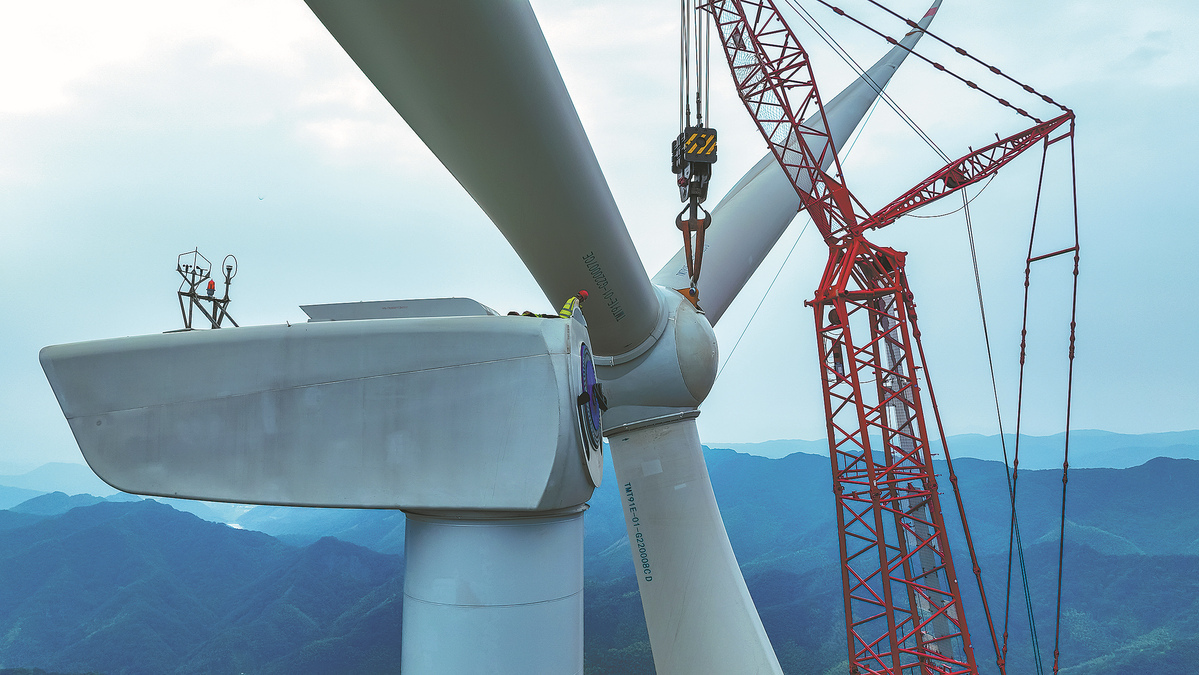
China has been undergoing an energy transformation. In 2023, the country contributed more than half of the added 5.11 billion kilowatts of renewable energy capacity globally. And Chinese-made electric vehicles, wind turbines, solar photovoltaic panels and other green products have played a significant role in reducing the CO2 emissions of the countries and regions importing them.
Also, in the first half of this year, China signed 51 South-South climate cooperation documents with 41 countries, including building low-carbon demonstration zones and solar-, wind — and hydro-power projects.
And China is willing to work with other countries to jointly address the climate crisis, as stressed by Chinese leaders and high-level officials in many international forums.
The author is a writer with China Daily.
houliqiang@chinadaily.com.cn