Fiscal reform charts a new development path









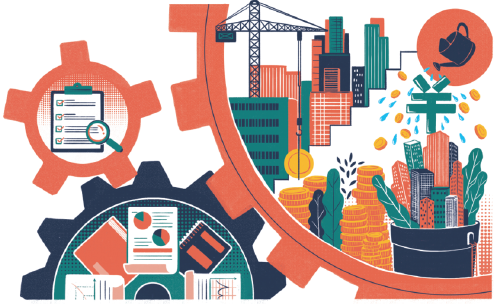
The resolution of the third plenary session of the 20th Central Committee of the Communist Party of China, held from July 15 to 18, said China will "deepen reform and advance Chinese modernization under the rule of law and ensure unity between reform and the rule of law".
Since finance is a cornerstone of good governance, China has to ensure its financial policy supports comprehensive reform and helps advance Chinese modernization, which are challenging tasks given the complicated international environment and complex domestic problems. But under the Party's directives, China's financial policy has been designed to facilitate reform.
Achievements and new directions
Since the 18th CPC National Congress in 2012, guided by Xi Jinping Thought on Socialism with Chinese Characteristics for a New Era, China has made remarkable achievements in the financial sector while adhering to the new development philosophy, which emphasizes stability and progress. It coordinates the "Five-Sphere Integrated Plan" and the "Four-Pronged Comprehensive Strategy", keeping in mind both domestic and international imperatives, balancing development and security, and pursuing high-quality development.
President Xi Jinping has said that comprehensive reform is the driving force behind Chinese modernization. In this regard, China's financial policy has always been focused on establishing a modern fiscal system in line with the national governance system, in order to strengthen budget management, and promote fiscal and tax reforms.
China's financial management has transformed from one focused on balancing "revenue and expenditure" to being a primary tool for macroeconomic control. Active fiscal policy uses tax tools to manage short-term economic fluctuations and supports long-term economic transformation. Structural tax cuts began in 2012, followed by large-scale tax reductions in 2016.
These cuts reduced operational costs, benefited taxpayers, facilitated the transformation of businesses and boosted consumer spending. Over the past 12 years, tax reductions and fee cuts have exceeded 14 trillion yuan ($1.95 trillion), the largest among major economies, enabling China to maintain healthy growth despite economic shocks such as the COVID-19 pandemic.
China's macro tax burden stabilized after 2023 thanks to tax reforms. These reforms optimized the main tax categories, by replacing business tax with value-added tax (VAT), plugging the loopholes in the taxation system, curbing double taxation, and promoting the division of industry. And corporate and personal income tax reforms have reduced the burden of taxpayers, helping finance to play new roles in the new era.
Taxation's new roles in national development
China's financial sector has evolved substantially, supporting the construction of a high-level socialist market economy. The 18th CPC Central Committee's third plenary session in November 2013 outlined the goals of comprehensive reform, aiming to improve the socialist system and modernize national governance.
A modern, scientific fiscal system is not just about updating financial mechanisms but also about strengthening governance, by optimizing resource allocation, maintaining market unity, promoting social equity and ensuring long-term stability. As for fiscal support for poverty alleviation, from 2013 to 2020, central, provincial and local governments allocated nearly 1.6 trillion yuan ($223 billion) for poverty alleviation work, with the central government contributing about 41.3 percent of the amount.
New functions in governance
China's financial system now features both governance and control, essential for achieving the rejuvenation of the Chinese nation. Fiscal policy underpins economic and social prosperity, ensuring stability during uncertain times, and the financial sector connects the State, market, society and the people, maintaining the right balance, preventing overreach and ensuring governance is based on communication and coordination.
One of the financial sector's new roles is to lay a solid foundation for transforming China into a modern socialist country by the middle of this century. Amid a new technological revolution and industrial transformation, finance is also driving the development of new quality productive forces.
Since 2012, China has also seen a rapid growth in investments in research and development, which have promoted innovation. According to the National Bureau of Statistics, China's R&D expenditure reached 3.3 trillion yuan in 2023, up by 8.1 percent year-on-year. And the intensity of R&D expenditure (the ratio of R&D investment to GDP) was 2.64 percent.
Also, national fiscal expenditure on science and technology was 1.06 trillion yuan in 2023, an increase of 7.9 percent year-on-year, accounting for about one-third of total R&D investment. This notable growth in R&D funding highlights China's efforts to enhance its original innovation capability and basic research.
Despite significant fiscal pressure, financial support to the science and technology sector has increased, demonstrating China's commitment to promoting technological innovation, which is crucial for improving the national sci-tech strength.
Vision of 20th CPC Central Committee
The 20th CPC Central Committee has said the next few years are critical for advancing Chinese modernization and achieving national rejuvenation. However, China's financial sector, with its new roles, functions and positioning, still has room for further improvement.
Amid a new wave of fiscal and tax reforms, China's financial system is poised to embark on a new journey by fulfilling certain tasks. First, it has to fully implement Xi Jinping Thought on Socialism with Chinese Characteristics for a New Era, and integrate financial reforms with the Party's policies and decisions.
Second, there is a need to understand the profound importance of the resolution of the third plenum of the 20th CPC Central Committee, which emphasized the importance of using economic reform to promote social equity, improve people's well-being and facilitate systematic integration. These efforts will better integrate production relations with productive forces, the superstructure with the economic base, and national governance with social development.
And third, China has to identify its reform priorities, keeping in mind that effective macroeconomic control and governance are essential for leveraging the advantages of the socialist market economy. Accordingly, China will improve its macroeconomic control system, intensify financial and taxation reforms, strengthen macroeconomic policy, and improve the strategic planning and policy coordination mechanisms.
China will also implement measures to prevent and mitigate risks in key fields including real estate, local government debt and small financial institutions, adhering to the central government's requirements to complete the reforms by the 80th anniversary of the founding of the People's Republic of China in 2029.
The author is an associate researcher at the National Academy of Economic Strategy, Chinese Academy of Social Sciences.
The views don't necessarily represent those of China Daily.
If you have a specific expertise, or would like to share your thought about our stories, then send us your writings at opinion@chinadaily.com.cn, and comment@chinadaily.com.cn.