Male mosquito sorter may help beat dengue
International team invents device to rein in the insect's reproduction









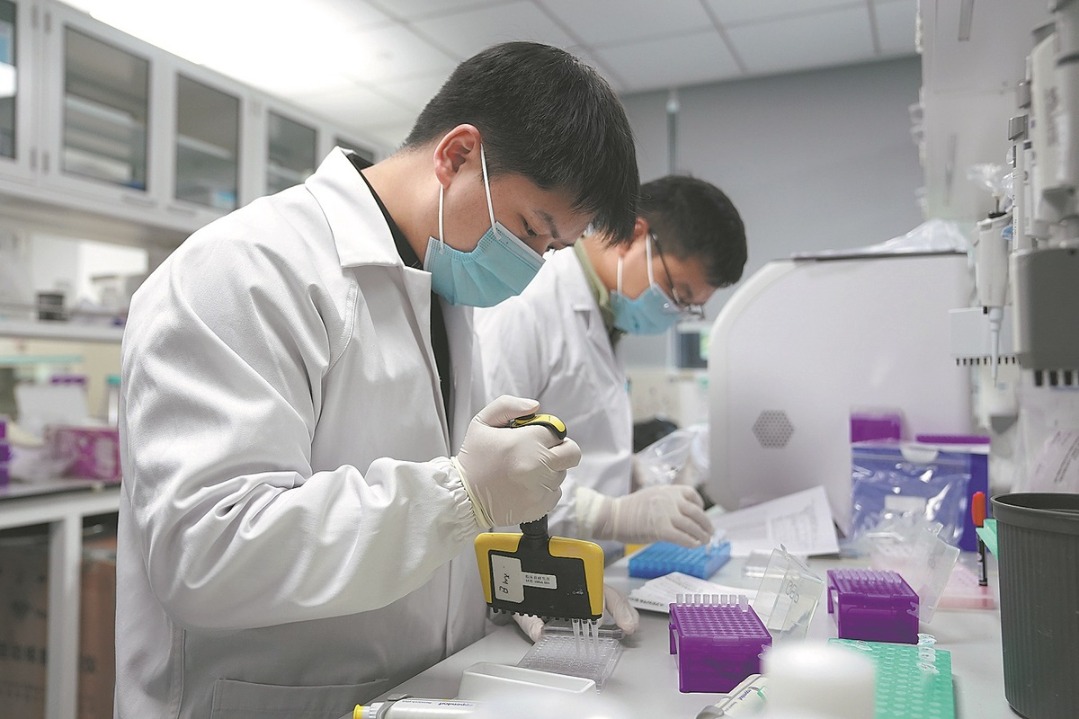
Scientists have made a breakthrough in "fighting mosquitoes with mosquitoes" by developing an automated device that can efficiently separate male and female mosquitoes, playing a significant role in increasing the production of sterile males to control mosquito reproduction.
The research result, achieved by an international research team, has attracted worldwide attention following its publication in the academic journal Science Robotics earlier this month.
The team includes professors and experts from Michigan State University in the United States, and Jinan University and Guangzhou Wolbaki Biotech Co, both in Guangdong province.
Xi Zhiyong, a professor at Michigan State University, said the device has helped overcome a major engineering bottleneck in controlling mosquito-borne diseases through biological control strategies.
Xi said one approach infects male mosquitoes with wolbachia, a bacterium that exists in many insects, including mosquitoes, but does not infect mammals.
Eggs produced by female mosquitoes that mate with wolbachia-infected males are infertile, which leads to a reduced mosquito population. And only female mosquitoes bite humans.
The device is used to separate wolbachia-infected males for release into the wild, Xi said.
"It has been proven to be effective in preventing and controlling the spread of dengue fever and related mosquito-borne diseases after repeated testing by a dozen countries worldwide," Xi said on Sunday.
The World Health Organization has concluded that the technology has potential for long-term control of dengue mosquito vectors and has started to develop guidelines for deploying the technology in countries where dengue is endemic, he said.
Xi said 18 of the devices have been sold in the United States, Brazil, Cuba, Thailand, Italy and other countries hit hard by dengue fever, playing a role in controlling the spread of mosquito-borne diseases.
Researcher Gong Juntao, who is deputy general manager of Guangzhou Wolbaki Biotech, said the research team independently developed an automatic mosquito pupae male and female separator with two national invention patents.
The mixing, separation and collection processes of the pupae are efficiently integrated, which can effectively and quickly separate a large number of male mosquito pupae when there is sufficient supply, Gong said.
"Compared with traditional manual separation methods, the automatic mosquito pupae male-female separator has increased the production capacity of male mosquitoes by 17 times, and can achieve the separation of 16 million male mosquitoes a week," Gong said.
Xi, also co-founder and chairman of Guangzhou Wolbaki Biotech's board, is a former director of the Sun Yat-sen University-Michigan State University Joint Center of Vector Control for Tropical Diseases.
"Now we need to solve two problems, expanding production scale and reducing costs, to meet the growing demand for the technology in dengue-endemic countries," he said.
Xi and his team started the project to "pit mosquitoes against mosquitoes" in Guangzhou, the capital of Guangdong province, in 2011.
Li Yongjun, an associate professor at Jinan University, said mosquito-borne diseases, led by dengue fever, have become increasingly severe with climate change and increased human mobility in recent years.
"Chemical control has limited effects on these pests and brings environmental pollution and drug resistance problems," said Li, who participated in the research.
Xinhua contributed to this story.




- China, Philippines to keep talks open on maritime affairs
- AI governance tops China’s 2025 technology buzzwords list
- China-Swiss exhibition on green construction opens
- China says navy, coast guard are peace guardians
- Hunan scholar donates 104 artifacts documenting Japanese aggression
- Beijing approves first foundational and comprehensive regulation on elderly care