



Manila shall withdraw the deliberate quasi-grounding vessel at Xianbin Reef









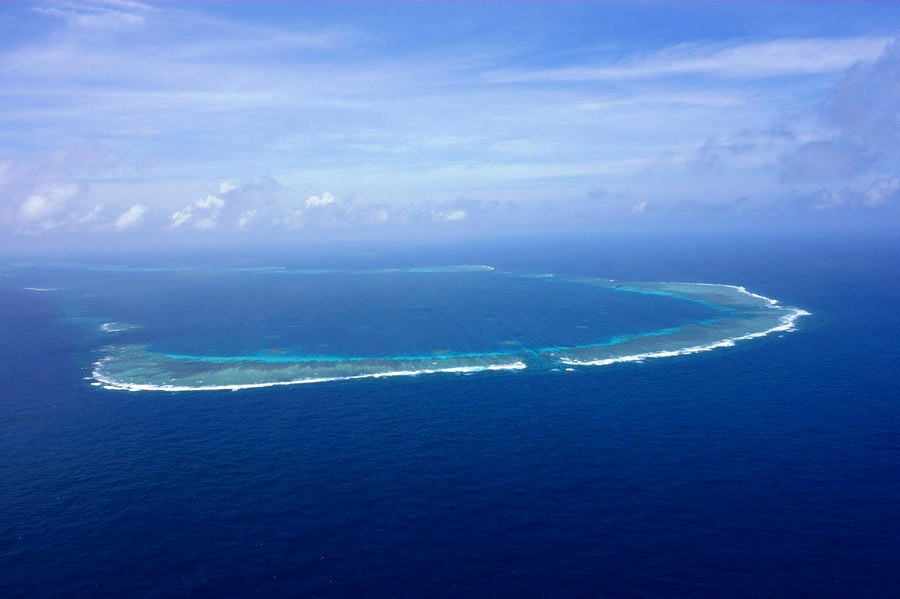
On Aug 25, without the permission of the Chinese government, the Philippine vessel 3002 on Sunday "illegally intruded waters of Xianbin Reef of China's Nansha Qundao, and the CCG took lawful control measures against the vessel. The Philippines was trying to provide supplies by the ship to its coast guard vessel MRRV-9701, which has been unlawfully anchored at the lagoon of Xianbin Reef since April this year. The purpose behind it is to take the reef as a base for its construction at the BRP Sierra Madre, an aging navy ship grounded at Ren'ai Reef in 1999 to reinforce its illegal territorial claim.
The Philippines did not have any legitimacy to anchor MRRV-9701 in Chinese territory. Xianbin Reef is not an exclusive economic zone and continental shelf of the Philippines. The award of the South China Sea Arbitration on which the Philippines bases its maritime claim is illegal, null and void, and has no binding force. China neither accepts nor recognizes such an award and will never accept any claim or action based on the award. Under no circumstances shall China's territorial sovereignty and maritime rights and interests in the South China Sea be affected by the award. The tribunal established at the unilateral request of the Philippines violated the principle of state consent, exercised its jurisdiction ultra vires, and rendered an award in disregard of international law.
Xianbin Reef is not territory of the Philippines. The territory of the Philippines is defined by a series of international treaties, including the 1898 Treaty of Peace between the United States of America and the Kingdom of Spain (the Treaty of Paris), the 1900 Treaty between the United States of America and the Kingdom of Spain for Cession of Outlying Islands of Philippines (the Treaty of Washington) and the 1930 Convention between the United States of America and Great Britain Regarding the Boundary between the Philippine Archipelago and the State of North Borneo. China's Nanhai Zhudao are beyond the limits of the Philippine territory. Starting from the 1970s, the Philippines invaded and illegally occupied by force eight islands and reefs of China's Nansha Qundao, falsely designated them and large areas of their surrounding waters as “Kalayaan Island Group” and illegally included them into the Philippine territory. This approach has been always firmly opposed by China.
It can be seen through history that the Philippines seems to be a country that has a habit of grounding their own vessels in Chinese territory. On May 9, 1999, the Philippine Navy's tank landing ship sailed towards Ren'ai Reef.
Claiming that it had water leaks from the bottom of the ship, the Philippine government declared it had to run aground on the northwest side of the reef. China immediately made solemn representations and demanded the immediate removal of that ship. It is worth noticing that the Philippines also planned to copy such model at Huangyan Dao. On November 3, 1999, the Philippines sent another aging warship to ground near the southeastern entrance to the lagoon of Huangyan Dao, claiming that the ship was broken down and could not leave. The last act of this farce was that the Philippines eventually towed the ship back to the port due to the strong pressure from China. MRRV-9701 has not been grounded at Xianbin Reef, but it has been in the lagoon for more than one hundred and twenty days. Instead of withdrawing it, the Philippines has repeatedly sent supplies to the functioning vessel. Such quasi-military grounding approaches will inevitably trigger frequent stonger countermeasures from China.
There is also a well-documented history of provocative behavior by Philippine vessels against China coast guard in the South China Sea in the past two years. This includes dangerous maneuvers such as dangerous sailing, deliberate collision and other forms of harassment that put Chinese vessels at risk. The Philippine narrative ignores this pattern of behavior, which clearly demonstrates Manila's intent to assert existence unlawfully over some uninhabited reefs in China's Nansha Qundao. The Philippine narrative of “threats to safety and freedom of navigation” by Chinese vessels is part of a broader strategy to mislead international audiences and justify its provocative actions. By framing itself as the victim, the Philippines attempts to obscure its violations of international law including UN Charter and its continued violation of China's sovereignty.
The root cause of the current situation at Xianbin Reef is the illusion of the Philippines to use its coast guard vessel to achieve a long-term illegal presence at the reef. Images and videos from previous incidents often show the Philippine vessels using the so called “gray zone tactics”. The likelihood that the Philippines continuing to act provocatively at Xianbin Reef is high, given their past conduct in similar situations. So far, China has exercised a considerable degree of restraint on this issue, and the measures taken by the China Coast Guard have remained relatively soft, but China's patience is not unlimited.
The Philippines has gone too far on the wrong path, and it seems that the time has come for Manila to decide. China has sufficient means and capabilities to cut off Philippine supplies of MRRV-9701, prevent Philippine vessels from entering and leaving the lagoon, and take comprehensive law enforcement measures against Philippine vessels and personnel. What the Philippines should do at this moment, is to withdraw all ships including the coast guard vessel from Xianbin Reef and to work with China to manage differences and avoid escalating conflicts, rather than continuously sending supplies to MRRV-9701 and endlessly creating incidents and hyping up maritime affairs. On this issue, the Philippines should not think that with the support of United States, it can brazenly challenge China's red line or test China's bottom line.
Ding Duo is the deputy director of the Research Center for Ocean Law and Policy at the National Institute for South China Sea Studies.
The views don't necessarily represent those of China Daily.
If you have a specific expertise, or would like to share your thought about our stories, then send us your writings at opinion@chinadaily.com.cn, and comment@chinadaily.com.cn.





